Types of Dog Leashes: A Glossary From Flat Lead to Long Line
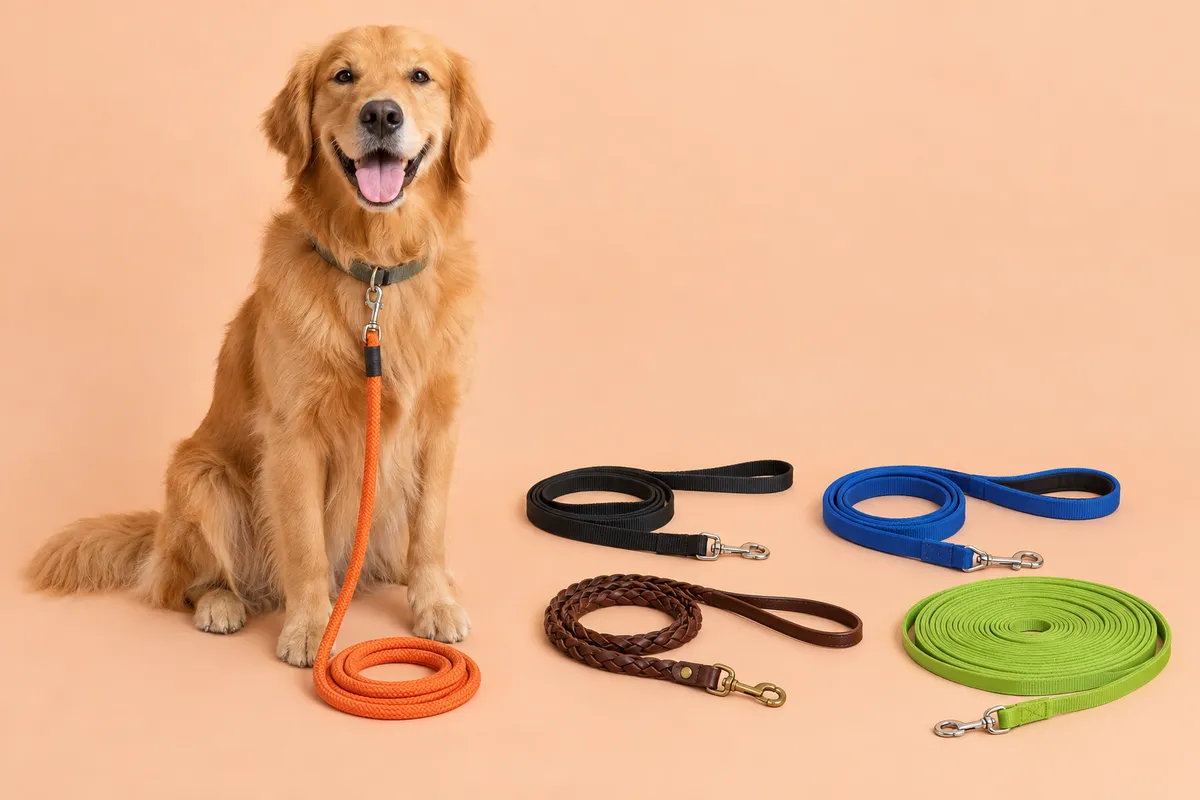
Most walks only need a flat leash about 4 or 6 feet long. Rope, biothane, leather, traffic handles, waist belts, long lines, slip leads and couplers each solve one specific job.
In short
- A flat leash in nylon, rope, biothane or leather is the everyday choice for most dogs and most walks.
- A 4 foot leash keeps a dog close on busy sidewalks, while a 6 foot leash gives more room to sniff on quiet streets and is a common length for training classes.
- Long lines of 15 to 50 feet are for recall practice and sniff walks in open spaces, never for city sidewalks.
- Traffic handles, bungee sections, waist belts and couplers are add-ons that fix one job each: close control, softer jolts, free hands and two dogs.
- Match the leash width and snap size to your dog: thin and light for small dogs, wider webbing and a sturdier clip for big, strong dogs.
Hello, lovely. Here is the short answer: a plain flat leash about 4 or 6 feet long suits most dogs on most walks. Every other type below is a flat leash with one job added.
Which type of dog leash is best?
The best leash is the one that fits your walk. A flat leash with a comfortable handle and a reliable snap covers daily strolls; two dogs, running, recall practice or busy roads call for a specialist type. Browse the whole range in dog leashes and the longer training leads in training and behavior.
| Leash type | What it is | Best for |
|---|---|---|
| Standard flat leash | Flat webbing, usually nylon, with a loop handle and a snap | Everyday walks |
| Rope leash | Round braided rope, often with a padded handle | A softer grip, medium and large dogs |
| Biothane leash | Coated webbing that sheds water and wipes clean | Rain, mud, beaches, swimmers |
| Leather leash | Flat or braided leather that softens with use | Daily walks, a classic feel |
| Traffic handle leash | A second handle near the snap | Crossings, crowds, waiting at curbs |
| Double-ended leash | A clip at both ends plus rings along the length | Changing length, two clip points |
| Hands-free waist leash | A belt with a leash clipped to it | Running, hiking, pushing a stroller |
| Long line | A light lead from about 15 to 50 feet | Recall practice and sniff walks |
| Slip lead | One piece that forms its own loop | Quick moves from car to door, vet visits |
| Coupler | A short Y piece with two clips | Walking two dogs on one leash |
Standard flat leash: 4 foot or 6 foot?
Choose 4 feet for busy places and 6 feet for quieter ones. A 4 foot leash keeps your dog right beside you on crowded sidewalks, in shops that welcome dogs and at crossings. A 6 foot leash gives a little slack for sniffing and is a common length for group training classes, so check what your class asks for. Nylon webbing is light and easy to wash; reflective stitching helps on evening walks, which our night walk checklist covers in more detail.
Flat leashes for everyday walks
Look for a padded handle and reflective stitching if you walk after dark.


Matching width to your dog
Width is about weight and grip. Thin leashes around 3/8 inch suit toy and small dogs, because a heavy snap and wide strap drag on a tiny collar. Medium dogs do well around 5/8 to 3/4 inch. Large, strong dogs usually feel safer on 1 inch webbing with a sturdier clip.
Rope leash
A rope leash is a round, braided cord rather than a flat strap. It feels softer in the hand, and many come with a padded handle and reflective threads. Rope is a little heavier than nylon webbing, so most rope leashes are sized for medium and large dogs.
Rope leashes
A padded handle makes a big difference on long walks.


Biothane leash (waterproof)
Biothane is polyester webbing sealed in a smooth coating, a little like a rubbery belt. It does not soak up water or hold mud and smell, and it wipes clean with a damp cloth. That makes it a favorite for beach days, swimmers and wet climates. It can feel slick in a wet hand, so a knot or a second loop helps you hold on.
Biothane leads
Standard length, slip style and a long tracking line.


Leather leash
Leather is the classic. A good leather leash starts a little stiff and softens with use, and braided sections near the snap add strength where the leash takes the most strain. Let it dry naturally if it gets wet. Some puppies love to chew leather, so keep an eye on young dogs.

Braided leather for daily walks
A brown leather leash with braided sections at both ends and a solid brass snap: the soft, classic option for walkers who like a natural feel.
- Braiding near the clip and handle
- 6 foot length
- Brass hardware
Padded handle and traffic handle leashes
A padded handle is a foam or neoprene lining inside the main loop, kinder to your palm on long walks. A traffic handle is a second, short handle close to the snap. When you reach a crossing, a crowded patch or a narrow trail, you slide your hand down and hold your dog close without wrapping the leash round your wrist.
Two-handle leashes
The lower handle sits just above the snap for close control.


Double-ended and multi-function leashes
A double-ended leash has a clip at each end and two or three rings along its length. You can clip both ends to a harness, shorten it through a ring or wear it across your body. Some add a bungee section and a car seat belt clip. If your dog pulls, our guide to front clip and back clip harnesses explains how two clip points work, and a qualified trainer can help you build a calm walk.
Leashes that change shape
Several lengths and clip points in one leash.


Hands-free waist leash
A hands-free leash clips to a padded belt around your waist, so your arms swing freely for running, hiking or pushing a stroller. Most add a bungee section and a spare handle. Keep a hand ready at crossings, and save hands-free walking for dogs that already walk calmly beside you. For trail days, our fall hiking checklist lists what else to pack.
Waist leashes for running and hiking
A bungee section and spare handles are worth having.


Long lines for recall practice and sniff walks
A long line is a light lead from about 15 to 50 feet, used in open spaces such as parks, beaches and big yards. It gives your dog room to explore while you keep a connection, which is why trainers use it for recall practice. Wear gloves, never wrap the line around your hand, keep it away from other people and dogs, and use a harness rather than a collar so a sudden stop at the end does not land on your dog's neck. Browse more in long line dog leashes.
Long lines
Bright or reflective lines are easier to see in long grass.


Slip lead
A slip lead is one piece of rope or biothane that runs through a ring to make its own loop, so it needs no collar. It is quick to put on for short moves. A slip lead tightens when the dog pulls, so use it gently, set the stopper so it cannot close too far, and ask your vet or a trainer before using one for everyday walks. Our dog collar glossary covers martingales and other collars that limit tightening.
Slip leads
Look for an adjustable stopper on the loop.


Coupler for two dogs
A coupler is a short Y-shaped piece with a clip for each dog, which then attaches to one main leash. A swivel at the center keeps the two arms from twisting. Couplers work best with two dogs of similar size and pace who already walk well; a big gap in size or energy usually means two separate leashes are easier.
Couplers and double leashes
A center swivel stops the arms tangling.


Bungee or shock-absorbing sections
A bungee section is a stretchy length sewn into the leash, usually near the snap. When your dog darts after a squirrel, it stretches first, which softens the jolt on your arm and shoulder. They give slightly, so add a traffic handle if you need close control near roads.

Bungee leash with two handles
A 6 foot bungee leash with a padded main handle and a second handle near the clip, so you get the softer feel and the close control in one leash.
- Stretch section near the clip
- Two padded handles
- Reflective stitching
Leash hardware: snap, trigger and locking carabiner
- Bolt snap: the classic clip with a sliding bolt you pull back with your thumb. Simple and common on most leashes.
- Trigger snap: a hinged gate you press open, easier with cold fingers or gloves.
- Locking carabiner: a gate with a twist or screw lock, so it cannot be pushed open by a tag or a ring. Popular for strong dogs and hiking.
- Swivel: a rotating joint above the clip that keeps the leash from twisting.
- Brass, steel or alloy: brass resists rust near salt water; check any clip for sharp edges and a smooth gate before each walk.
Whichever leash you choose, check the stitching and the clip often, and replace a leash that is frayed, chewed or has a sticky gate. Introduce a new leash gently at home, stay close during the first few walks, and enjoy the outings.
Questions people ask
Is a 4 foot or 6 foot leash better for dogs?
A 4 foot leash is better for busy sidewalks, crossings and crowds because it keeps your dog close. A 6 foot leash gives more room to sniff on quiet streets and is a common length for training classes. Many people keep both.
Which type of dog leash is best?
For most dogs, a flat leash in nylon, rope, biothane or leather with a comfortable handle and a sturdy snap is best for daily walks. Choose a specialist type only for a specific job: a long line for recall practice, a waist leash for running, a coupler for two dogs.
What type of leash is good for a dog that pulls?
A leash alone does not stop pulling. Many walkers pair a standard 4 or 6 foot leash with a front clip harness and add a traffic handle for close control. A qualified trainer can help you teach a calm walk.
How long should a long line be?
Long lines usually come from about 15 to 50 feet. Shorter lines are easier to handle while you learn; longer ones suit wide open spaces. Always attach a long line to a harness, never wrap it around your hand.
About the numbers
- Google search, people also ask and related searches, United States, read 2026-10-08: Questions included "Is a 4 foot or 6 foot leash better for dogs?" and "Which type of dog leash is best?"; related searches included types of leashes for dogs that pull, types of dog leashes for training, best leash for small dogs that pull and how to choose a dog leash for large dogs.
- Hey Lovi product listings, read 2026-10-08: Leash widths offered from 3/8 inch to 1 inch, standard leashes in 4, 5 and 6 foot lengths, and long lines from 15 to 50 feet.