Retractable Leash Myths and Facts: When One Makes Sense
Retractable leashes are not bad in themselves. They are a specialist tool: fine in open, quiet space for a dog that already walks politely, and a poor fit for sidewalks, crowds and training.
In short
- A retractable leash suits open, quiet places and a dog that already walks politely; it is the wrong tool for sidewalks, crowds and dogs that pull.
- Its spring keeps light tension on the line at all times, so for loose-leash training a fixed 4 to 6 foot leash works better.
- Choose a retractable by the weight rating on the housing, and pick flat tape over thin cord for all but very small dogs.
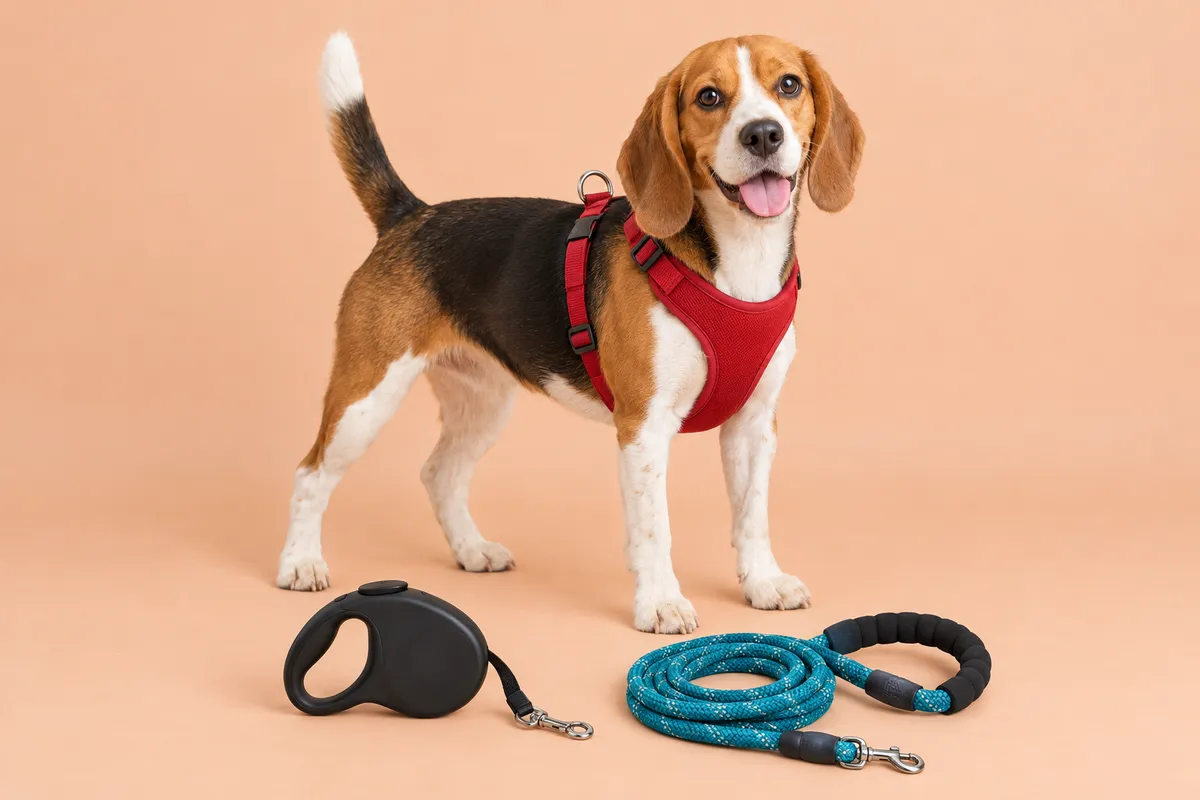
- Clip it to the back ring of a harness and lock it short whenever people, dogs, bikes or traffic come near.
- For recall practice, a 10 to 30 foot long line beats a retractable because it can go slack and trail.
Are retractable leashes bad for dogs? Not on their own. A retractable leash is a specialist tool: lovely for a sniff around an empty field with a dog who already walks politely, and the wrong pick for a busy sidewalk or a puppy still learning what a leash means. Here are the common myths, the facts behind them, and the leashes that do everyday jobs better.
When a retractable leash makes sense, and when it does not
Think of a retractable as a long line with a reel. It earns its place where extra room is safe, and gets in the way everywhere else.
| Situation | Retractable? | Better choice |
|---|---|---|
| Quiet open field, empty beach or big unfenced yard | Yes, with a dog who walks politely | A retractable or a long line |
| Sidewalks, street crossings, parking lots | No | A fixed leash or a traffic handle leash |
| Busy parks, markets, outdoor patios | No | A 4 to 6 foot leash, held short |
| The vet, groomer or daycare doorway | No | A slip lead or a short leash |
| Teaching loose-leash walking | No | A fixed 6 foot leash |
| Recall practice | No | A 10 to 30 foot long line |
| A dog who pulls hard or lunges | No | A traffic handle leash on a harness |
Myth: retractable leashes are bad for every dog
Fact: the tool is rarely the problem; the place is. On open ground with nobody around, a retractable lets a confident dog sniff and wander without you jogging behind. Trouble starts when 16 or 26 feet of line meets a sidewalk, a doorway or another dog, because your dog can be out of reach before you react.
Many parks, trails and towns post a maximum leash length, so read the sign at the trailhead before you unlock the line.
Retractables sized by weight
Lengths run from 10 to 26 feet, and each housing is rated for a top weight, from extra small dogs up to large breeds.




Myth: the brake button gives you full control
Fact: the button stops more line paying out; it does not bring your dog back. To shorten the line you still walk toward your dog or let the spring take up slack as they return, which takes seconds you may not have at a corner. Near anything busy, use the lock.
The handle is the other catch. It is a chunky plastic housing, not a loop around your wrist. If it slips, the spring drags it toward your dog, and the clatter can send a nervous dog running. The makers' own safety instructions say to hold the handle only and never grab the moving tape or cord or wind it around a hand, because a sudden pull can burn or cut.
Myth: more line teaches a dog to walk nicely
Fact: the spring inside a retractable keeps the line gently taut so it does not sag and drag, which means your dog feels a light pull at every step. Pulling forward is rewarded with more line. That is the opposite of what loose-leash walking teaches, where a soft, hanging leash is the signal that all is well.
For training walks, use a fixed leash of 4 to 6 feet. A rope leash with a padded handle is kind to your hands, flat nylon webbing folds into a pocket, and coated webbing wipes clean after a muddy walk. If pulling is the real puzzle, our guide to front-clip and back-clip harnesses explains how each ring changes a pull.
Fixed 6 foot leashes for everyday walks
Braided rope, reflective nylon webbing and coated webbing, each with a sturdy snap hook.


Myth: any retractable will do, as long as it is long
Fact: the weight rating matters more than the length. Every housing has a spring and brake built for a top weight, from models for extra small dogs up to 18 pounds to large-breed models rated to 110 pounds. Choose by your dog's weight and strength, and between two sizes, go up.
Then choose the line itself:
| Line | What it is | Good for | Keep in mind |
|---|---|---|---|
| Tape | A flat nylon ribbon, wider than a cord | Most dogs, from small to large breeds | Wider and heavier, so the housing is a little bigger |
| Cord | A thin, round line | Small, light dogs and a light handle | Hard to see, and easier to tangle around a leg |
| Neon or reflective tape | Tape in a bright color, often with reflective parts on the housing | Dusk, dawn and gray days | Still lock it short near roads |

The retractable to choose for visibility
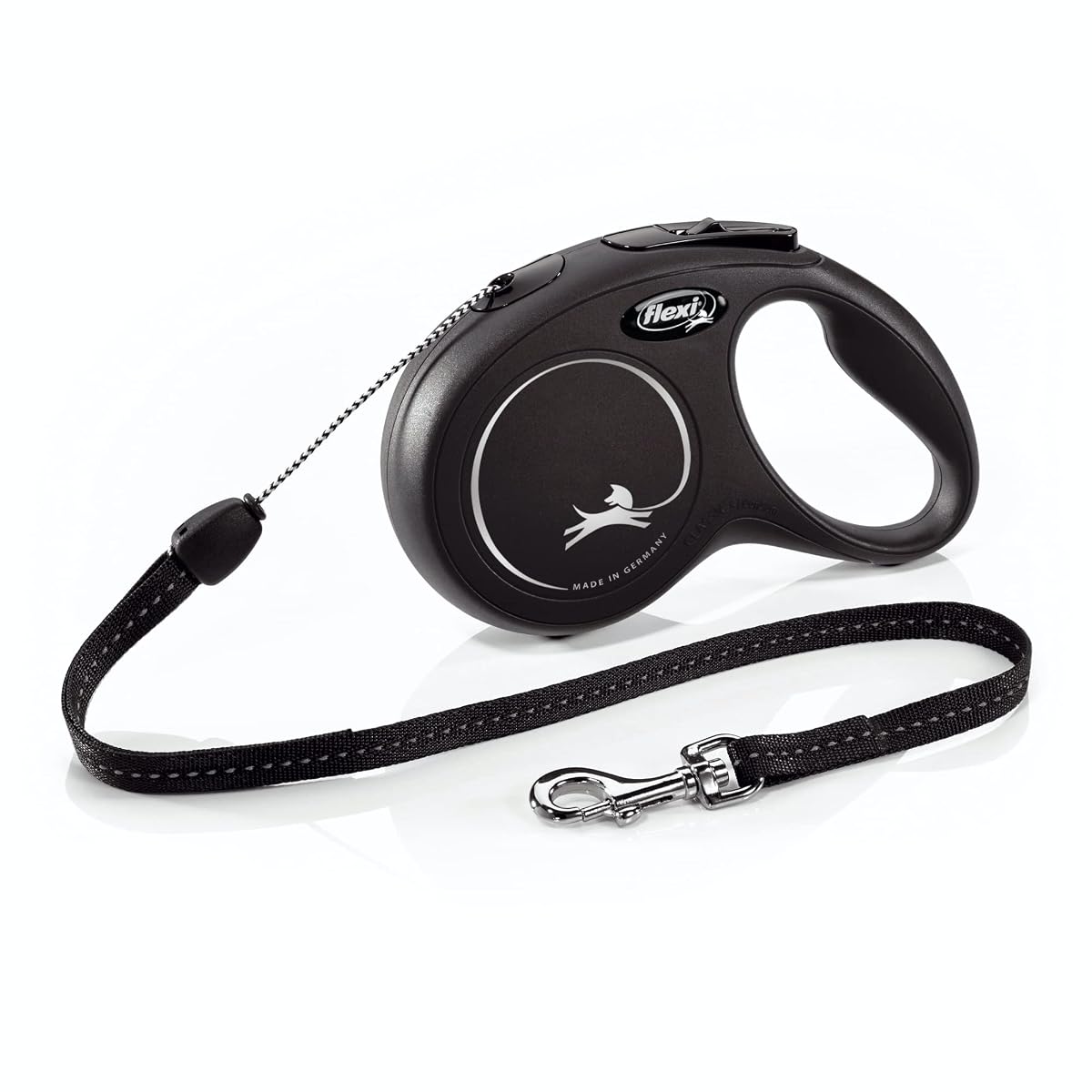
A 16 foot tape in neon yellow, with reflective parts on the housing, rated for small dogs up to 33 pounds. A bright, flat tape is much easier for you and passing cyclists to see than a thin dark cord. For evening walks, add the lights and reflective gear from our night walk checklist.
- Neon yellow tape with reflective sticker and components
- One-handed brake, pause and lock
- Rated for small dogs up to 33 pounds
Myth: collar or harness, it makes no difference
Fact: a retractable belongs on the back ring of a well-fitted harness. A dog who trots to the end of 16 feet meets a firmer stop than one on a 6 foot leash, and a harness spreads that stop across the chest. If your dog has neck, back or breathing concerns, ask your vet which setup suits them.
Skip the front ring here. Front-clip harnesses work by turning a dog toward you when the leash goes tight, and a retractable is never fully slack. Look for harnesses with a sturdy back D-ring.
Myth: a retractable is the best way to practice recall
Fact: a long line does that job better. It is a plain flat lead, usually 10 to 30 feet, with no spring and no housing. It lies slack on the grass while your dog explores, so coming back is your dog's choice, and if they wander you can gather the line hand over hand or step on the trailing end.
Waterproof coated webbing suits long lines: it does not soak up water, rinses clean and will not rot. With a strong dog, wear gloves and let the line run rather than wrap it around your hand.

A long line for recall practice
A 15 foot line of 3/4 inch waterproof coated webbing in hunter orange, with solid brass hardware. It wipes clean after a wet field, is easy to find in long grass, and gives your dog room to roam while you practice coming back.
- 15 feet by 3/4 inch
- Waterproof coated webbing that rinses clean
- Bright orange, easy to see on the ground
More long lines
From 10 to 30 feet: coated webbing rinses clean, nylon with a padded handle is soft in the hand.


Everyday leashes for busy places
Traffic handle leashes
A traffic handle is a second handle a short way above the clip on a leash of about 6 feet. Your hand drops to it at a crossing or when another dog passes, holding your dog right at your side.

Two handles for busy sidewalks
A 6 foot leash for medium and large dogs, with a top handle, a second traffic handle near the clip, and reflective detail on both sides. A comfortable everyday leash that becomes a short one in a second.
- 6 feet with a top handle and a traffic handle
- Reflective on both sides
- Made for medium and large dogs, including dogs who pull
More traffic handle leashes
Each has a padded top loop and a second loop close to the clip.


Slip leads
A slip lead, usually 5 to 7 feet, is a leash and loop in one piece: the end runs through a ring, so it slips over the head with no collar or harness, and it tightens when the dog pulls. Many have a sliding stopper that holds the loop at the size you set. It is handy for short, calm moments, such as a hop out of the car or a few steps to the groomer's table, not for long walks with a dog who pulls. Ask a trainer to show you the fit.
Slip leads for quick moments
Thick rope, slim rope and coated webbing, from 5 to 7 feet.


If you do use a retractable: five habits
- Clip it to the back ring of a harness, not a collar or front ring.
- Match the weight rating on the housing to your dog.
- Lock it at leash length before corners, gates, doorways and other dogs.
- Hold the handle, never the line, and never wrap the tape or cord around a hand.
- Check the line before each walk and retire a leash with frays or a spring that no longer winds smoothly.
Introduce any new leash gently at home: let your dog sniff the housing and hear the click of the brake, and stay close on the first few outings. Browse all dog leashes, or find long lines and slip leads in training gear.
Questions people ask
Why do vets not recommend retractable leashes?
The usual worries are about control rather than the leash itself. On a long, spring-loaded line a dog can reach a road, another dog or a stranger before you can bring them back, and a dog who runs to the end gets a sudden stop. For anything about your own dog's neck, back or breathing, ask your vet.
Do dog trainers recommend retractable leads?
For teaching loose-leash walking, a fixed 4 to 6 foot leash is the usual tool, because a retractable keeps light tension on the line and pulling earns more line. For recall work, a long line with no spring does the job. A retractable fits best once those skills are in place.
Are retractable leashes good for small dogs?
They can be, in open space, with a model rated for your dog's weight; some are made for extra small dogs up to 18 pounds. A small dog can still reach a bigger dog, a bike or the curb at 16 feet, so lock the line short whenever anything is near.
Are retractable leashes bad with a harness?
No, a harness is a better partner for a retractable than a collar. Use the back D-ring: front-clip rings work by turning a dog when the leash tightens, and a retractable's constant light tension keeps that turn going.
How do you use a retractable leash properly?
Hold the handle only, keep your thumb near the brake and lock the line at leash length whenever people, dogs or traffic are close. Unlock it only in open, quiet space, and never grab the moving tape or cord.
About the numbers
- Google related searches, read 2026-10-06: related searches for retractable leashes: pros and cons of retractable leashes, are retractable leashes good for small dogs, are retractable leashes bad with harness
- Google People also ask, read 2026-10-06: questions asked: why do vets not recommend retractable leashes, do dog trainers recommend retractable leads, are retractable leashes good for small dogs, how to properly use a retractable leash
- Retractable leash makers' published safety instructions, read 2026-10-06: hold the handle only; never grab the moving cord or tape or wrap it around fingers or hands; use the brake and lock to keep a dog close