How to Put a Harness on a Cat (and Choose One That Stays On)
Measure the neck and chest, pick a vest, H-style, figure-8 or step-in harness, fasten it snug enough for two flat fingers, and practise indoors with treats before any walk.
In short
- To put a harness on a cat, slip the neck loop over the head (or lay a vest across the back), bring the chest strap under the belly behind the front legs, buckle it and adjust until two flat fingers fit under every strap.
- Measure your cat's neck and the widest part of the chest just behind the front legs with a soft tape before you choose a size, and size by the chest first.
- Vest and jacket harnesses spread pressure over a wide panel and are harder for most cats to back out of; strap styles are lighter and suit calm cats.
- Most cats need several short, treat-paired sessions indoors before they move normally in a harness, so start days before the first trip outside.
- A light, fixed-length leash gives you more control than a retractable one, which is why many cat walkers advise against retractables.
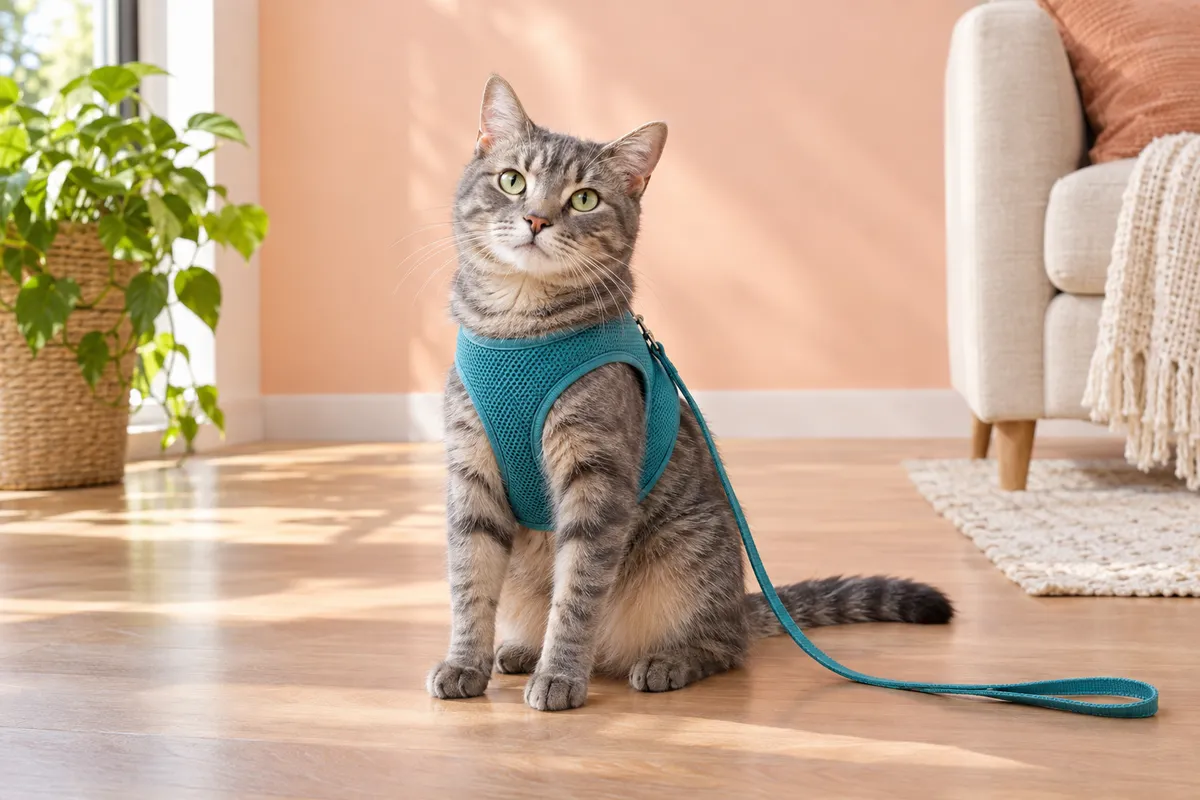
To put a harness on a cat, open the harness flat, slip the neck loop over your cat's head (or drape a vest over the shoulders), bring the chest strap under the belly just behind the front legs and clip it closed. Then tighten each strap until two flat fingers slide underneath, no more. A good fit plus slow, treat-filled practice is what keeps it on.
A cat harness is a set of straps or a small padded vest that wraps the neck and chest, so a leash pulls against the body rather than the throat. That is the whole reason to use one instead of a collar: a collar is for ID, a harness is for holding on. If you are still sorting out collars, our cat collar myths vs facts guide covers breakaway buckles and fit.
Which type of cat harness should you choose?
Choose a vest or jacket harness for a first harness, a strap style for a calm cat that dislikes fabric, and a step-in only if your cat happily lets you lift its paws. The table shows how the four common designs compare once they are on.
| Type | How it goes on | Feel for the cat | Best for |
|---|---|---|---|
| Vest or jacket | Over the head or laid over the back, then one or two chest buckles | Wide padded panel spreads pressure; covers more fur | First-time walkers, wriggly cats, kittens |
| H-style | Neck loop over the head, belly strap behind the front legs, joined by a strap along the back | Light and minimal; thin straps | Calm cats who dislike wearing fabric |
| Figure-8 | Small loop over the head, larger loop around the chest, meeting at the shoulders | Lightest of all; quick to adjust | Short supervised outings with a relaxed cat |
| Step-in | Front paws step through two openings, then it clips over the back | Nothing passes over the head | Cats who flinch at anything near their ears |
Vest and jacket harnesses
Wide mesh panels with adjustable neck and chest straps, most with a matching leash.


H-style, figure-8 and step-in harnesses
Lighter strap designs for cats who tolerate less fabric.


How do you measure a cat for a harness?
Measure two places with a soft sewing tape: around the base of the neck where a collar would sit, and around the widest part of the ribcage just behind the front legs. No soft tape at home? Wrap a piece of string, mark where it meets, then lay it flat against a ruler.
- Wait until your cat is relaxed, ideally sleepy after a meal or a play session.
- Measure the neck with the tape lying flat, not pulled tight.
- Measure the chest behind the front legs, again flat against the fur.
- Write both numbers down and compare them with the size chart on the harness listing.
- If your cat sits between two sizes, choose by chest, and pick the size whose range puts your cat's chest near the middle so you have room to tighten or loosen.
What is the two-finger fit test?
The two-finger test means you can slide two flat fingers, side by side, under each strap, and no more. Any looser and a determined cat can pull a shoulder or head free; any tighter and the straps rub or restrict breathing and movement.
- Check the neck loop, the chest strap and, on an H-style, the strap along the back.
- Watch your cat walk across the room: legs should move freely and the straps should not ride up into the armpits.
- Gently tug the D-ring backwards and upwards. The harness should stay put rather than slide towards the head.
- Recheck after ten minutes of wear, because many cats puff up or settle once they relax.
- Remove the harness after each session and check for rubbed fur or redness. If you see either, adjust the fit and ask your vet about any sore spots.
How do you put each type of harness on, step by step?
Every style follows the same idea: get the neck part settled first, then close the chest part behind the front legs. Practise the buckles in your hands before your cat ever sees the harness, so you are quick and quiet when it counts.
Vest or jacket harness
- Loosen every strap a little and open the buckles.
- Sit beside your cat (not over it) and lay the vest across the shoulders, or guide the head through the neck opening with a treat held on the far side.
- Bring the chest flaps under the belly behind the front legs and close the buckle or hook-and-loop strip.
- Tighten the neck, then the chest, and run the two-finger test.
- Reward straight away, then unclip the leash ring so nothing dangles.
H-style harness
- Hold the harness so the D-ring is on top and the back strap points towards the tail.
- Slip the smaller loop over the head so it rests at the base of the neck.
- Reach under the belly behind the front legs, bring the chest strap round and click the buckle.
- Centre the back strap along the spine, then adjust both loops to the two-finger fit.
Figure-8 harness
- Find the small loop (neck) and the large loop (chest); the leash ring sits where they meet.
- Slip the small loop over the head with the ring between the shoulder blades.
- Pass the large loop under the chest behind the front legs and fasten it.
- Tighten carefully: with only two thin loops, fit is the only thing holding it on.
Step-in harness
- Lay the harness flat on the floor with the openings facing up.
- Lift one front paw at a time into each opening, with a treat in front of the nose to keep your cat standing.
- Draw the sides up over the shoulders and clip them together on the back.
- Adjust and run the two-finger test; step-ins made for small dogs can sit wide on a slim cat's neck.
How do you get a cat used to wearing a harness?
Go slowly, indoors, in sessions of a minute or two, and pair every step with a favourite treat. The goal is a cat who sees the harness and expects something good, which usually takes days, sometimes longer, and that is perfectly normal.
- Meet it. Leave the harness near the food bowl or favourite nap spot for a few days so it becomes part of the furniture.
- Touch it. Hold it near your cat, then touch it to the shoulders, treating each time. Click the buckles nearby so the sound stops being a surprise.
- Drape it. Lay it over the back without fastening, treat, and take it off.
- Fasten it. Buckle it loosely during a meal or while offering a lickable treat, then remove it after a few seconds.
- Wear it. Build up to a few minutes, then longer, while you play with a wand toy so your cat forgets about it.
- Add the leash. Clip on the leash and let it trail under supervision, then pick it up and simply follow your cat around the house.
Many cats flop over or freeze the first few times they feel straps. Never drag them along: stay close, treat, and try a shorter session tomorrow. A daily indoor cat play routine is a lovely time to practise, because a cat chasing a wand toy forgets the harness.
Rewards and markers for harness practice
Lickable purees are quick to eat and easy to offer while you buckle; a clicker marks the moment your cat does well.


What kind of leash is best for walking a cat?
A light, fixed-length leash with a small swivel clip is the usual choice, with a longer line kept for supervised time in a fenced yard. Many cat walkers advise against retractable leashes for cats, because the constant pull and sudden lock can startle a cat and give you less control if it bolts. Our retractable leash myths and facts piece explains how they work.
Leashes and long lines
Lightweight leads and reflective long lines for supervised outdoor time.


What makes a cat harness escape-resistant?
No harness is truly escape-proof, but some features make it far harder for a cat to wriggle free. Look for these when you compare options.
- Two points of adjustment, neck and chest, so you can close every gap.
- A chest panel or strap that sits well behind the front legs, which makes backing out much harder.
- A leash ring on the back, between the shoulder blades, so pulling does not twist the harness off.
- Secure buckles plus a hook-and-loop strip on vests, so one opening does not undo the whole thing.
- Light, breathable mesh, so your cat is comfortable enough not to fight it.
For a cat who tests every gap
This jacket-style harness has a wide padded body, adjustable straps at the neck and chest and the leash ring on the back, the combination that makes slipping out hardest.
- Covers the chest and back rather than relying on thin straps
- Comes with a matching leash
- Adjusts at more than one point
A soft vest for a first harness
A breathable mesh vest with reflective strips and a matching leash, offered in several sizes from very small up, which makes it easy to match your measurements.
- Lightweight mesh
- Wide size range
- Reflective strips
Can kittens wear a harness?
Yes, and kittens often accept a harness more readily than adult cats, which makes early practice worthwhile. Choose a kitten size, check the fit every week because kittens grow fast, and keep sessions short and playful. Never leave a kitten (or any cat) alone in a harness, where straps can catch on furniture.
Kitten harnesses
Extra-small sizes with plenty of adjustment for a growing body.


Before your first walk outside
Start somewhere quiet, such as a balcony or fenced garden, let your cat lead, and keep the first trips to a few minutes. Make sure your cat wears ID and is microchipped, and carry it out in a carrier at first so the door never becomes an escape route. Our guide to choosing a cat carrier helps there, and the holiday travel checklist shows where a harness fits on travel days.
Questions people ask
How tight should a cat harness be?
Snug enough that two flat fingers fit under each strap and no more. Check it again after a few minutes, because cats often relax and the fit loosens.
Are cat harnesses cruel?
A well-fitted harness introduced slowly is not cruel; it is gentler on the neck than clipping a leash to a collar. Watch your cat's body language, keep sessions short, and stop if your cat seems stressed.
What is the best harness type for a cat that escapes?
A vest or jacket harness that adjusts at both the neck and chest is usually the hardest to back out of. Fit it with the two-finger test and always supervise, because no harness is fully escape-proof.
Can a cat wear a harness all day?
No. Put the harness on for practice and outings, then take it off, because straps can snag on furniture and rub the coat. Never leave a cat unsupervised in one.
How long does it take to harness train a cat?
It varies from cat to cat. Some accept a harness in a few sessions, others need a couple of weeks of short daily practice, so go at your cat's pace.
About the numbers
- Google Keyword Planner, United States, 12-month average, read 2026-11-01: about 27,100 searches a month for cat harness, about 9,900 for cat harness and leash, about 8,100 for cat leash, about 5,400 for escape proof cat harness and about 2,900 for kitten harness, rising
- Google autocomplete, US, read 2026-11-01: people search "cat harness how to put on", "are cat harnesses cruel" and "what is cat harness training"