An Indoor Cat Play Routine: Wands, Tunnels, Perches, Puzzles
The best enrichment toys for indoor cats work as a daily routine: a wand to chase, a tunnel to ambush from, a window perch to watch and a puzzle to find food in.
In short
- Indoor cats get the most from toys used as a short daily routine that copies a hunt: watch, stalk, chase, catch, eat.
- A wand toy asks more of a cat than any toy left on the floor, because you make the lure flee, hide and get caught.
- Tunnels and cat trees give the chase cover to ambush from and height to climb and look out from.
- A window perch suits most indoor cats if it suits the window: suction cups need smooth glass, sill mounts need the right sill.
- Puzzle and hunting feeders turn part of the daily food into a search; start easy and ask your vet about portions.
- Rotate toys every few days and put wands away after play.
The best enrichment toys for indoor cats are the ones you use as a routine, not a basket in the corner. Cats hunt in short bursts: watch, stalk, chase, pounce, eat. A good indoor day gives each step a place: a window perch for watching, a tunnel and a cat tree for stalking and climbing, a wand for the chase you run together, and a puzzle feeder so part of a meal is found.
A simple daily play routine for an indoor cat
Short sessions you repeat beat one long one, and ending a chase with a catch and then food mirrors how a real hunt finishes. Stop while your cat still wants more, and add one new thing at a time while you stay close.
| When | Activity | What it gives your cat |
|---|---|---|
| Morning | Perch time with the blinds open | Birds, people and weather to watch |
| While you are out | Kickers, a tunnel and a hidden hunting feeder | Something to grab, kick and search for alone |
| Evening | A wand session that ends in a catch | A full stalk, chase and pounce |
| Before bed | A puzzle feeder with part of the evening meal | A quiet, nose-down task after the chase |
| All day | A cat tree beside a window | Height to climb, scratch and survey from |
Wand toys: the hunt you play together
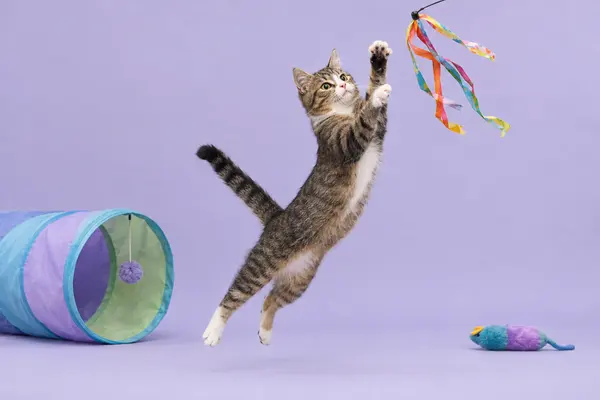
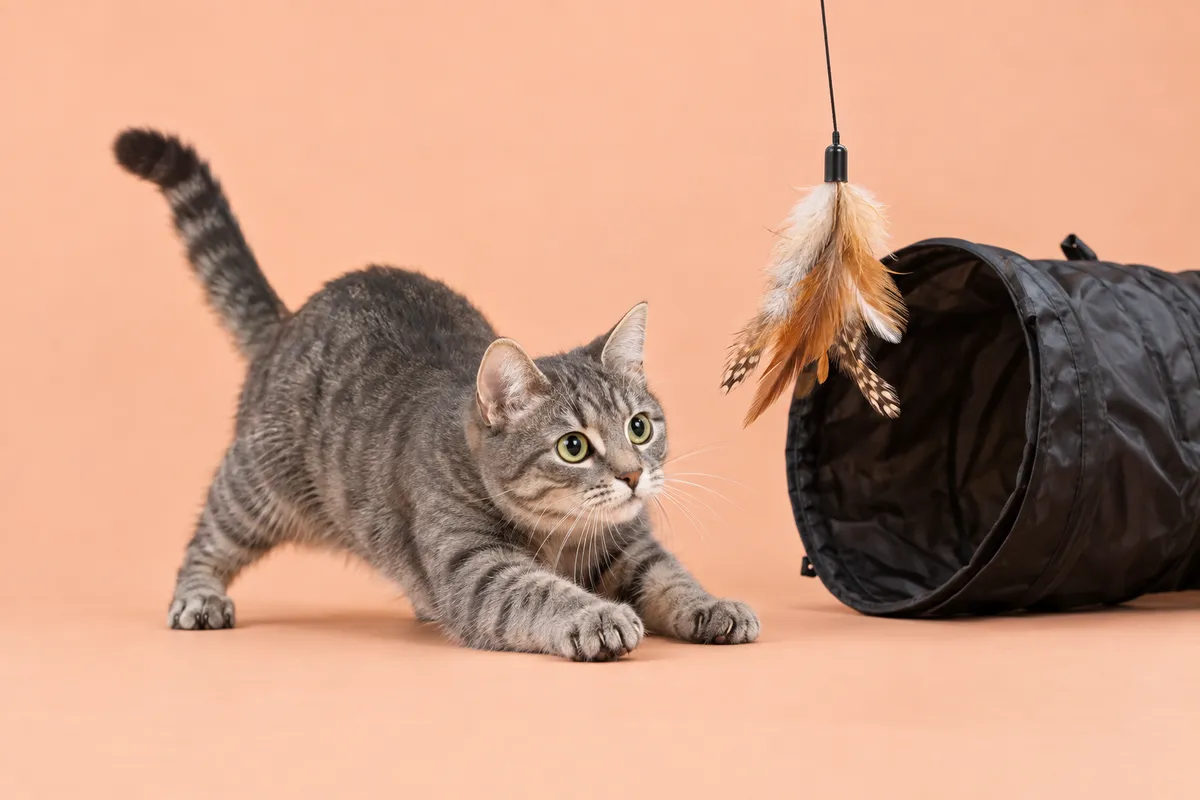
A wand is where most of the real chasing happens, because you make the lure act like prey. Move it away from your cat, never toward them. Drag it along the floor, tuck it behind a chair leg, let it go still, then flick it out of reach. Let your cat win often, and finish with a last catch and a meal.
Match the lure to the hunter. Feathers flutter like a bird for cats who leap; ribbons and fleece snake across the floor for cats who stalk low; a small mouse on a braided wire skitters like ground prey. A telescoping 39-inch wand keeps fingers far from claws, while a polycarbonate rod trailing four feet of fleece is easy to swish around a sofa. Browse all wand toys.
Wand toys for every kind of hunter
Feathers for leapers, ribbon and fleece for stalkers, a wire mouse for ground hunters.


For long chases with spare lures
A carbon fiber wand that telescopes to 39 inches with a 21-inch woven nylon line, so the lure can dart well away from your hands. It comes as a pair, with seven worm lures, a fish and a spare line.
- Foam grip, carbon fiber rod
- Refill lures with bells
- Two wands, so a friend can join in
Kickers and solo toys for the hours you are out
A kicker is a long, soft toy a cat hugs with the front paws and rakes with the back legs, the same move used on a real catch. An 11-inch stick gives an adult cat plenty to hold, and a soft pillow shape is made to snuggle. Crinkle layers add sound, and mesh, felt and burlap give claws something different to grip.
Not every cat reacts to catnip, and the scent fades with time. A burlap rat that comes with its own tube of catnip can be refilled instead of replaced. For a cat who likes a toy that answers back, a touch-activated bird chirps and flaps when batted. See more catnip kickers.
Kickers and toys that play back
Leave two or three out and swap them every few days.


Tunnels: hiding spots made for ambush
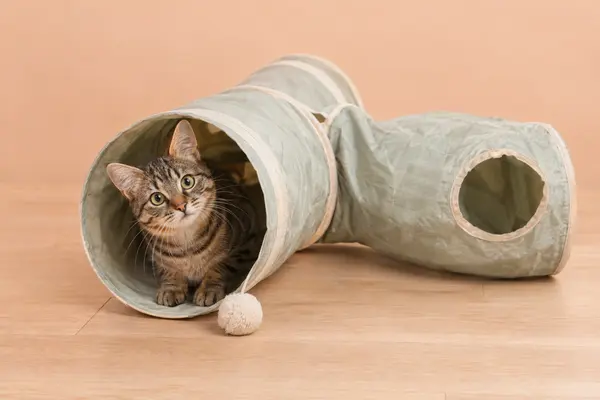
A tunnel gives the chase somewhere to go. Drag a wand lure past one opening and wait: your cat may race through and burst out the far end, or lie low and swat through a peephole.
Size it to your cat: a 10-inch tube suits kittens and most adults, and a 12-inch tube gives a big cat room to turn. Three-way and four-way shapes add exits for chase games between two cats. Polyester and 210D Oxford cloth tubes are made for lively play, a short plush tube is soft enough to curl up in, and all of them fold flat for storage. A round tunnel bed, 39 inches across, zips together around a soft bed in the middle. Find more tunnels and play toys.
Tunnels for ambush and naps
Choose a 12-inch tube for a large cat.


Window perches: are they good for cats?
For most indoor cats, yes, if the perch suits your window and your cat's weight. A perch is a soft, raised seat with a view of birds, people and weather, and there are four common ways one holds on.
| Style | How it holds | Check first | Good for |
|---|---|---|---|
| Suction-cup hammock | Four cups on the glass carry a metal frame | Smooth, clean glass; the weight limit | Picture windows, glass doors |
| Cups with arms below | Cups plus metal arms bracing the bed underneath | Glass tall enough for the frame and its arms; the weight limit | Heavier cats |
| Hook-on sill perch | Metal hooks over the sill or into the window slot, with supports below | Sill thickness, slot depth and the gap to the wall | Window sills, with no suction cups |
| Clamp-on sill perch | A sliding clamp gripping the sill edge | Sill thickness within the clamp's range | Window sills and bedsides |
Press down on any perch with your hand before your cat tries it, re-check suction cups often, and keep the window closed or the screen secure. A cat tree beside it makes an easy step up. If that window turns chilly, a warm bed nearby helps: see heated vs self-warming cat beds, or browse more window perches.
Window perches by mounting style
Suction cups need smooth glass; sill mounts need the right sill.


For a heavier cat at a glass door
Triangular metal arms brace this suction-cup perch from below, so the bed does not hang from the cups alone. It is rated for up to 40 pounds, with an open front for a clear jump in.
- Metal support arms
- Rated for up to 40 pounds
Puzzle and hunting feeders: let part of a meal be found
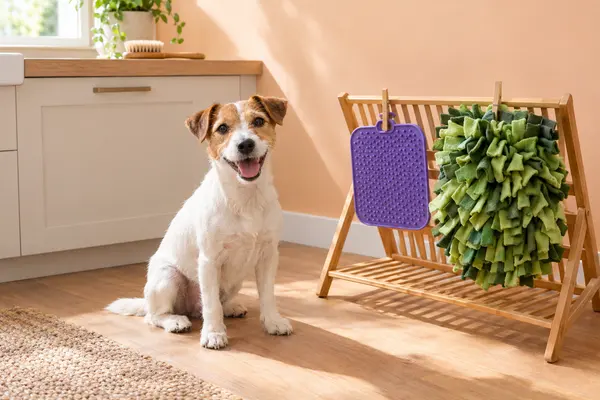
A puzzle feeder turns eating into a search. Measure some of the usual daily food into it instead of the bowl, so play never adds extra; your vet can say how much your cat needs.
Start easy so the first try ends in success. Mouse-shaped hunting feeders hold dry food; hide them around the house for your cat to find and bat. A board with 16 hidden compartments uses pegs and swivel leaves, and you can make it harder as your cat learns. A single tray offers six activities at once, and a four-box set gives each compartment its own challenge. Wash puzzles often and dry them fully.
Puzzle and hunting feeders
Begin on the easiest setting, then add challenge.


For a cat who loves to stalk
Three mouse-shaped feeders you fill with dry food and hide in different rooms, so a meal becomes a hunt: search, find, bat, eat. A scoop in the set makes filling quick.
- Three refillable feeders
- Hide them high, low and behind doors
Cat trees: height for climbing, scratching and watching
A cat tree gives height to look out from, posts to scratch and a cave or hammock to curl up in, all on one footprint, and beside a window it becomes the step up to a perch.
Choose by your cat's size and your room. For a big cat, look for a wide base and wide platforms: one 65-inch tower is built to hold up to 33 pounds. A 61-inch tower with five scratching posts, two caves and a hammock comes with an anti-tip kit, so fix it to the wall. Short on space? A 27-inch tree with sisal posts and a condo fits a corner, and a 36.6-inch wall-mounted jute scratcher with a pine hammock keeps the floor clear. Compare all cat trees.
Cat trees for every room
Anchor tall towers to the wall.


For a larger cat in a smaller room
A 37.8-inch tree with a widened perch, 17.7 by 11.8 inches, so a larger cat can stretch out. Its ramp is a scratching board and a ladder in one, for an easy climb.
- Widened, padded perch
- Two-door cave and a fluffy basket
Keep the routine fresh
- Leave out two or three toys, store the rest and swap every few days.
- Move things around: a perch in another window, feeders in fresh spots.
- End active play with food, so the hunt has a finish.
- Retire anything torn, loose or frayed.
- If your cat's interest in play changes suddenly, ask your vet.
Questions people ask
What are the most stimulating toys for cats?
Toys that move like prey, above all a wand toy that you move, because it brings out the whole watch, stalk, chase and pounce. Puzzle and hunting feeders come next, since they make a cat search for food, and kickers give something to grab alone. Rotating toys keeps any of them interesting longer.
Is there a 3-3-3 rule for cats?
Yes. It is a rule of thumb shelters and rescues share for newly adopted cats: about 3 days to decompress, 3 weeks to learn the routine and 3 months to feel at home. Every cat moves at its own pace. Start play with a hiding spot such as a tunnel and gentle wand play from a distance, then add puzzles and a perch as your cat settles; if anything worries you, ask your vet.
Are window perches good for cats?
For most indoor cats, yes: a perch is a soft, raised seat with a view of birds and sunshine. Choose one that suits your window, with smooth glass for suction cups or the right sill for a sill mount, and check the weight limit. Keep the window closed or the screen secure, and give an older cat a cat tree or step as an easy way up.
About the numbers
- Humane Society of the Pikes Peak Region, The 3-3-3 Rule: Helping Your New Cat Feel at Home: First 3 days to decompress, first 3 weeks to build a routine, first 3 months to feel at home; a guide, not a strict timeline, since every cat is different.