Heated vs Self-Warming Cat Beds: Which Keeps a Cat Cozier
A heated cat bed makes its own warmth from a plug-in pad; a self-warming bed holds and reflects your cat's body heat. Choose heated for cold rooms and shelters, self-warming for cozy indoor naps.
In short
- A heated cat bed has an electric pad that makes its own warmth; a self-warming bed holds and returns the warmth your cat already gives off.
- For most indoor cats in a heated home, a self-warming bed is plenty: no cord and nothing to switch on.
- A heated bed earns its place in cold rooms, on tile or concrete floors, and in garages, porches and outdoor shelters.
- On a heated pad, look for a chew-resistant cord, a removable cover, a low or adjustable setting, a timer or auto shut-off, and a safety listing mark.
- Always leave your cat a way off the heat, and ask your vet before using heat with a kitten or an older cat.
Short answer: a heated cat bed keeps a cat warmer because it makes its own heat, and a self-warming bed is easier because it needs nothing but your cat. For most indoor cats on a chilly evening, self-warming is plenty. For a drafty room, a cold floor, a garage or an outdoor shelter, a heated pad is what keeps a cat cozy.
In the United States, "best heated cat bed" and "self heated cat bed" are rising searches, and the top related searches split between beds for indoors and beds and houses for outdoors, so this guide covers both.
How a self-warming cat bed works
A self-warming bed has no plug and no battery. Inside sits a thin reflective layer, often a metallized film much like a space blanket, between a soft top fabric and a core of polyester fiber batting. The batting slows heat loss, the film bounces your cat's body warmth back toward them, and the plush or faux fur top holds still, warm air. It feels warm once your cat settles in and cools when they hop off.
What it cannot do is add heat. It only returns what your cat puts in, so in a cold garage, or for a small or slim cat, it has less to work with. That is why the shape around the mat matters too.
Self-warming mats with a reflective core
Flat mats for a crate, a perch, a sofa corner or the bottom of an existing bed.


A quilted self-warming mat that goes anywhere
A quilted faux fur mat over an insulating fiber core that holds your cat's body heat and sends it back, with no power at all. It is light enough to carry from the sofa to a sunny window or pack for a trip, and it goes straight in the washing machine.
- No cord and nothing to switch on
- Quilted faux fur over an insulating fiber core
- Machine washable
How a heated cat bed works
A heated cat bed, or a heating pad made for pets, has a low-wattage element sealed inside a waterproof shell, usually soft PVC, under a removable fleece, velvet or Oxford cloth cover. Some are simple, like a flat 30-watt pad. Others have a controller with six steps from 86 to 131°F and a timer from 2 to 24 hours, or a thermostat that switches off by itself.
That is real added warmth, ready before your cat lies down, which is why heat earns its place where the room itself is cold. It also asks more of you: an outlet, a cord to manage, and a cooler spot your cat can always move to.
Heated pads made for pets
From a 16-inch round to a 28 by 20 inch mat, each with a timer or an automatic shut-off.


A simple heated pad for a cold corner
A flat 17.7 by 15.7 inch pad that draws 30 watts, with a steel-wrapped cord and a soft fleece cover that comes off for washing. It is small enough to sit inside many cat beds, leaving a cooler edge around it.
- 30 watts
- Steel-wrapped cord
- Removable, machine-washable fleece cover
- Carries a MET safety listing
Heated vs self-warming cat beds, side by side
| Self-warming bed | Heated bed or pad | |
|---|---|---|
| Where the warmth comes from | Your cat's own body heat, held in and reflected back | An electric element, warm before your cat lies down |
| Power | None | A wall outlet and a cord to route safely |
| Best spots | Heated indoor rooms, perches, crates, carriers | Cold rooms and floors, garages, porches, shelters |
| Warmth | Gentle; rises and falls with your cat | Steady, often adjustable |
| Cleaning | Many wash whole | Wash the cover; wipe the sealed pad |
| Watch for | Too little warmth in a very cold space | Chewing, wear, and no way off the heat |
Which one keeps your cat cozier?
Cozier depends on where your cat naps. Match the bed to the spot:
- A cat in a heated home: self-warming. A cave or deep-rimmed bed with a reflective mat inside covers nearly every cool evening.
- A drafty room or a cold floor: a heated pad under its cover, set low, inside a bed bigger than the pad.
- A garage, porch or barn: a heated cat house, with wind-blocking walls, a raised floor and a pad inside.
- Two cats who disagree about warmth: a pad on one side of a roomy bed, so each can pick a side.
- No outlet nearby: a microwavable heat disc tucked under the bedding.

Warmth without a cord
A plate-sized disc with a sturdy shell that you warm in the microwave and slip under your cat's bedding. Its maker says it gives up to 10 hours of warmth with no cord or outlet. Warm it exactly as its instructions say.
- No cord or outlet needed
- Plate-sized, made to sit under a pet bed
- Reusable
Shape matters as much as warmth
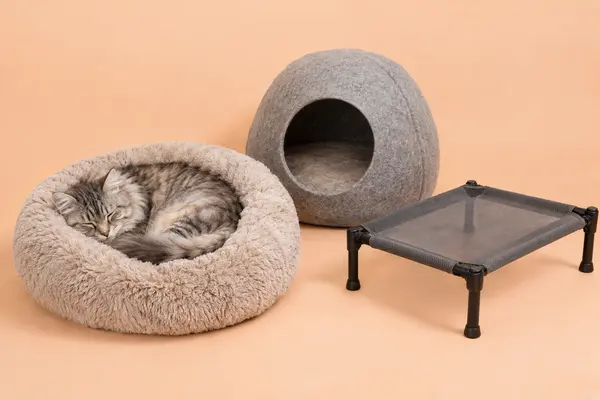
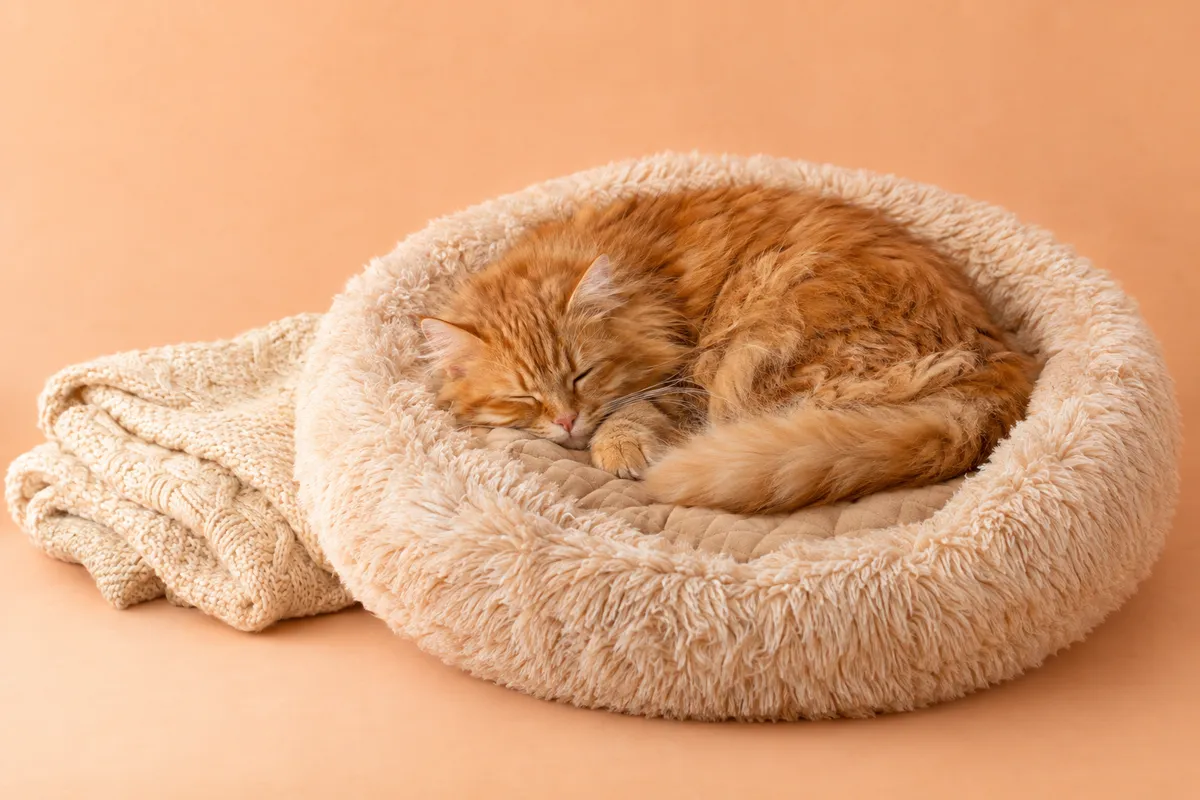
Cats curl up tight when they are chilly, and a bed that wraps around a curled cat keeps warm air close. The donut has a deep plush rim to tuck into. The cave or hooded bed is a closed shell with one doorway. The tent is soft fabric over a light frame, with a cushion on the floor. Thick felt and natural wool caves hold warmth with no reflective layer at all.
Donuts, caves and tents that hold warmth in
Sizes vary a lot, from caves made for cats up to 12 or 15 lb to a 24-inch donut, so check each one against your cat.


A felt cave for a big cat, or two
A donut-shaped tunnel bed in thick felt, which insulates and softens noise. It is made for large cats: one can hide in the tunnel while another naps on top. It unzips for cleaning.
- Thick, insulating felt
- Made for large cats, or two at once
- Unzips for cleaning
Heated cat houses for porches, garages and outdoor cats
A heated cat house combines walls and a roof that block wind and rain, a floor raised off cold ground, and a heated pad inside. Look for a waterproof roof and base, doors that come off for cleaning, and a chew-resistant cord. Plug it into a covered outdoor outlet, and if the cord needs an extension, use one rated for outdoor use. Set the house against a wall with the doorway facing away from the weather. More shelters sit with the cat houses and condos.
Weatherproof heated houses
Two raised, heated houses, each with a waterproof roof.


A heated house for a porch, garage or barn
A water-resistant fabric house that comes with its own heated mat on a chew-proof cord, a timer to choose when the mat turns on, and an outdoor extension cable. Two removable flap doors keep out the wind while your cat comes and goes, and the house folds flat to store in spring.
- Heated mat with a chew-proof cord
- Timer to choose when the mat turns on
- Two removable flap doors
- Fits pets up to 25 lb
How to use a heated cat bed safely
Treat a heated bed like any small appliance in your cat's space: read its label and check it often.
- Use a pad made for pets, with a sealed waterproof shell, a chew-resistant cord and a cover made for claws and fur. Skip heating pads made for people.
- Look for a safety listing mark from an independent testing lab, such as UL, ETL or MET.
- Keep the cover on and start on the lowest setting, and follow the label on whether the pad may sit inside a bed or under bedding.
- Leave a way off the heat: a pad smaller than the bed, or an unheated blanket beside it.
- Manage the cord. Run it along a wall, check it and the shell weekly for bite marks or cracks, and retire a damaged pad.
- Use the timer for nights and long days out unless the label says the pad can run continuously, and unplug it once the weather warms up.
- Keep it dry. Outdoors, use only a covered, weatherproof outlet.
For a kitten, an older cat or any cat that moves slowly, ask your vet before adding heat. A self-warming bed is the simpler choice until you have that answer.
Ready for a cozy corner? Browse self-warming cat beds, pet heating pads, heated cat houses or every cat bed, and introduce any new bed gently, in a spot your cat already likes.
Questions people ask
What are the potential risks of using a heated cat bed?
The main ones are a chewed or damaged cord, a pad that gets wet or cracked, a pad used without its cover, and heat with no way off it. Choose a pad made for pets with a chew-resistant cord and a safety listing mark, keep the cover on, start low and leave an unheated spot nearby. Check the cord and shell every week.
Is it safe to leave a heated cat bed on all the time?
Only if its label says it is made to run continuously. Many pet pads have a timer or an auto shut-off: use it for nights and long days out, and unplug the pad when the weather turns warm.
Do self-warming cat beds actually work?
Yes, within their limits. A reflective layer and insulating batting hold the warmth a cat gives off and send it back, so the bed feels warm once your cat settles in. They add no heat of their own, so in a cold garage or an outdoor shelter a heated bed does more.
Is it safe to let my cat lie on a heating pad?
A pad made for pets, used as its label says, is designed for that: gentle settings, a sealed shell, a chew-resistant cord and a cover. Skip pads made for people, and always leave room to move off the warmth. For a kitten or an older cat, ask your vet first.
About the numbers
- Google Trends, United States, past 90 days, read 2026-10-06: rising related searches: heated cat beds (+300%), best heated cat bed (+90%), self heated cat bed (+60%); top related searches include heated cat bed outdoor (80), heated cat house (70) and heated cat bed indoor (43)