Where to Put a Cat Scratching Post So Your Cat Actually Uses It
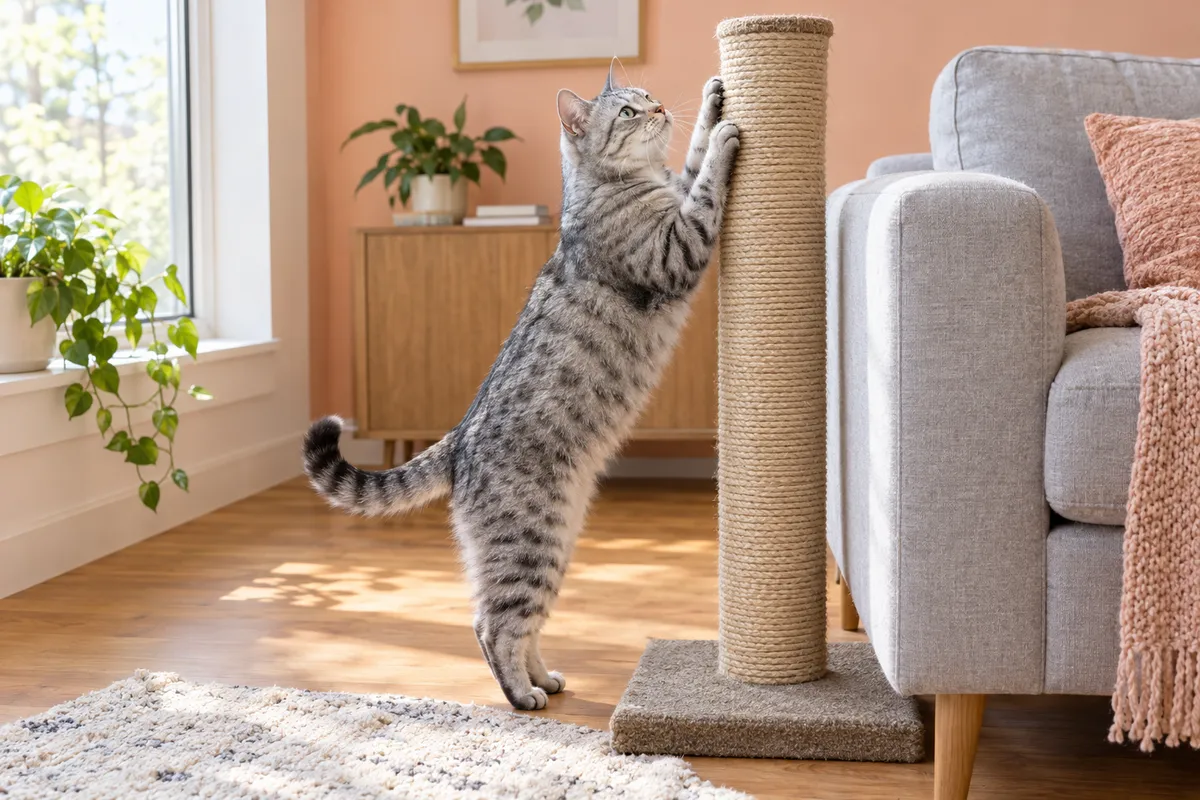
Put a scratching post where your cat already scratches, wakes up and walks past: beside the sofa, near beds, by doors and windows. Make it tall, steady and easy to find.
In short
- The best place for a cat scratching post is right next to the spot your cat already scratches, such as the arm of the sofa or the corner of a rug.
- Cats love to scratch the moment they wake up, so a scratcher beside each favourite sleeping spot gets used far more than one tucked away in a spare room.
- Doorways, hallways and windows are territory spots, and a scratcher there gives your cat a proper place to leave its mark.
- A good rule is at least one scratcher per cat plus one more, spread across the rooms your cats really use.
- A post only works if it stays put: choose a heavy base or fix it to the wall, and move it gradually if it needs a new home.
Where to put a cat scratching post comes down to one idea: put it where your cat already wants to scratch. That means right beside the sofa arm or rug they have chosen, next to the beds they nap in, and by doors and windows they patrol. A scratcher in a quiet corner is a scratcher your cat forgets.
Hello, lovely. If your cat walks past a lovely new post straight to the couch, the spot is usually the problem, not the post. Cats scratch to stretch, keep claws in shape and leave scent and visible marks, so they pick places and moments that matter to them. Match both, and the post wins.
Why does location matter more than the post itself?
Location matters because scratching is a social signal as much as a stretch, so cats choose spots that other members of the household (you included) will see. That is why the front of the sofa, the hallway rug and the doorframe get the attention. A scratcher in the laundry room sends a message nobody receives.
Before you move anything, watch for a few days: where your cat scratches, when, and whether they reach up high or rake along the floor.
Should the scratching post go next to the sofa they already scratch?
Yes, next to the sofa is the single most useful spot, because your cat has already told you that corner is important. Stand the post right against the arm or corner they use, close enough that it is the easier surface to reach. Then make the sofa itself less appealing for a while with a cover or a clear shield.
A sisal sofa protector gives your cat a proper scratching surface in that very same place. Once the habit has moved to the post, ease the cover off.
Scratchers that sit right beside the sofa
Tall posts with a solid base and sisal covers that wrap the sofa arm itself.


For the cat who has already chosen the sofa arm
This sisal shield wraps over the arm and down the side of the sofa, so the scratching spot stays exactly where your cat wants it while the fabric underneath is covered.
- Covers the corner cats reach for first
- Rough woven sisal gives a satisfying pull
- Easy to take off once the habit moves to a post
Why put a scratcher near where your cat sleeps?
A scratcher near the bed works because most cats stretch and scratch the moment they wake up. If the nearest good surface is your mattress edge, now you know where the post goes.
Look for every sleeping spot: the sunny cushion, the cat bed, the end of your own bed. A flat cardboard scratcher or a lounger that doubles as a bed is perfect here.
Scratchers that double as a nap spot
Cardboard loungers and boxes for the after-nap stretch.


A lounger for the bedside stretch
A curved cardboard lounger that cats lie in and scratch along, so the place they wake up is also the place they scratch.
- Sleep and scratch in one spot
- Low and wide for cats who scratch lying down
- Fits beside a bed or under a window
Why do doorways and windows make good scratching spots?
Doorways and windows are the edges of your cat's territory, which is exactly where cats like to leave their marks. The front door, the hallway between rooms and the window where neighbourhood cats wander past are all classic scratching spots, especially when you come home and your cat greets you with a big stretch.
Floor space is often tight there, so think vertical and flat to the wall: a wall-mounted post, a cardboard scratcher hanging from a door handle or a sisal board fixed into a corner. Near a window, pair a scratcher with a perch; our cat window perch guide has ideas for that best seat in the house.
Scratchers for doors, walls and corners
Mount, hang or lean them where floor space is short.


A wall-mounted post for busy hallways
A sisal-wrapped post that fixes to the wall, so it never tips and never takes up floor space by the front door or along a hallway.
- Cannot wobble or fall over
- Mount it at the height your cat stretches to
- Keeps walkways clear
How many scratching posts does a cat need?
Aim for at least one scratcher per cat plus one extra, spread across the rooms your cats really use. In a home with more than one floor, put at least one on every level. More scratchers in more places means more chances to make the right choice, and fewer reasons to pick the couch.
In multi-cat homes, spread them out so no one cat can guard every post, and mix the shapes, since cats in one home can scratch very differently.
| Home | Suggested scratchers | Where to put them |
|---|---|---|
| One cat, small apartment | Two or three | Beside the sofa, by the bed, near the door |
| One cat, house with stairs | One per floor, plus one by the sofa | Main living room, bedroom, entry hall |
| Two cats | Three or more | In different rooms so nobody guards them all |
| Three or more cats | One per cat plus one, mixed styles | Living areas, sleeping spots, doorways and windows |
Vertical, horizontal or angled: which scratcher suits your cat?
Match the scratcher to how your cat already scratches. A cat who stands up against the sofa side wants a tall vertical post. A cat who claws the rug or the top of the couch wants a flat horizontal scratcher. An angled ramp sits between the two and suits cats who like a bit of both.
Many cats enjoy more than one style, so offering a mix is a kind idea. A kitten study published in the Journal of Feline Medicine and Surgery found that the kittens preferred a cardboard scratcher, and preferred surfaces laid flat over the same surfaces standing up, which is a good reason to include something low and flat for young cats. For the material side of the choice, see our guide to sisal vs cardboard cat scratchers.
| Style | Best for | Put it | Good to know |
|---|---|---|---|
| Tall vertical post | Cats who stretch up the sofa side or doorframe | Beside the sofa, in the living room | Needs a heavy base or a wall fixing |
| Wall or door scratcher | Small spaces and hallways | By the front door, in a corner | Mount at full-stretch height |
| Flat cardboard pad | Rug and carpet scratchers, kittens | Next to beds and favourite rugs | Flip it over when one side wears |
| Angled ramp | Cats who like both styles | Near the sofa or a window | A gentle start for shy scratchers |
| Lounger or box | Cats who nap where they scratch | In sunny nap spots | Bed and scratcher in one |
Angled and flat scratchers to mix in
Low shapes for rug rakers and in-between scratchers.


How tall and how steady should a scratching post be?
A scratching post should be tall enough for your cat to stretch out fully with front legs extended, and steady enough that it does not move at all when they pull hard. A post that wobbles or tips even once can put a cat off for good, so stability matters more than looks.
- Height: watch your cat stretch up against a door and use that reach as your guide.
- Base: wide and heavy, or fixed to the wall. Give it a good shove yourself before your cat tries it.
- Surface: level floor, away from table edges and wobbly furniture.
- Cover: tightly wound sisal rope or woven sisal gives a satisfying, tearable texture.
If you would like climbing and perching too, a sturdy cat tree can be your main scratching post. Our guide on how to choose a cat tree covers bases and heights, or browse every cat scratching post in the shop.
A tall, steady post for big stretches
A thick sisal rope post on a broad, heavy base, built for cats who stand up and pull hard with their whole body.
- Wide base resists tipping
- Thick rope for a strong grip
- Tall enough for a full stretch
How do you move a scratching post without your cat losing interest?
Move a scratching post a little at a time, a short distance every day or two, rather than carrying it across the house in one go. Your cat follows the post to its new home because each step feels like the same familiar spot.
- Start with the post right where your cat scratches now, even if it is in the way.
- Wait until your cat is using it happily every day.
- Shift it a short step toward where you would like it to live.
- Pause if your cat goes back to the furniture, then move more slowly.
- Leave the old scratched spot covered until the new habit is settled.
How do you make a scratching post more inviting?
Make the post the most fun object in the room: rub a little catnip or silvervine into it, drag a wand toy up and across it, and praise or reward your cat when they scratch. Many scratchers arrive with catnip included for exactly this reason. Some cats do not respond to catnip at all, so play is the more reliable invitation.
Never place your cat's paws on the post or move them through the motion; cats like to choose. Keep it light and playful, and stay close while your cat explores something new.
If scratching suddenly changes, for example your cat stops scratching, scratches far more, or seems reluctant to stretch or use their paws, ask your vet. Changes in everyday habits are worth a check.
Questions people ask
Where is the best place to put a cat scratching post?
Right next to the spot your cat already scratches, usually the sofa arm, a rug or a doorframe. After that, add scratchers beside sleeping spots and near doors and windows, where cats like to leave their mark.
Should a scratching post go in the living room or the bedroom?
Both, if you can. The living room is where cats show off their marks, and the bedroom is where they stretch after sleeping. A post that sits in a spare room nobody uses tends to be ignored.
How many scratching posts should I have for two cats?
Three or more is a good start, following the rule of one per cat plus one. Put them in different rooms so one cat cannot guard them all, and mix vertical and flat styles.
Why won't my cat use the scratching post?
It is usually in the wrong place, too short, too wobbly or the wrong style. Move it beside the furniture your cat already scratches, check it does not tip, and try a flat or angled scratcher if your cat rakes rugs. Play with a wand toy on it to get things started.
Can I move a scratching post once my cat uses it?
Yes. Move it a short distance every day or two instead of all at once, and slow down if your cat returns to the furniture. Keep the old spot covered until the new place is a habit.
Does catnip help a cat use a scratching post?
It helps many cats, since a little rubbed into the surface makes the post more interesting. Not every cat responds to catnip, so pair it with play and praise.
About the numbers
- Zhang, Plummer and McGlone, "Preference of kittens for scratchers", Journal of Feline Medicine and Surgery: kittens preferred a cardboard scratcher, and preferred carpet and screen surfaces laid flat over the same surfaces standing up