How to Choose a Cat Tree: Height, Stability, Sisal and Wood
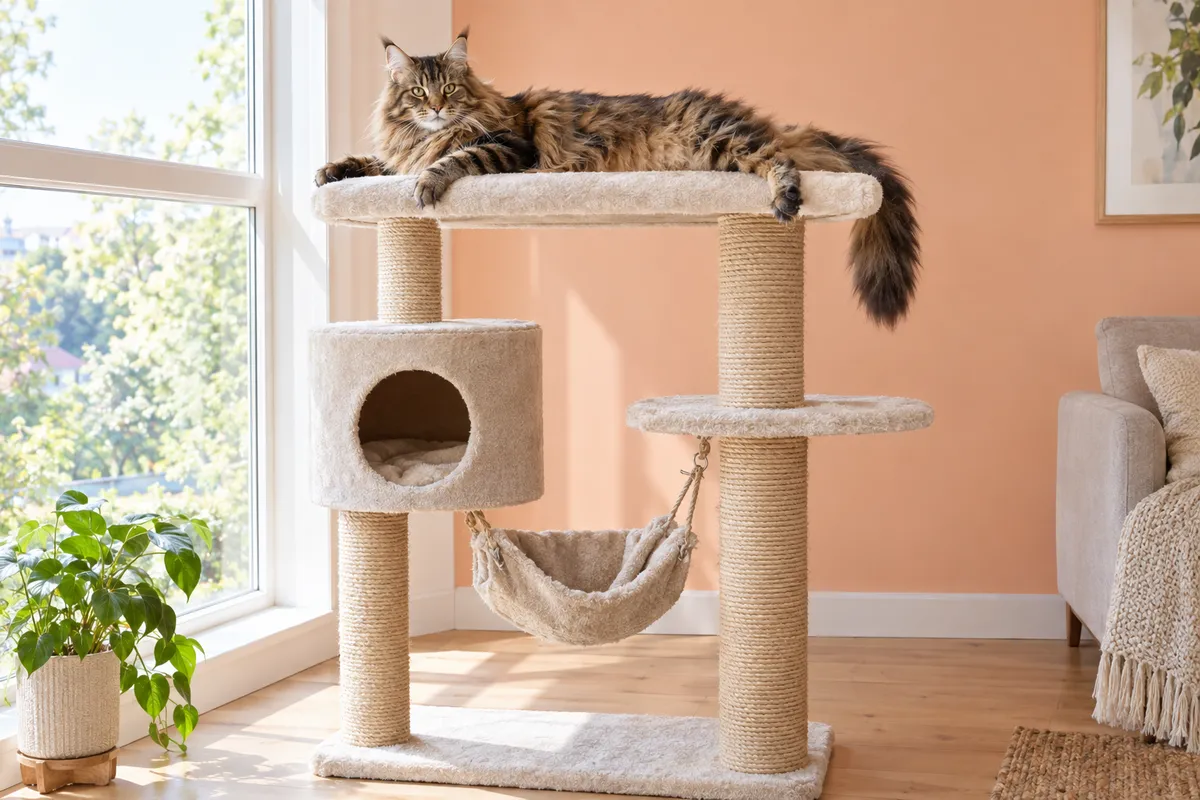
Choose a cat tree by your cat's size first: a wide, heavy base, thick sisal posts and platforms your cat can lie flat on. Then match height and footprint to your room.
In short
- Pick the base before the height: a wide, heavy base and a wall anchor matter more than how tall the tower is, especially for big cats.
- Look for thick posts wrapped in natural sisal rope; sisal fabric suits cats who scratch flat, and carpet belongs on the resting spots.
- For a large cat, try the lie-flat test: your cat should fit on a platform stretched out, not curled into a ball with legs hanging off.
- Solid wood and real branches last longest and look like furniture; particleboard trees are lighter and cheaper but wobble sooner and dislike damp.
- Put the tree where your cat already wants to be, usually by a window in the room where the family spends its evenings.
Hello, lovely. A good cat tree is the one your cat actually climbs, naps on and scratches every day. The secret is simple: choose for your cat's size and your room first, then for looks. A wobbly tower with tiny perches ends up as a very expensive coat rack, while a steady one with roomy platforms becomes the favorite seat in the house.
Height and footprint: measure your room, not just your ceiling
Start with the space. Measure the floor area you can give up and the ceiling height, then compare both to the tree's listed dimensions. A short tower with a big top platform suits a studio or a kitten; a tall tower suits a confident climber and a corner with room to spare.
- Short (under about 40 inches): easy to place beside a sofa or under a window, kind to kittens and to older cats who prefer smaller hops.
- Medium (about 40 to 60 inches): the everyday sweet spot for one or two adult cats, tall enough to watch the room from.
- Tall and floor-to-ceiling: more levels for multi-cat homes and climbers. Floor-to-ceiling styles press against the ceiling with an adjustable pole, so check your exact height range.
Footprint matters as much as height. One compact tower in our trees and condos measures about 22 by 14 inches across and 39 inches tall: a good picture of a tree that fits beside a bookcase.
Compact trees for small rooms and kittens
Short towers with roomy tops, easy to fit beside a sofa or under a sill.


Stability: base width and wall anchoring for big cats
The steadiest trees have a wide, heavy base and a wall anchor. A cat leaping onto a top platform pushes it sideways, and the higher that platform sits, the more leverage the jump has. A base that spreads well beyond the top perches resists that push; a narrow base lets the whole tower rock.
Many taller trees come with an anti-tip kit: a strap or bracket that screws into the wall behind the tower. Use it, screw into a stud where you can, and tighten every bolt again after the first week as the parts settle.
Some trees state a weight they are built to hold. One wide-based tower in our range lists 33 pounds, which is a helpful number to compare when you share your home with a Maine Coon, a Ragdoll or two cats who like to land on the same perch at once.
Posts and scratching surfaces: sisal rope, sisal fabric or carpet
Thick posts wrapped in natural sisal rope are the classic choice, and for good reason: the rope grips claws, holds up to hard scratching and feels like the rough bark cats would choose outdoors. Thicker posts also make the whole tree stiffer. One mid-height tower lists its posts at 2.56 inches across; chunkier posts are worth looking for on a tree meant for a big cat.
| Surface | How it feels to a cat | Best place on a tree |
|---|---|---|
| Sisal rope | Firm, ridged, grips claws for long vertical pulls | Posts and tall scratching columns |
| Sisal fabric (woven sisal) | Flatter and tighter, good for raking | Ramps, boards and flat panels |
| Carpet | Soft, loopy; some claws catch in the loops | Platforms, beds and condo floors |
| Plush or faux fur | Warm and cozy for naps | Perches, hammocks and condo linings |
Cats differ: some scratch up, some scratch flat. If yours already loves a flat board, look for a tree with a sisal ramp or board as well as rope posts. Our sisal vs cardboard scratcher guide covers textures in more depth.
Platforms for large breeds: the lie-flat test
Big cats need platforms they can lie flat on. Picture your cat stretched out on its side, then measure from nose to the base of the tail and across the body. A platform that holds that shape with no paws dangling is the right size. A perch that only fits a curled-up cat will be ignored by a large adult.
Product listings help here. One small tower has a widened perch of 17.7 by 11.8 inches for larger cats, and a short tree has a top platform of 20 by 16.5 inches. Raised edges add a feeling of safety.
Trees for large cats
Wide platforms, wide bases and plenty of room to stretch out.


Big top platforms for a big cat
A 65-inch tower built around extra large platforms, so a long-bodied cat can sprawl at the top instead of perching on the edge.
- Wide, padded resting levels
- Sisal-wrapped posts on every level
- A good match for a corner with room to spare
Condos, hammocks and perches: what each one is for
Extras should match how your cat likes to rest. Condos are enclosed boxes for cats who nap hidden; hammocks are slings for cats who like to sink in; open perches and baskets are lookouts for cats who like to see everything.
- A condo works best low on the tree, where its weight helps stability and a shy cat can duck in quickly.
- Check that a condo opening is wide enough for your cat to turn around inside, not just squeeze through.
- The top perch is prime real estate. In a multi-cat home, more than one high spot means fewer standoffs.
Tall towers for multi-cat homes
Several levels, more than one condo or top spot, and anti-tip hardware on the tall models.


Solid wood vs particleboard: what is the best wood for a cat tree?
Solid wood is the most durable choice: real branches, rubberwood and pine hold screws tightly, shrug off years of climbing and look like furniture rather than gear. Most plush towers are built on particleboard instead, sometimes labeled CARB certified board. Particleboard is lighter and more affordable, but its screw holes loosen with use and it can swell if it gets damp.
| Material | Strength over time | Look | Good to know |
|---|---|---|---|
| Natural branch or solid wood | Very sturdy; screws stay tight | Modern, sculptural, furniture-like | Often fewer levels; heavier to move |
| Rubberwood and pine | Sturdy for wall shelves and steps | Clean, natural grain | Common on wall-mounted pieces |
| Plywood or engineered wood | Good middle ground | Painted or veneered | Check the edges for chipping |
| Particleboard (CARB rated) | Fine for light use; loosens sooner | Covered in plush or carpet | Keep dry; retighten bolts often |
Whatever the material, check the product details for the finish used and let a new tree air out before your cat moves in.
Wooden cat trees
Real branches, solid wood posts and wood frames for homes that want a cat tree to look like furniture.


Wall-mounted shelves, steps and window perches
No floor space? Go up the wall. Wall shelves, steps and bridges give a cat a climbing route with no footprint at all. Mount them into studs, space the steps so your cat can step rather than leap, and start with a low first step near a chair or sofa. A suction-cup window perch adds a sunny lookout in minutes.
Wall shelves, steps and lookouts
Build a climbing path that leaves the floor free.


Where to put a cat tree: window, living room or bedroom
Place the tree beside a window in the room where your family spends its time. Cats love a view of birds and passing life, and they like to be near their people without being underfoot. A living room corner by a window usually wins; a quiet bedroom suits a shy cat.
- Keep it away from heaters and busy doorways, and stand it against a wall or in a corner.
- Pair the tree with play: a few minutes with a wand toy near the base makes it a fun place. Our indoor cat play routine has ideas.
Which cat tree for which home
| Home or cat | What to look for | Good shape |
|---|---|---|
| Studio or small apartment | Small footprint, wide top perch | Short tower or wall shelves |
| Kitten | Low levels, ramps, small hops | Short tower with a condo |
| Large breed or heavy cat | Wide base, thick posts, lie-flat platforms | Medium to tall tree with a wall anchor |
| Two or more cats | Several high spots, more than one hideaway | Tall multi-level tower |
| Older or less agile cat | Short gaps between levels, ramps or steps | Short tree or wall steps |
| Design-minded home | Solid wood or branch posts | Modern wooden tree |
Refreshing worn sisal and tired platforms
A shredded post does not mean a new tree. Rewrap it with fresh sisal rope: peel off the old rope, scrape away loose glue, then wind new rope tightly from the bottom up, with glue or double-sided tape every few turns. Let it set before your cat scratches. Self-adhesive carpet or felt pads refresh platforms too.
Rope, posts and pads for repairs
Match the rope thickness to your old wrap for a neat finish.


Whatever you choose, introduce the new tree gently and stay close for the first climbs. You can browse every style in our cat trees and condos and our scratching posts.
Questions people ask
What type of wood is best for a cat tree?
Solid wood, such as natural branches, rubberwood or pine, is the most durable because it holds screws tightly and does not swell. Particleboard trees are lighter and more affordable but loosen sooner. Check the product details for the finish used and air out any new tree before use.
How tall should a cat tree be?
Match the height to your cat and your room. Short towers under about 40 inches suit kittens, small spaces and older cats, while taller towers suit confident climbers and multi-cat homes. A tall tree should always have a wide base and a wall anchor.
What size cat tree does a large cat need?
Look for platforms your cat can lie flat on fully stretched out, a base noticeably wider than the top, thick sisal posts and a stated weight capacity that suits your cat. Use the anti-tip kit on any tall model.
Is sisal rope or carpet better on a cat tree?
Sisal rope is better for scratching posts because it grips claws and holds up to hard use. Carpet and plush are better for resting spots like platforms and condo floors. Many cats enjoy a tree that offers both.
Can I replace the sisal rope on a cat tree?
Yes. Remove the old rope, clean off loose glue, and wind new sisal rope tightly with glue or double-sided tape every few turns. Let it set fully before your cat uses it.
About the numbers
- Google Trends, United States, past 90 days, read 2026-10-06: searches for cat tree roughly flat, down 3% over four weeks; rising related searches included solid wood cat tree style queries
- Google search, people also ask and related searches, read 2026-10-07: questions included what type of wood is best for a cat tree; related searches included cat tower and sisal rope