Cat Window Perch Guide: Hammocks, Sill Seats and Cat TV Setup
Pick a cat window perch by your glass and sill: suction-cup hammocks for smooth single panes, sill seats for deep ledges, shelves or a tree for a route. Then give the view something to watch.
In short
- A suction-cup window hammock suits smooth, flat, single sheets of glass; textured, tinted-film or very cold glass is better served by a sill-mounted perch or a cat tree.
- Read the weight limit on the listing, then choose one that holds well over your cat's weight, because cats land with more force than they weigh standing still.
- Test every suction cup with a firm press on the empty frame before your cat uses it, and check the cups again each week.
- For cat TV, place a bird feeder outside where your cat can watch but nothing can be reached, either right against the glass or well away from the window.
- Only open a window your cat can reach when a secure, latched screen is in place.
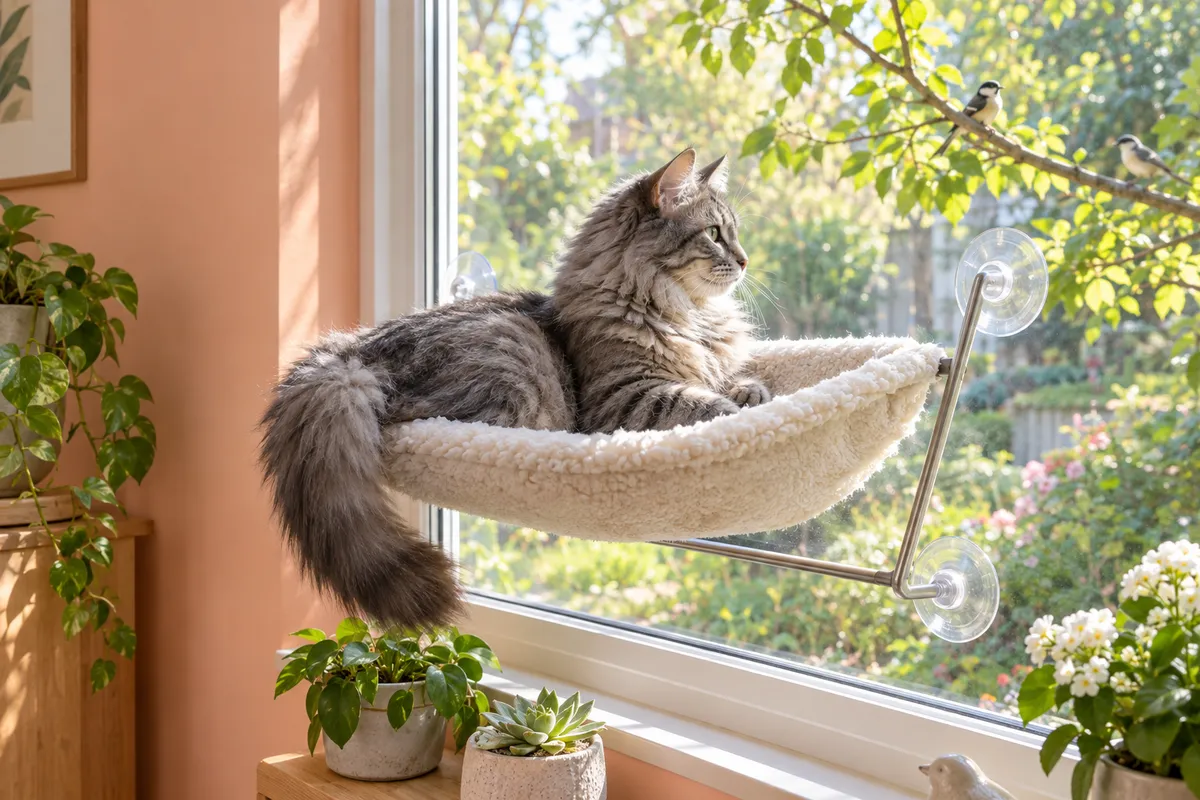
A cat window perch turns a pane of glass into the best seat in the house. The right one depends less on your cat than on your window: the glass, the sill and what sits below it. This room guide walks the window from the glass outwards, then sets up the view so there is always something worth watching.
If your cat already has a tall tree, our guide to choosing a cat tree covers height and stability; here we focus on the window itself.
Start with the window, not the perch
Pick the window first, then the perch that fits it. Look for a window with a view that moves (a tree, a garden, a quiet street), light at the times your cat naps, and a spot you can see from your sofa so you can enjoy the show too.
- Glass: smooth, clean, flat glass holds suction cups best. Textured, frosted or patterned glass, and glass with a peel-off privacy film, usually does not.
- Sill: measure its depth and thickness, and the gap between the sill edge and the wall below. Sill-mounted perches list the sizes they fit.
- Below the window: a radiator, a heater vent or a fragile shelf directly under a perch is a poor landing zone.
- Blinds and curtains: a cat can tangle in long cords; tie them up high or choose cordless blinds.
| Perch type | Fits best | Watch for |
|---|---|---|
| Suction-cup hammock | Large smooth glass panes, rentals | Cups loosen with cold, dust and time; check weekly |
| Sill-mounted seat | Sills of the depth the maker lists | Needs a lip to hook over and a firm wall below |
| Wall shelf or bridge | A wall beside the window | Drilling into studs or proper anchors |
| Cat tree by the window | Any window, any glass | Floor space and an anti-tip strap |
Suction-cup window hammocks: glass, weight and testing the cups
A suction-cup hammock is the quickest way to a window seat, and it works when the glass is right and the cups are cared for. Most use four large cups on a metal frame, and some add support arms that brace from below. Check the stated weight limit and pick one well above your cat's weight: a cat jumping on lands harder than a cat lying still.
- Clean the glass and the cups with warm water and a drop of dish soap, then dry both completely. Dust and grease are the usual reason cups slide.
- Press each cup flat in its final spot, pushing out every bubble, then lock any lever or screw cap.
- Fit the frame, then press down firmly on the empty bed with your hand for a full minute before your cat gets near it.
- Mount it low at first, near a sill or a chair, so your cat can step on rather than leap.
- Re-check the cups weekly, and more often in cold weather when glass and rubber both stiffen.
Suction-cup window hammocks
Look for the weight limit and how the frame is braced.


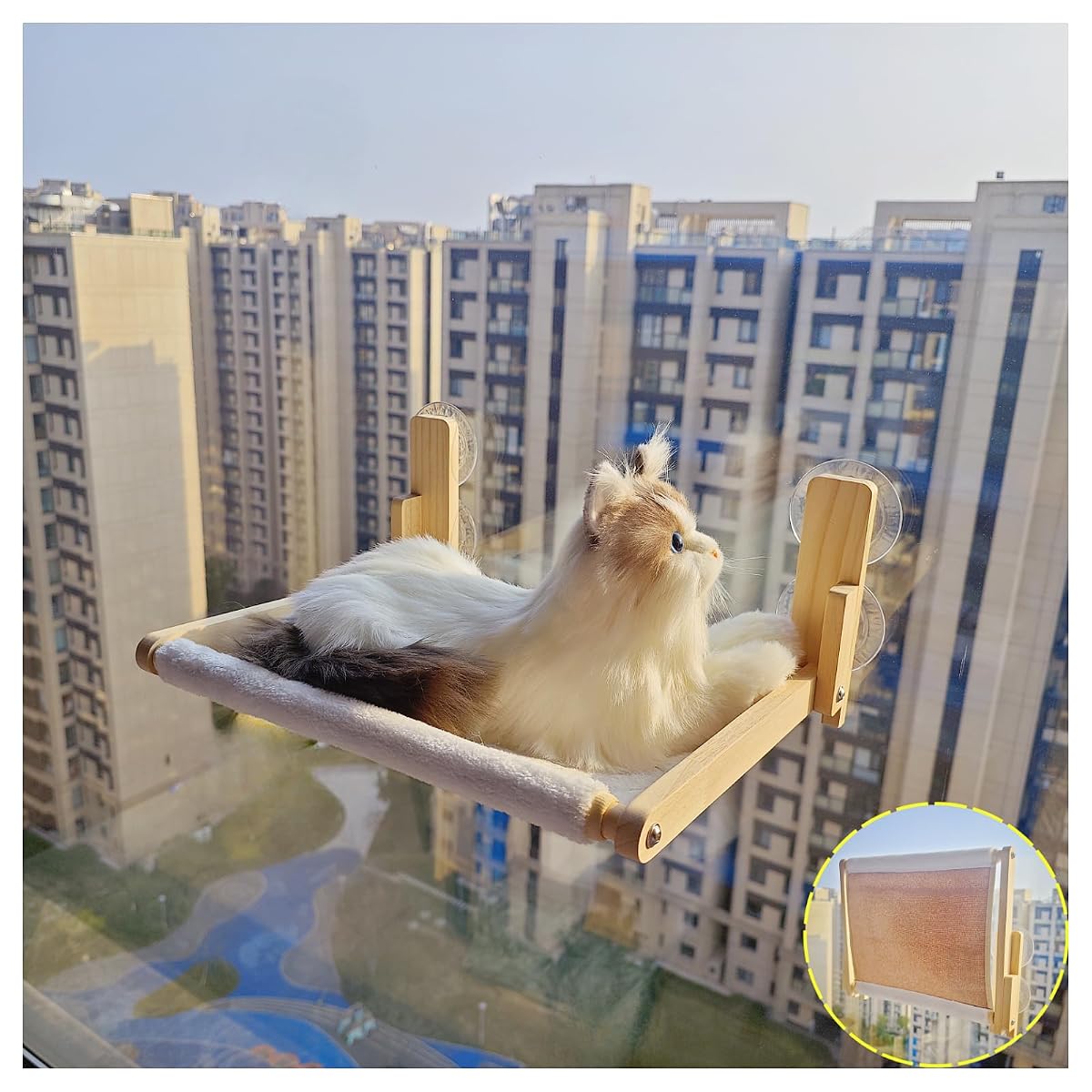


Braced from below
This hammock rests on a pair of triangular metal arms that run down the glass, so the bed is held from underneath as well as at the cups. The maker states it holds up to 40 lbs, and the open front leaves a clear jump on and off.
- Fleece-style bed with a raised rim
- Metal arms carry load to the lower cups
- Good choice for larger cats on big smooth panes
Sill-mounted perches: no cups on the glass
If your glass is textured, filmed or small, a sill-mounted perch is usually the steadier answer. It hooks over the sill or clamps to it and leans on a bracket against the wall below, so the glass carries nothing.
Measure before you choose. One sill seat we carry, for example, asks for a slot at least half an inch deep, a sill no deeper than 6 inches and a gap of 3 inches or less between the sill edge and the wall underneath. Sliding-clamp designs adjust to different thicknesses in one step, and some double as a bedside or drawer-top bed.
Sill seats and clamp-on perches
Check the sill sizes each one lists before you pick.


A bolster bed on a hardwood bracket
A hardwood bracket hooks over the sill and braces against the wall, with a metal frame and a deep bolster around the bed. It suits a wide sill and a cat that likes to curl with its chin on an edge.
- No suction cups on the glass
- Bolster on three sides
- Read the sill size guide first
A cat tree by the window, and wall shelves to make a route
A cat tree beside the window works with any glass and gives a climb on the way up. Set it close enough that the top perch looks straight out, attach the anti-tip strap to the wall, and keep it clear of curtain cords. You will find more in our cat trees and condos.
Tall trees with a top perch
Strap any tall tree to the wall.


Wall shelves turn a window into a destination with a path. Run steps up the wall beside the frame to a shelf level with the glass, leaving a comfortable stride between each. Fix them into studs or with anchors rated for the load, and give the top shelf a cushion or sisal so landings grip. Browse more cat shelves and scratching posts.
Wall steps, shelves and bridges
Good for a route from floor to window.


Setting up cat TV: a bird feeder placed for watching
The best cat TV is real life outside the glass. A bird feeder, a bird bath or a planter that draws butterflies gives your cat movement to follow while the birds stay completely out of reach.
- Place it for the birds' safety too. Bird experts advise a feeder either within about 3 feet of the glass or more than 30 feet away, so birds cannot build speed toward the window.
- Never reachable. The feeder sits outside a closed window or behind a secure screen. Your cat watches; it never touches.
- Away from cover. Keep feeders clear of low shrubs where outdoor cats could hide.
- Keep it clean. Wash feeders and baths regularly so the visitors stay healthy.
Screens and safety
A window perch is for a closed window or a window behind a sturdy screen. Standard insect screens are made to keep bugs out, not to hold a leaning cat, so check that yours sits snugly in its track and latches. If your cat pushes or claws at it, keep that window shut.
- Never open a window your cat can reach without a secure screen in place.
- Choose a perch with no gap between the bed and the glass where a paw or tail can wedge.
- Stay close the first few times your cat uses a new perch, and take it down if anything shifts.
Sun and warmth on a cold sill
Windows are bright but can be chilly in winter. A pet heating pad with a chew-resistant cord, or a self-warming mat that needs no plug, makes a cold sill or a tree shelf cozier. Run any cord safely out of the way and follow the label for use. Our comparison of heated and self-warming cat beds explains the difference. In summer, notice when the sun is strongest and make sure there is shade and water nearby.
Warm layers for a window seat
Plug-in pads and no-plug self-warming mats.


Rotate the view and play near the window
Keep the window fresh. If you have two good windows, move the hammock between them with the seasons, follow the sun, or open a different blind each morning. A short play session near the perch before a nap lets your cat chase, then settle and watch. Our indoor cat play routine shows how to fit it into a day.
Flutter toys for window play
Touch-activated birds for chasing near the perch.


Whatever you choose, introduce it gently, reward the first visits with a treat, and enjoy the view from your side of the room.
Questions people ask
Are window perches good for cats?
A window perch gives an indoor cat a raised, sunny spot to rest and something to watch. Choose one that fits your glass or sill and test it before your cat uses it. For any question about your own cat's health or behaviour, ask your vet.
How much weight can a cat window perch hold?
It depends on the model, so read the weight limit each one states. The ones in this guide list limits from about 35 to 50 lbs. Pick a limit well above your cat's weight, since a jump lands harder than a cat lying still.
Can a cat window perch break a window?
A perch should only go on sound, smooth glass in good condition, never on cracked panes. If your glass is old, thin or textured, use a sill-mounted perch, a wall shelf or a cat tree instead, so the glass carries no weight.
Is there a cat window perch that doesn't need suction cups?
Yes. Sill-mounted perches hook or clamp onto the window ledge and brace against the wall below, with nothing stuck to the glass. Wall shelves and cat trees placed beside the window also need no cups.
Why do my cat window perch suction cups keep falling off?
Usually dust, grease, textured glass or cold. Wash cups and glass with warm soapy water, dry them, press out every bubble and lock the caps. Re-check them weekly, and replace cups that have gone stiff or warped.
About the numbers
- Google people also ask and related searches, United States, read 2026-10-07: questions on whether window perches are good for cats, weight limits, perches without suction cups, suction cups not sticking and whether a perch can break a window
- Cornell Lab of Ornithology, All About Birds: Where to Put Your Bird Feeder, via a Google answer read 2026-10-07: feeders within about 3 feet of a window or more than 30 feet away reduce window collisions
- Product details of the perches shown, read 2026-10-07: stated weight limits of 35 to 50 lbs; one sill perch requires a 0.5-inch slot, a sill of 6 inches or less and a gap of 3 inches or less