How to Choose a Cat Carrier: Hard, Soft, Backpack, Expandable
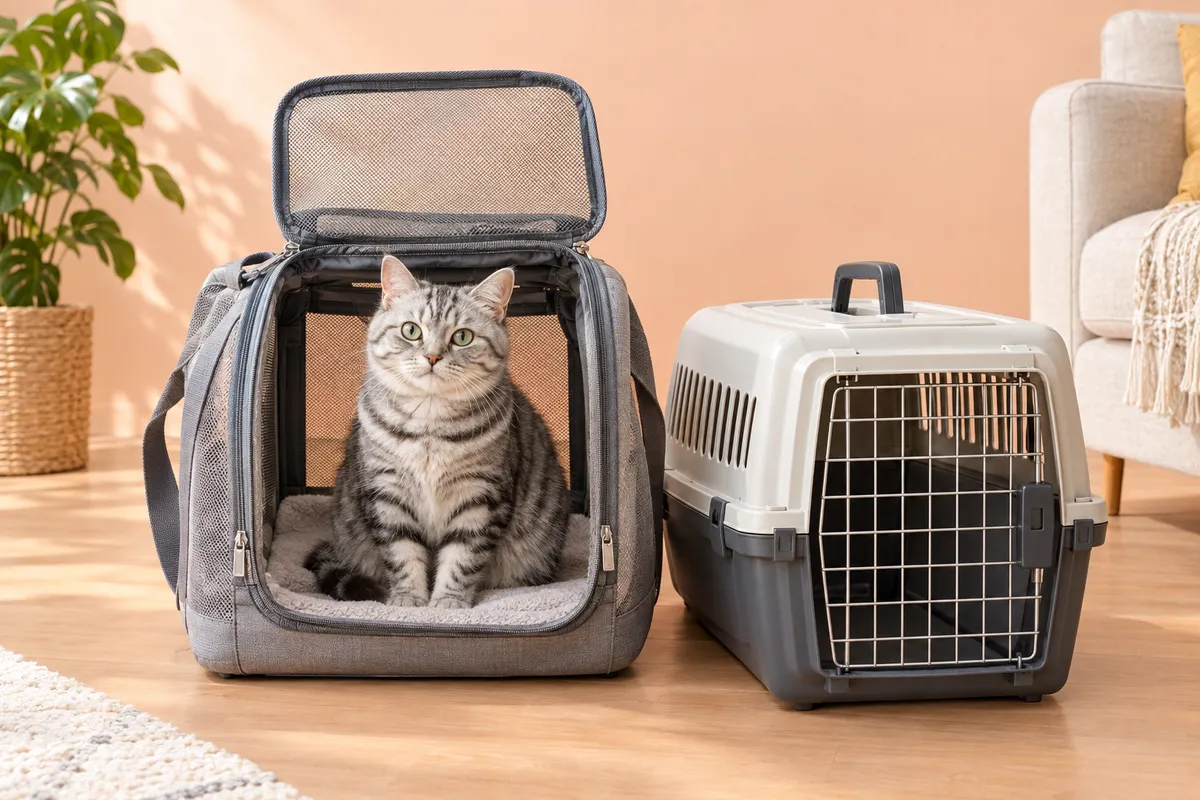
Choose a hard carrier for easy cleaning and a top that lifts off, a soft carrier for light everyday trips, and a backpack or expandable style for longer outings. Size it so your cat can stand and turn.
In short
- A hard carrier is the easiest to wipe clean and often comes apart in two halves, so a nervous cat can stay put in the base while the top lifts away.
- A soft-sided carrier is light, folds flat and suits short trips and travel; for a flight, check your airline's own size rule before you buy.
- Backpack carriers with a bubble window keep your hands free, and expandable carriers zip open into extra room for rest stops.
- Whatever the style, look for ventilation on several sides, secure zips or clips, a seat-belt loop and a washable pad, in a size where your cat can stand up and turn around.
- Leave the carrier out as a bed with treats inside and take short practice trips, so the carrier means a nap spot rather than only the car.
Hello, lovely. The best cat carrier is the one your cat walks into and you can carry without a struggle. For most homes that means a sturdy carrier with a top opening for vet days, plus a lighter soft or backpack style if you travel or like outings together. Here is how each type works, what to check on any carrier, and how to help your cat feel at home in it.
Hard vs soft cat carriers at a glance
Hard carriers win on cleaning and structure; soft carriers win on weight and storage. Backpacks and expandable carriers are soft carriers with extra tricks. Use this table to match a style to how you actually travel.
| Type | Best for | Easy to clean | Weight and storage | Watch for |
|---|---|---|---|---|
| Hard (two-piece plastic) | Vet visits, car trips, cats that scratch or chew at mesh | Wipe or rinse the whole shell | Bulkier; takes up a cupboard shelf | Check the clips and door latch close firmly |
| Soft-sided bag | Short trips, travel, carrying on a shoulder | Removable pad washes; the bag needs spot cleaning | Light; many fold flat | Mesh a cat can claw, zips without locks |
| Top-opening soft | Cats that brace against a front door | Same as soft | Light | A frame that holds its shape when open |
| Backpack with bubble window | Walks, hikes, longer carries | Pad washes; clear dome wipes | Bulky on the back, hands free | Sun on the clear window, warm days |
| Expandable | Long journeys and rest stops | Pad washes | Folds down; packs bigger than a basic bag | Keep the extra room zipped shut when moving |
Hard carriers: the easy-clean choice with a lift-off top
A hard carrier is a molded plastic shell with a wire or plastic door. Many are built in two halves joined by clips or latches around the middle seam. That design is the reason people ask for them for vet visits: unclip the top half and lift it away, and your cat can stay sitting in the familiar base instead of being pulled out through a small door. If your cat tends to wedge itself at the back, that is a real kindness.
Plastic also rinses clean after an accident. The trade-off is bulk: a hard carrier does not fold away and is heavier to carry far. Look for vent slots on the sides and back, a sturdy top handle and a door that latches firmly.
Hard and fold-flat plastic carriers
Molded shells with ventilation slots and a secure front door; one folds flat for storage.


A classic two-piece hard carrier
A plastic shell with a wire front door, vent slots along the sides and back and a carry handle on top. The listing gives the inside space as about 20.7 by 13.2 by 14.1 inches, roomy for a small to average cat.
- Smooth plastic wipes clean
- Wire door gives your cat a clear view out
- Latches around the seam hold the two halves together
Soft-sided carriers: light, packable and travel-friendly
A soft carrier is a fabric bag on a light frame, with mesh panels for air and a view. It weighs little, often folds flat, and many have a shoulder strap so you can carry it like a gym bag. Most of the carriers people take on a plane are this style, because the sides can give a little to fit under a seat. Check your airline's own size rule before you buy, since the limit differs from one airline to the next and even between aircraft.
Soft carriers have limits: a determined cat can claw at mesh, and fabric is harder to clean than plastic. Look for locking zips, a firm base board and a pad you can lift out and wash.
Soft-sided carriers for everyday trips
Fabric and mesh bags with shoulder straps and lift-out pads, in small to large sizes.


Soft carriers that open from the top
Many soft bags have a zip panel on top as well as an end door. Some go further, with a hooded canopy that opens like a wide mouth. Lowering a cat in from above is often easier than coaxing one forward through an end opening, and the cat can sit up and peek out while you are waiting.

A soft carrier with a wide top canopy
This grey bag opens with a hooded top that folds right back, so you can set your cat down inside rather than pushing it through a door. The listing gives it as about 17 by 11 by 17 inches, taller than many small carriers.
- Wide top opening plus a mesh side door
- Shoulder strap and carry handles
- Zip pocket on the side for small things
Backpack carriers with bubble windows
A backpack carrier puts the weight on both shoulders and leaves your hands free, which helps on walks, at a busy station or on a short hike. Many have a clear dome or bubble window on the front so your cat can watch the world, plus mesh on the sides for airflow. Others have a fabric blind you can roll down when your cat would rather not look.
Because the clear window lets sunlight in, keep backpack trips short on warm days and stay in the shade. Look for padded shoulder straps, a chest strap, a short inner safety leash that clips to a harness, and doors on more than one side.
Backpack carriers
Bubble windows, mesh sides and inner safety leashes; one has two compartments for a pair of small cats.


A breathable backpack with a view
Mesh on three sides keeps air moving, and a roll-down flap at the front lets you close the view when needed. The listing gives the outside size as about 12.6 by 11.4 by 16.5 inches and asks you to check your cat sits within about 14.5 inches tall and 12 inches wide.
- Hands free on both shoulders
- Measure your cat against the listing first
- Side pockets for small essentials
Expandable carriers for rest stops
An expandable carrier has one or more panels that unzip and fold out into a mesh room. While you are moving, it stays compact. At a rest stop or in a hotel room, unzip the extension and your cat can stretch out and lie down at full length. Some backpacks have the same idea built into the back.
Keep the extension zipped closed whenever you are carrying the bag or it is on a seat, and only open it when you are sitting close by.
Expandable carriers and backpacks
Zip-out mesh rooms for a stretch at a rest stop, from kitten size to large.


A backpack that opens into a rest tent
This grey polyester backpack has mesh windows on several sides and an extension on the back that unzips into a tented room. The listing includes a removable mat for the expanded space.
- Backpack straps for walking, extra room for resting
- Mesh on several sides for air
- Fold the tent away when moving
What to check on any cat carrier
- Size: your cat should be able to stand up, turn around and lie down. Measure your cat from nose to the base of the tail and from the floor to the top of the head, then compare with the carrier's inside size, not only the outside.
- Ventilation on several sides: mesh or vent slots on at least three sides, so air moves even when one side is against a seat or a wall.
- Secure closures: zips that lock or clip together, or latches that close firmly on a hard shell.
- A seat-belt loop: a strap or loop that lets you buckle the carrier into a car seat so it cannot slide.
- A washable pad: a lift-out pad or liner you can put through the wash.
- Two ways in: a top opening plus a front or side door makes every trip easier.
In the car, set the carrier on the back seat or the floor behind a front seat and buckle it in. Our guide to dog car seats covers more about securing a pet in the car. You can browse every style in carriers and travel.
How to get a cat used to the carrier
Most cats meet the carrier only on the way to somewhere new, so it starts to mean exactly that. Change the story slowly, at your cat's pace, and stay close.
- Leave it out as a bed. Put the carrier in a room your cat likes, door open or top off, with a soft blanket that smells of home.
- Add treats and toys inside. Drop a treat or a favorite toy in now and then, so finding good things there becomes ordinary.
- Close the door for a moment. Once your cat naps inside, close the door for a few seconds, then open it and give a treat.
- Lift and set down. Carry the carrier a few steps around the house and set it down gently.
- Take short trips. A drive around the block and straight home, then a slightly longer one.
For a climber who loves a high hiding spot, see our guide to choosing a cat tree.
If your cat will walk outside too, our step-by-step guide on how to put a harness on a cat covers harness types, fit and short indoor practice sessions.
Questions people ask
Do cats prefer hard or soft carriers?
It depends on the cat. Some like the enclosed, den-like feel of a hard shell, while others settle better in a soft bag with a padded floor. What matters most is that the carrier is familiar, so leave whichever you choose out at home as a bed.
What kind of cat carrier is best for vet visits?
A carrier with a top that opens or lifts off is the practical choice, because your cat can stay in the base instead of being pulled out through a small door. Two-piece hard carriers and soft carriers with a wide top opening both do this. Ask your own vet clinic what works best for them.
Are soft carriers safe for cats?
A well-made soft carrier with locking zips, a firm base and sturdy mesh is a good everyday carrier. Check the zips and seams before each trip and buckle the carrier in with its seat-belt loop in the car. For a cat that claws hard at mesh, a hard carrier may hold up better.
Do cats prefer big or small carriers?
A carrier should be big enough for your cat to stand, turn around and lie down, but not so large that the cat slides around when you carry it. If you want extra room for long journeys, an expandable carrier gives space at rest stops and stays compact while moving.
About the numbers
- Google search, people also ask and related searches, United States, read 2026-10-07: Questions on hard vs soft carriers, carriers for vet visits, soft carrier safety and carrier size; related searches for top-opening hard carriers and cat backpack carriers