What Size Dog Crate Do I Need? Measure, Choose and Set Up
Measure your dog from nose to tail base and from floor to head top while sitting, add a few inches, then pick the crate whose length and height clear both numbers.
In short
- A crate fits when your dog can stand without ducking, turn around easily and lie flat with legs stretched out.
- Measure nose to tail base and floor to head top while sitting, add a few inches to each, then match both numbers to a crate.
- For a puppy, buy the crate for their adult size and use a divider panel to shrink it for now.
- For puppies, the 2:1 rule means about one hour of awake, supervised time, then about two hours of calm rest in the crate.
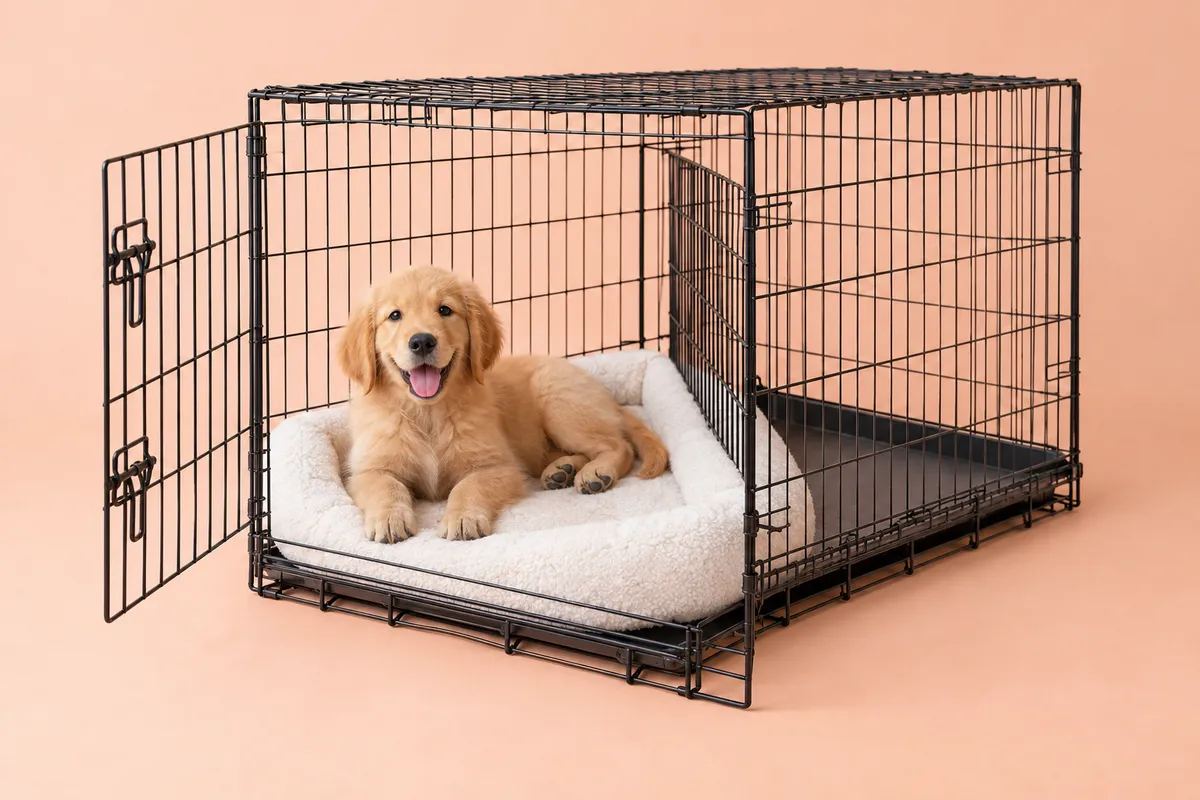
The right dog crate lets your dog stand up without ducking, turn around easily and lie flat with legs stretched out, and is not much bigger. Measure, add a little room, then match the numbers to a crate. Here is how, plus the bed that fits and a setup your dog will like.
How to measure your dog for a crate
- Length: with your dog standing, measure from the tip of the nose to the base of the tail. Leave the tail out.
- Height: ask for a sit and measure from the floor to the top of the head, or to the ear tips if they stand up.
- Add room: add a few inches to both numbers.
- Match: crates are named by length, so take the first size at or above your length number, then check its height clears your height number.
- Check at home: if ears brush the roof when your dog stands, go up a size.
One crate in this guide prints a handy sizing tip: measure length and sitting height, then add 4 inches to each. It works as a rule of thumb for any wire crate.
Dog crate size chart: 22 to 48 inches
Wire crates come in standard lengths. The size names and measurements below are the ones printed by the crates in this guide, and the weights are the ones printed on the matching fleece crate beds.
| Crate length | Size name | Crate size (L x W x H) | Weight printed on the matching bed |
|---|---|---|---|
| 22 in | Extra small | 22.5 x 14 x 16 in | About 5 to 11 lb |
| 24 in | Small | 24 x 18 x 19 in | About 11 to 25 lb |
| 30 in | Medium | 30.6 x 19.3 x 21.4 in | About 26 to 40 lb |
| 36 in | Intermediate | 36 x 23 x 25 in | About 41 to 70 lb |
| 42 in | Large | 42 x 28 x 30 in | About 71 to 90 lb |
| 48 in | Extra large | 48 x 30 x 33 in | About 91 to 110 lb |
Height catches people out. A 24-inch crate stands about 19 inches tall, so a dog who sits 17 inches high is already near the roof. Between two sizes, choose the bigger: a divider can take up spare room, but nothing makes a crate taller. See every size in crates, pens and gates.
Folding wire crates, extra small to extra large
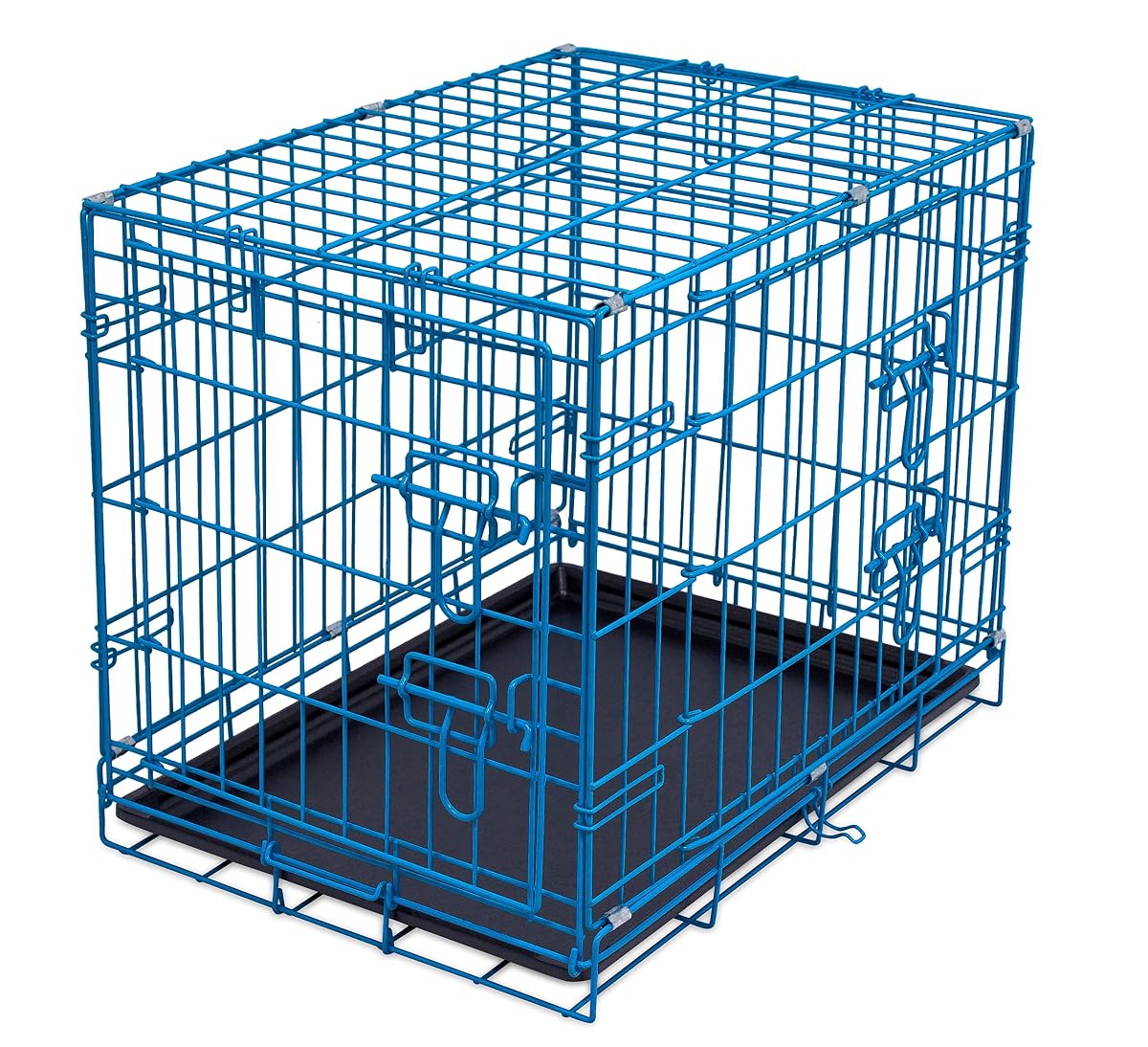
Each comes with a divider panel and a leak-proof pan.




Buying for a puppy? Size for the grown dog
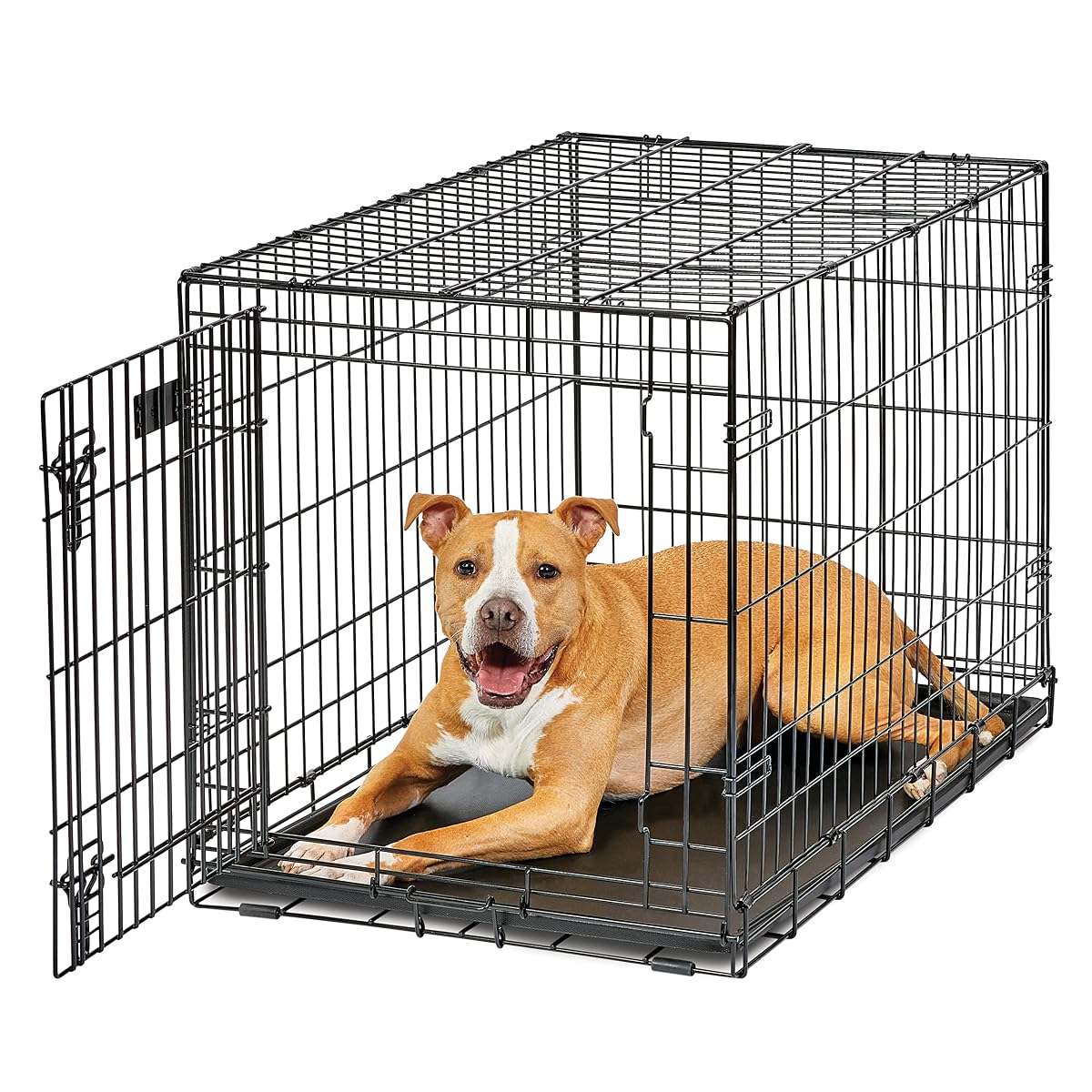
Buy the crate your puppy will need as an adult, then shrink it with a divider panel: a wire wall that hooks inside. Set it so your puppy can just stand, turn and lie down. With lots of spare floor, a puppy may use the far end as a bathroom, which makes house training messier. Slide the panel back as they grow, and you buy one crate instead of three.
Each crate in the first grid above comes with a divider. Spare panels are made for specific crate models, so match your crate's model number first.
A crate with a divider, plus spare panels
Spare panels fit named crate models; check yours first.


For a puppy who will grow into a large dog
A 42-inch double door wire crate with a divider panel that moves back as your puppy grows.
- Two doors, so you can turn it to suit the room
- Leak-proof plastic pan for easy clean-up
- Rubber feet to protect floors, rounded side clips, and it folds flat
Wire, steel, wood or fabric: choosing a crate type
Size comes first, then style.
| Crate type | What it is | Best for | Think about |
|---|---|---|---|
| Folding wire | Coated wire that folds flat, slide-out pan, often a divider | Puppies, home training, airflow | Add a cover for a cozier den |
| Heavy steel | Thick steel frame and bars, slide-out tray, often on wheels | Big, strong dogs who push at doors | Heavy; needs assembling |
| Furniture style | Wood cabinet with wire panels, top works as a table | Living rooms, calm adult dogs | Wood can be chewed |
| Covered wire kit | Wire crate with a fitted fabric cover | Dogs who settle with walls around them | Keep the front open for air |
| Soft-sided | Fabric and mesh over a frame that pops up | Trips with a crate-trained dog | Not for chewers or alone time |
Other crate styles
A crate that doubles as a side table, a covered wire kit and a soft travel crate.


For a living room that wants furniture, not a cage
A wooden crate for small to medium dogs that reads as an end table. The sliding door saves floor space, and the top lifts off to make an open playpen.
- Top holds pet essentials up to 11 lb
- Check your dog's sitting height against the inside, not the outside
Crate features worth checking
- Two doors: a front and a side door let you turn the crate to suit the room.
- Secure latches: slide bolts with a locking tip and a guard against clever paws; some crates lock at five points.
- A slide-out pan: a leak-proof tray that pulls out for cleaning.
- Rubber feet: they keep wire off wood floors.
- A floor grid or metal pan: a grid lifts paws above spills, and a galvanized steel tray replaces a chewed plastic pan.
Small two door crates, grids and pans
Spare pans and grids are made to a crate's length.



Choosing a crate bed or crate pad that fits
A crate bed should cover the floor edge to edge so nothing bunches. Buy it by crate length: a 36-inch bed for a 36-inch crate. For firmer beds, see what makes a dog bed orthopedic, or browse all dog beds.
| Bed type | How it feels | Best for |
|---|---|---|
| Fleece bolster bed | Soft synthetic sheepskin with a padded rim | Dogs who like a pillow edge |
| Plush crate pad | Thick fluffy plush, anti-slip base | Dogs who dig and nest |
| Egg-crate foam bed | Contoured foam under a removable plush cover | Dogs who like a firmer bed |
| Waterproof foam pad | High-density foam, waterproof lining, reversible cover | Drool and the odd accident |
| Thin reversible mat | Flannel one side, fleece the other | Puppies, carriers and the car |
Bolster beds sized to crates
18, 24, 30, 36 and 42 inches, to match standard crate lengths.


Crate pads: plush, foam and fleece
Each is machine washable or has a cover that comes off.


The bed that matches a 36-inch crate
A fleece bolster bed cut to the floor of a standard 36-inch crate, with a rim to rest a chin on.
- Elastic corner straps hold it to the pan
- Printed for dogs of about 41 to 70 lb
- Machine washable; not meant for heavy chewers
Setting up the crate so your dog likes it
- Put it in a calm spot near where the family spends time, away from heater vents, drafts and strong sun.
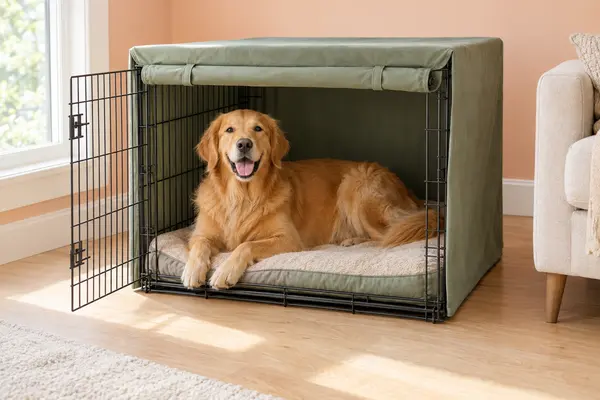
- Add a fitted bed, and a light cover over the top and three sides if your dog likes walls around them.
- Take off collars, tags and leashes first, so nothing catches on the wire.
- Introduce it gently: door open, treats near the crate, then just inside, then at the back.
- Offer a stuffed chew toy or a lick mat for quiet time, and stay close with any new toy.
- Keep it kind: a resting place, never a punishment.
For the puppy months, a pen beside the crate makes a safe play zone, with a washable pad in its far corner. Find more training supplies for the early weeks.
For the puppy months
A reusable pad for a pen corner and a tall exercise pen with a door.


How long can a dog stay in a crate? The 2:1 rule
Crate time means short stretches of rest, not the whole day. As a general guide, Humane World for Animals says puppies under 6 months should not stay in a crate for more than three or four hours at a time, and adult dogs should not be left crated for more than four to five hours during the day. Your own dog's limits depend on age, exercise and temperament, so ask your vet or a certified trainer.
Some puppy trainers follow the 2:1 rule: about one hour of awake, supervised time (potty, a meal, a short game), then about two hours of calm rest in the crate. It gives a puppy a predictable day with naps built in. Treat it as a rhythm, not a timer, and let your puppy out whenever they wake and ask.
For a workday, use an exercise pen: bed at one end, water and toys in the middle, a pad at the far end, with the crate inside and its door open. A game from our puzzle toys by level guide keeps that time busy.
For long days: a pen around the crate
Eight tall wire panels with a double-latch door, for indoors or the yard.
- 48-inch panels for dogs who can hop a lower pen
- Folds flat when not in use
A crate your dog loves also makes a quiet room on noisy nights. Our Halloween guide has more ideas for a calm night.
Once the size is right, our explainer should you cover a dog crate covers when a cover helps, airflow and crate furniture as an alternative.
Questions people ask
What is the ideal crate size for a dog?
One where your dog can stand without ducking, turn around easily and lie flat with legs stretched out. Measure nose to tail base and floor to head top while sitting, add a few inches to each, and choose the crate that clears both. Use a divider if it is roomy for now.
What does the 2:1 rule for crate training mean?
It is a puppy routine some trainers use: about one hour of awake, supervised time, then about two hours of calm rest in the crate. Treat it as a rhythm, and let your puppy out whenever they need a potty break.
What's the longest a dog should be left in a crate?
No single number suits every dog. As a general guide, Humane World for Animals says puppies under 6 months should not stay in a crate for more than three or four hours at a time, and adult dogs no more than four to five hours during the day. For longer days, use an exercise pen or a midday visit, and ask your vet or a certified trainer.
What size dog fits in a 36-inch crate?
The 36-inch bed in this guide is printed for dogs of about 41 to 70 pounds, and the 36-inch crate is sold for intermediate breeds. Shape matters more than weight: your dog's length plus a few inches should fit within 36 inches, and sitting height plus a few inches within the crate's height of about 25 inches.
Should you put a bed or blanket in a dog crate?
For most dogs, yes: a fitted, washable bed makes the crate far more inviting. Choose one sized to the crate's length so it lies flat. If your dog chews bedding, start with a thin mat or a bare pan and remove anything being chewed.
About the numbers
- Humane World for Animals, crate training guidance, read 2026-10-06: A crate should be large enough for a dog to stand up and turn around in; introduce it with treats and the door open; puppies under 6 months no more than three or four hours at a time, adult dogs no more than 4-5 hours during the day; never use the crate as punishment.
- Find Your Balance Dog Training, "Puppies: The 2:1 rule", read 2026-10-06: Describes one hour of structured, supervised time out of the crate followed by two hours of rest in the crate for puppies.