Dog Puzzle Toys by Level: From First Puzzle to Expert Games
Start most dogs on a Level 1 puzzle with one move per treat, then step up only when they solve it quickly and calmly. Here is what each level asks and which toys fit.
In short
- Start most dogs on a Level 1 puzzle that asks for one simple move per treat, such as lifting a peg or nudging a lid.
- Puzzle levels count the steps: Level 2 mixes one-step and two-step moves, Level 3 adds a sequence, and Level 4 stacks several sequences on one board.
- Move up a level when your dog solves the current puzzle quickly, calmly and without help; step back if they chew pieces or walk away.
- Puzzle toys are for supervised play: pick them up when the treats are gone and replace any piece that is cracked or chewed.
- Plush hide-and-seek puzzles suit dogs who search rather than shred; if yours unstuffs toys, choose a hard board instead.
The right dog puzzle toy is one your dog can solve with a little effort and a lot of wagging. Start most dogs on a Level 1 puzzle with one simple move per treat, such as lifting a peg, and step up only when they finish it quickly and calmly. Here is what each level asks, with real examples, plus the rolling and plush puzzles that sit beside the boards.
How dog puzzle levels work
Many puzzle makers grade their toys by level, often on a four-step scale: Level 1 Beginner, Level 2 Intermediate, Level 3 Advanced and Level 4 Expert. The level roughly counts the steps between your dog and each treat. A Level 1 board asks for one move per treat. Level 2 mixes one-step and two-step moves on the same board. Level 3 adds a sequence, where one move unlocks the next. Level 4 stacks several sequences and many compartments into one game.
| Level | What your dog does | Typical parts | Ready for it when |
|---|---|---|---|
| Level 1 Beginner | One move per treat: lift, nudge or tip | Lift-off pegs, bone-shaped lids, tipping cups | Your dog is new to puzzles, or a puppy |
| Level 2 Intermediate | One-step and two-step moves on one board | Sliders plus lids, flaps, cones or moving paddles | Level 1 is solved fast, with no hints from you |
| Level 3 Advanced | A sequence: unlock first, then open | Twist locks, drawers, pull-out trays, rows of sliders | Level 2 is solved calmly, with no chewing of parts |
| Level 4 Expert | Several sequences in one game | Levers, drawers, sliders and turning discs together | Level 3 boards have started to feel routine |
Level 1: the first puzzle
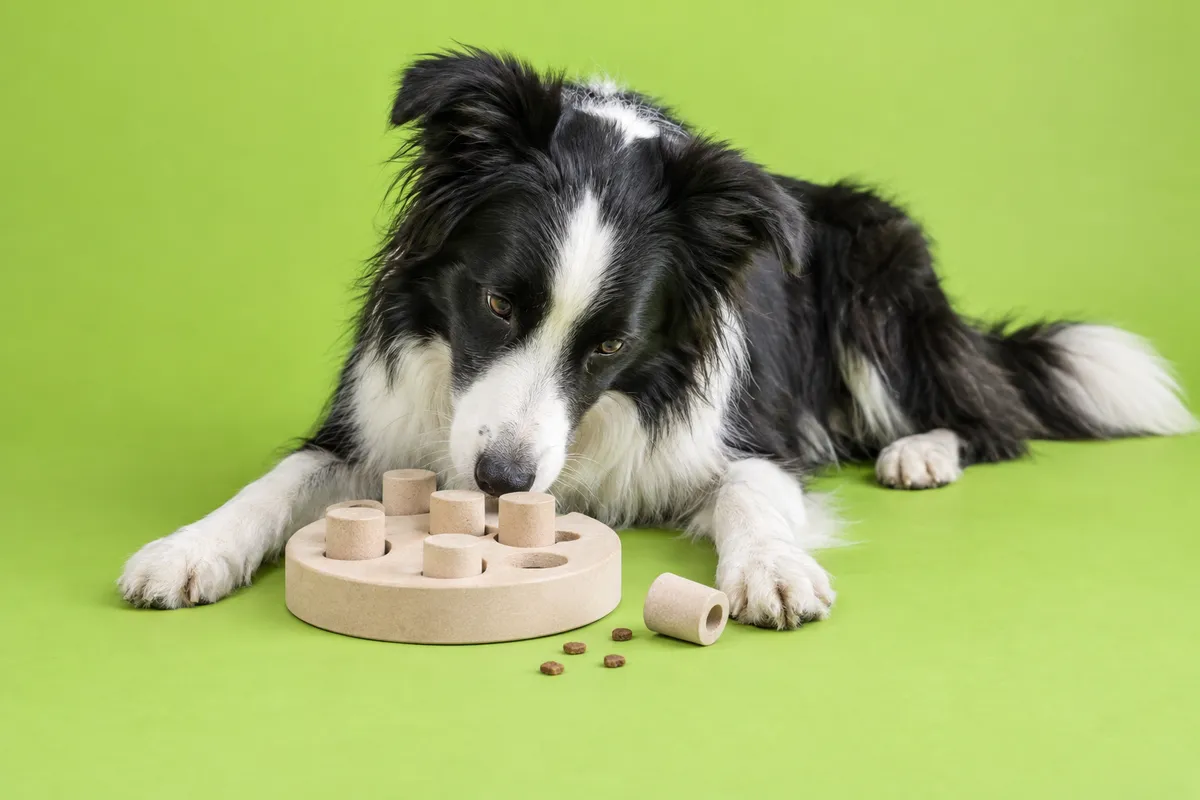
A good first puzzle has wide pieces a nose can tip easily, shallow wells and a base that stays put. Look for nonslip feet or suction cups, because a board that skids away makes the game frustrating. Pieces should be too big to swallow and smooth enough that there is nothing tempting to chew.
Below: a round composite board ringed with lift-off pegs, a puppy version with bone-shaped lids, an oversized paw-shaped board whose covers slide and lift (with a Level 2 track built in, so it grows with your dog), and a small-dog set of tipping beakers on a tray held down by suction cups. More boards turn up in a search for level 1 puzzles.
Level 1 puzzles for first-timers and puppies
One simple move per treat: lift, nudge or tip.


Level 2: one-step and two-step moves
Level 2 asks a dog to notice that not every piece works the same way. One board mixes flip-top lids, sliders and lift-out bone covers. A four-box set opens four different ways, with lids, flaps, knobs, ropes and drawers, and measures 12 x 12 x 4 inches.
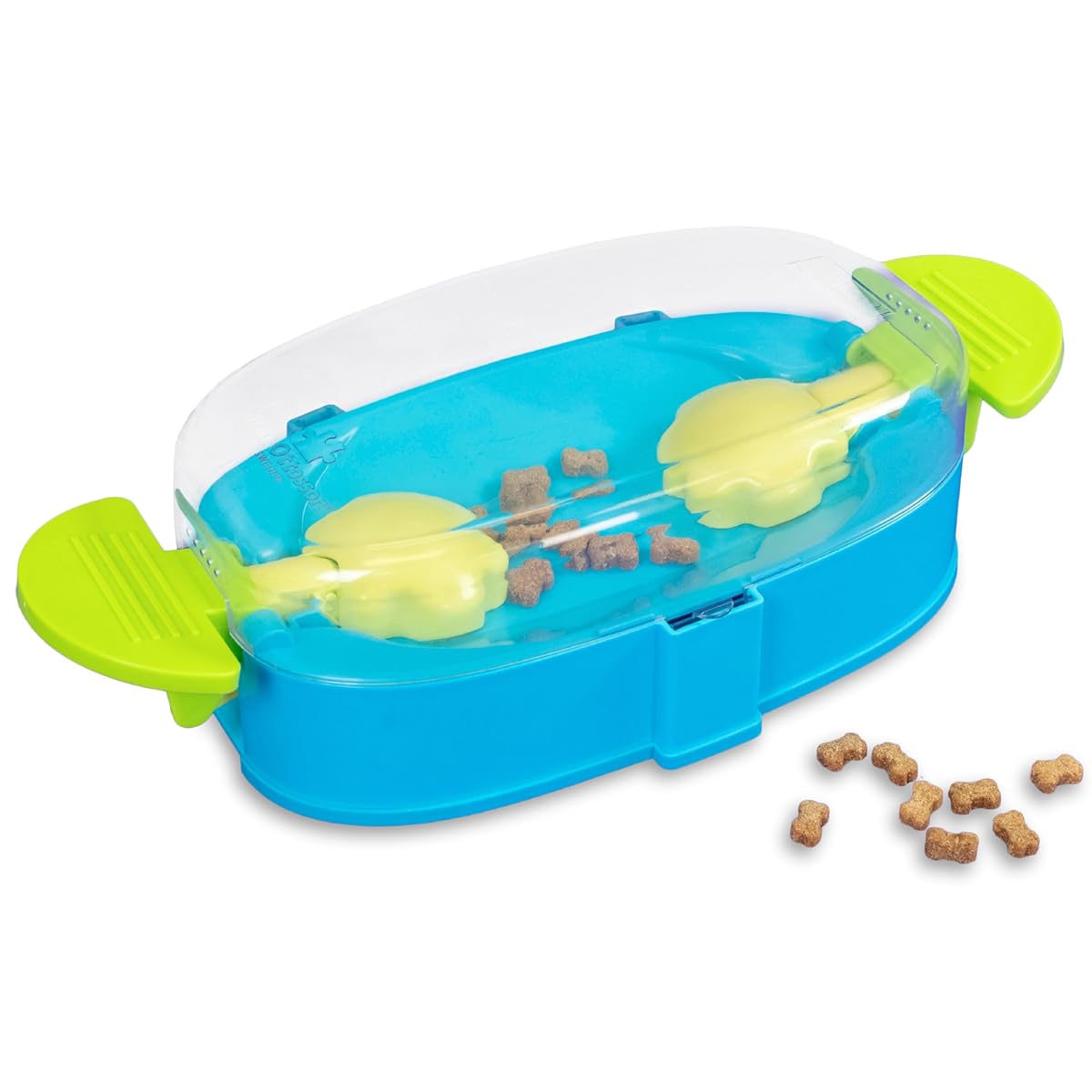
Other good next steps: a round board with cones to lift, flaps to flip and covers to slide; a board where blocks slide and flippers swivel; a feeder where pressing the handles moves paws inside and lets food out a little at a time; a maze your dog tips and nudges until the treats find their way out; and a tower where a tug on a loop tips treats from shelf to shelf, with cones to lift in its base.
Level 2 puzzles that mix moves
Sliding plus lifting, or a part that moves.




Level 3: puzzles with a sequence
At Level 3, order matters: your dog has to do one thing before another becomes possible. Expect a few head tilts, and show the first move yourself the first few times.

The six-drawer step up
A turquoise board with six treat drawers, each held shut by a bone lock. The bone has to be twisted before the drawer can be pawed or nudged open, which teaches the idea of a sequence in a clear, repeatable way.
- Six treat drawers
- A twist lock on every drawer adds the first step
- Load the drawers, slide them in and twist the bones to set it
More sequence puzzles: a slider board with a pull-out tray of 24 compartments that holds up to 1 cup of food; a board where flippers, sliding blocks and a spinning wheel have to be worked in order; a four-game board with cones that lift straight up, sliders, a knob to move and a drawer with a rope pull; an activity game that releases kibble when your dog drops its ball into the opening; and a wooden board spelling MICE, where wooden cylinders tip over before the orange sliders will move.
More Level 3 puzzles
One move unlocks the next.


Level 4: expert games
Level 4 is for dogs who have truly mastered Level 3 and still look at you for more. These boards combine levers, drawers, sliders and turning parts, often with treats hidden in layers so one move reveals the next hiding place.

For the dog who has solved everything
An orange tower of stacked layers with levers to flip, a wheel to spin, doors to slide and drawers to unlock, in a set order. Treats sit at different heights, so your dog has to work out which part moves what. Start with every layer unlocked, then lock more as your dog learns, and save it for a dog who already finishes Level 3 boards with ease.
- Levers, a wheel, sliding doors and locking drawers
- Treats hidden at more than one height
- Graded Level 4 Expert by its maker
Two more for the top of the ladder: an expert board where tiles slide, sliders move and a wheel spins, in order, and an advanced press-to-dispense puzzle with four levels in one. Its central container holds up to 16.6 oz of kibble or treats and lets it out through six adjustable openings, so you can make it harder as your dog learns.
Expert and advanced puzzles
Several puzzles in one board.


Puzzles that move: treat balls and rollers
Not every puzzle sits still. Rolling and bouncing toys make your dog push, paw and chase to earn each piece. They suit dogs who love to nose things across the floor, and a rug slows the roll.
Choose by how the toy lets food out. A ball with an adjustable inner disc lets you set the opening wider or narrower. A maze ball comes with a treat ball and a tennis ball, so it is three games in one. A spinning center inside a fixed outer ring tips treats out as it rolls. A bouncy stuffable ball and the classic stuffable rubber toy hold soft fillings or kibble, and the story of that red rubber toy is a fun read. Browse the balls shelf when your dog is ready for a moving challenge.
Rolling treat puzzles
Each one lets food out a different way.


Plush hide-and-seek puzzles
Plush puzzles turn searching into a game. A soft stump, tree or acorn hides several squeaky critters, and your dog pulls each one out by nose or mouth. Other plush puzzles hide a small treat ball inside a soft fish, or tuck treats into braids and snuffle layers.

The classic plush hide-and-seek
A soft plush tree trunk with squeaky squirrels that tuck into its holes. Your dog noses and pulls them out, then you hide them again. This small size is made for puppies and small dogs, and it is a search toy, not one for heavy chewers.
- Soft polyester plush with squeaky squirrels
- Small size for puppies and small breeds
- For supervised play; check it for damage after each session
Plush is for dogs who search, not dogs who shred. If yours unstuffs toys, choose a hard board instead, and check that each hidden piece is too big to swallow. More on the plush toys shelf.
More plush puzzles
Hide-and-seek for nose-first dogs.


When to move up a level, and when to step back
- Move up when your dog solves the puzzle quickly, calmly and without your help several times in a row.
- Stay put if your dog still needs a hint or loses interest halfway.
- Step back a level if your dog chews or flips the board, barks at it or walks away.
- Make any board easier by leaving lids off or using smellier treats; make it harder by filling only the trickiest compartments.
- Rotate two or three puzzles across the week, so each one still feels new.
Whichever level you start on, the best sign is a busy nose and a wagging tail. Browse all dog puzzle toys and add one new game at a time.
Questions people ask
How often should dogs play with puzzle toys?
Short, regular sessions work well for most dogs, once a day or a few times a week, ending while your dog is still keen. Rotating two or three puzzles keeps each one fresh. If you fill puzzles with kibble, take it from the day's portion, and ask your vet how much your dog should eat.
Do puzzle toys tire out dogs?
Sniffing and problem solving take real focus, so a puzzle can be a satisfying part of a busy dog's day. Think of it as a partner to walks and play, not a replacement for them. Every dog is different, so ask your vet how much activity suits yours.
What is the most stimulating activity for dogs?
There is no single answer, but many dogs love games that use the nose: treat puzzles, hide-and-seek with plush toys, scatter games and sniffy walks. Pairing a puzzle with a short training game or a round of fetch gives both the brain and the legs something to do.
What types of toys should be avoided for dogs?
Skip anything small enough to swallow, toys with parts that come loose, and plush for dogs who shred it. Puzzle boards are for supervised play, so take them away once the treats are gone and replace any piece that is cracked or chewed. Check each toy's label for size guidance.
Which puzzle level should a puppy start on?
Start a puppy on Level 1. Several boards come in puppy versions with easy lids, and a simple plush hide-and-seek toy makes a gentle first search game. Stay close and keep sessions short.
About the numbers
- Google Trends, United States, past 90 days, read 2026-10-06: Term: dog puzzle toy. Top related searches: puzzle toy for dog, dog puzzle toys.
- The puzzle maker's own guide to its four difficulty levels, read 2026-10-06: Level 1 is a simple one-step action; Level 2 combines one- and two-step actions; Level 3 needs a series of steps made in sequence; Level 4 Expert is for dogs who have mastered Levels 1 to 3.