Snuffle Mat vs Lick Mat: How Each One Keeps a Dog Busy
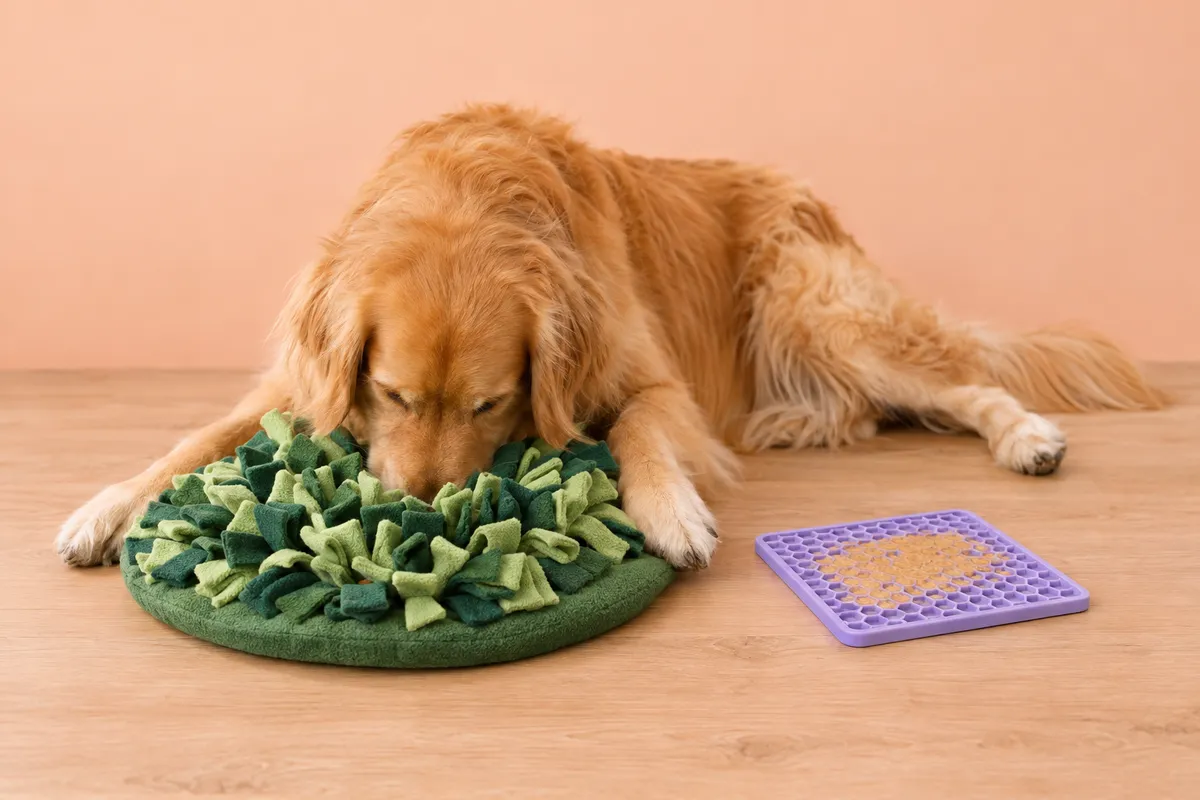
A snuffle mat hides dry kibble in fabric so your dog hunts with its nose; a lick mat holds soft food in a textured pad so your dog licks it out slowly. Pick by the food and the moment.
In short
- Snuffle mats turn dry food into a sniffing search; lick mats turn soft food into a slow licking job.
- Choose a snuffle mat for dry food and curious dogs at mealtime, and a lick mat for wet food and moments when a dog must stay put, like baths and nail trims.
- Match the size to the dog: fleece mats around 40 by 27.5 inches suit big breeds, while 16-inch squares and small silicone pads suit small dogs and cats.
- A stainless steel lick mat suits a dog that bites silicone, and a silicone snuffle mat with soft flaps takes both dry and wet food.
- Either mat is a supervised game: introduce it gently, stay close, and put it away once the food is gone.
A snuffle mat hides dry kibble in fabric strips so your dog hunts for it with its nose. A lick mat holds soft food in a textured surface so your dog works it out with its tongue. The snuffle mat suits a curious dog at mealtime; the lick mat suits quiet moments when a dog needs to stay in one spot, like a bath or a nail trim. Here is how each works and which mats fit which dogs.
Snuffle mat vs lick mat at a glance
It comes down to the food and the moment. Dry food rolls, so it belongs in the folds of a snuffle mat. Wet food clings, so it belongs in the grooves of a lick mat.
| Snuffle mat | Lick mat | |
|---|---|---|
| How the dog works | Sniffs, nudges and paws through strips or flaps | Licks soft food out of grooves, ridges and nubs |
| Food it suits | Dry kibble, small crunchy treats | Wet food, soft treats, a thin dog-safe spread |
| Feel of the game | Busy, lots of nose and paw movement | Slow and steady, usually lying down |
| Materials | Polar fleece, felt, silicone flaps | Silicone, TPE, natural rubber, stainless steel |
| Cleaning | Shake out, wash as the label says, air dry | Rinse, brush the grooves, dishwasher where the label allows |
| Best moments | Mealtime, rainy days | Baths, nail trims, brushing, crate time |
| Watch for | Dogs that chew fabric | Dogs that bite soft edges |
How a snuffle mat works
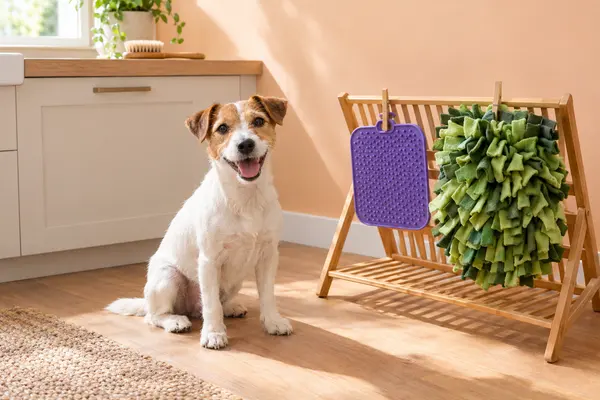
A snuffle mat is a fabric base with rows of polar fleece or felt strips tied through it. Scatter kibble over the top, ruffle the strips so pieces drop between them, and set it down. Your dog sniffs and paws through to find each piece. Tulip rows, flower rosettes, carrot pockets and plush mushrooms add more hiding places, so you can make the game easier or harder.
Size matters more than pattern. A big dog needs room to stand over the mat, while a small dog or a cat does better on a square it can reach across. Browse every snuffle mat we carry, or start here.
Fleece and felt snuffle mats, small to extra large
From a 16-inch square for small dogs to a 40 by 27.5-inch field for big breeds.


The snuffle mat that packs away
A round mat of grass-green felt strips, about 19 inches across, with a drawstring around its edge. Pull it partway and it becomes a deeper bowl that keeps kibble from scattering; pull it closed and it is a pouch for the car.
- About 19 inches across laid flat, smaller as a bowl or a pouch
- Strips all over, so food can hide anywhere
- For dogs and cats
How a lick mat works
A lick mat is a flat pad covered in texture: honeycomb cells, ridges, nubs, grooves and little wells. Spread soft food thinly with a spatula, press it into the texture, and your dog licks it out bit by bit. A thin layer is hard to gulp, so it lasts longer than the same food in a bowl.
Material decides where you use it. Food-grade silicone is soft and freezer friendly, and suction cups hold it to a tub wall, a tiled floor or a crate tray. Pads also come in TPE and natural rubber. Stainless steel suits a dog that bites the edge of a silicone mat, and it does not hold on to smells. For a longer session, freeze the spread mat flat for a few hours; the small silicone pair below is rated from minus 40 to 446 degrees Fahrenheit. See all our lick mats with suction cups.
Lick mats in silicone, rubber, TPE and steel
Suction-cup pads for bath time, puzzle pieces that join together and a double-wall steel mat for keen chewers.


For bath time and crate time
A large stainless steel lick mat with 46 suction cups underneath, so it holds to a shower wall, the floor or a crate tray. Its three wells are pressed with bone shapes and raised patterns, and a silicone spatula comes with it.
- Steel stands up to eager teeth
- Mounts at nose height for bathing and grooming
- Three wells for different foods
Which one suits your dog?
Pick by your dog's food and the job you need done, or keep one of each for different moments.
- Dry kibble, emptied in seconds: a snuffle mat turns the bowl into a search.
- A bath, a nail trim or brushing: a lick mat with suction cups on the tub wall or floor.
- A digger who paws at everything: a snuffle mat with pockets and plush pieces.
- A chewer: a stainless steel lick mat, or any mat you supervise closely.
- A small dog or a cat: a 16-inch snuffle square or a small silicone lick pad.
- One mat for everything: a silicone snuffle mat with soft flaps.
When you want both in one
Silicone snuffle mats sit between the two. Instead of fleece strips they have rows of soft silicone flaps: drop kibble between them for sniffing, or smear wet food over the tops for licking. They rinse clean, so messy foods never soak in.

A snuffle mat that doubles as a lick mat
A square purple silicone mat with rows of soft square flaps. Dry kibble drops into the gaps; wet food or a spread smears across the tops. It goes in the dishwasher.
- Dry or wet food on one mat
- Sized for small to large dogs
Prefer separate zones? Try a four-part silicone tray with a water bowl, a lick area, a snuffle area and a food bowl; a two-in-one silicone pad with two bowls, wavy ridges and a textured lick patch; or a fleece garden mat with carrot pockets that comes with its own square lick mat.
Trays and sets that do both
Separate zones for kibble, soft food and water.


Beyond the mat: plush puzzles and rabbit foraging
Plush puzzles hide food under parts your dog has to move: a pink pig whose plush legs fold over its snuffle center, an ice cream cart with eight removable squeaky scoops, and a sunflower mat with a stuffing-free plush squirrel and acorn pockets for kibble. There is more in squeaky toys and chew toys.
Rabbits forage too. A rabbit foraging mat about 11.8 inches square, with fleece lettuce leaves and carrots, takes a few pieces of their usual food and goes in the washing machine afterwards.
Plush puzzles and a mat for rabbits
Squeakers, pockets and pieces to move aside.


Cleaning, safety and putting it away
- Shake fabric mats out after each game, wash them as the care label says (some are hand wash only), and let them air dry.
- Rinse silicone and rubber in warm water, brush the grooves, and use the dishwasher only where the label says so.
- Check strips and edges for chew marks before each game, and retire a mat that is coming apart.
- Introduce a new mat gently with a few easy pieces, stay close, and put it away when the food is gone.
- Count the food on the mat as part of the day's meals, and ask your vet about anything to do with diet.
Lick mats earn their place on noisy nights: on Halloween, a frozen one in a quiet room gives a dog something to do while the doorbell rings. Our guide to a calm Halloween night at home covers the rest. Both kinds of mat live with our bowls and feeders.
Questions people ask
Are snuffle mats actually good for dogs?
For most dogs a snuffle mat is a simple, satisfying game: it lets them use their nose to find food and turns a quick bowl of kibble into a search. It is a toy, not a treatment. Supervise each game and put the mat away if your dog starts chewing the strips.
Are lick mats actually good for dogs?
A lick mat gives a dog a slow, steady job with soft food, and it is most useful when a dog needs to stay put, like during a bath. Spread food your dog already eats thinly, and count it as part of the day's meals. If your dog bites silicone, choose stainless steel.
Do vets recommend snuffle mats and lick mats?
We cannot speak for vets, and we have no vet's endorsement to quote for any of these mats. Your own vet knows your dog, so ask at your next visit, especially for a young puppy, a dog on a special diet or one that swallows fabric, and mention what you plan to spread on a lick mat. If you use peanut butter, check the label and choose one without xylitol.
Can cats use a snuffle mat or a lick mat?
Yes, several of these mats are sized for cats as well as dogs. A 16-inch snuffle square or a small silicone lick pad with a little of their usual wet food is a good start. Introduce it gently and stay close at first.
Can you put a lick mat in the freezer?
Many silicone and rubber lick mats can go in the freezer, and a frozen layer of food makes the licking last longer. Spread it, lay it flat for a few hours, then serve. Check each mat's label for its temperature range first.
About the numbers
- U.S. Food and Drug Administration, Paws Off Xylitol; It's Dangerous for Dogs, read 2026-10-06: Xylitol can have devastating effects on a dog; it is found in some peanut and nut butters; check the label for xylitol in the ingredients.