What Size Aquarium Heater Do You Need? Watts per Gallon Guide
Start with 3 to 5 watts per gallon: about 25 watts for a 5 gallon tank, 50 for 10, 100 for 20 and 200 to 300 for 55. Go higher in a cool room.
In short
- Most tropical tanks need 3 to 5 watts of heater per gallon of water, with the higher end for small tanks and cool rooms.
- A 5 gallon tank suits a 25 watt heater, a 10 gallon tank about 50 watts, a 20 gallon tank 75 to 100 watts and a 29 gallon tank 100 to 150 watts.
- A 40 gallon tank suits 150 to 200 watts, and a 55 gallon tank 200 to 300 watts, often split between two heaters.
- The colder the room compared with the water you want, the more watts you need, so size the heater for the coldest night of the year.
- Always check the water with a separate thermometer and unplug the heater before every water change.
What size aquarium heater do you need? For most tropical tanks, plan on 3 to 5 watts per gallon of water. An aquarium heater is a sealed heating element with a thermostat that switches on and off to hold the water at a set temperature. Small tanks and cool rooms sit at the top of that range; large tanks in warm rooms sit at the bottom.
Hello, lovely fishkeeper. If you are setting up your first tank, our freshwater community aquarium starter checklist covers everything else that goes in. This guide stays on one question: how many watts, and which kind of heater.
How many watts per gallon does an aquarium heater need?
Use 3 to 5 watts per gallon as your starting point. One widely read hobby guide puts it simply: 5 watts per gallon for tanks of 55 gallons or smaller, and 3 watts per gallon above 60 gallons. Big tanks need fewer watts per gallon because a large body of water holds its warmth longer and loses heat more slowly for its size.
Why a range and not one number? A heater only has to make up the difference between the room and the water. Keep a tank warm in a room that stays cozy all year and a small heater cruises along. Put the same tank beside a drafty window in January and that heater runs nonstop and still falls behind.
What size heater for a 5, 10, 20, 29, 40 or 55 gallon tank?
Find your tank in the table, then read across to your room. The figures come from the 3 to 5 watts per gallon rule, rounded to the sizes heaters are actually made in.
| Tank size | Warm room | Average room | Cool room or drafty spot |
|---|---|---|---|
| Betta tank, 2.5 to 3 gallons | 10 watts | 10 to 15 watts | 15 to 25 watts |
| 5 gallons | 15 watts | 25 watts | 25 watts |
| 10 gallons | 25 to 30 watts | 50 watts | 50 watts |
| 20 gallons | 75 watts | 100 watts | 100 watts, or two 50s |
| 29 gallons | 100 watts | 150 watts | 150 watts, or two 75s |
| 40 gallons | 150 watts | 200 watts | two 100s |
| 55 gallons | 200 watts | 250 to 300 watts | two 150s |
Count your real water, not the number on the box. Gravel, rocks and driftwood take up space, so a tank sold as 29 gallons may hold a few gallons less once it is decorated. When you land between two sizes, rounding up is fine: the thermostat simply switches off sooner.
Heaters for 5 to 15 gallon tanks
Compact submersible heaters in the 25 to 50 watt range.


What size heater does a betta tank need?
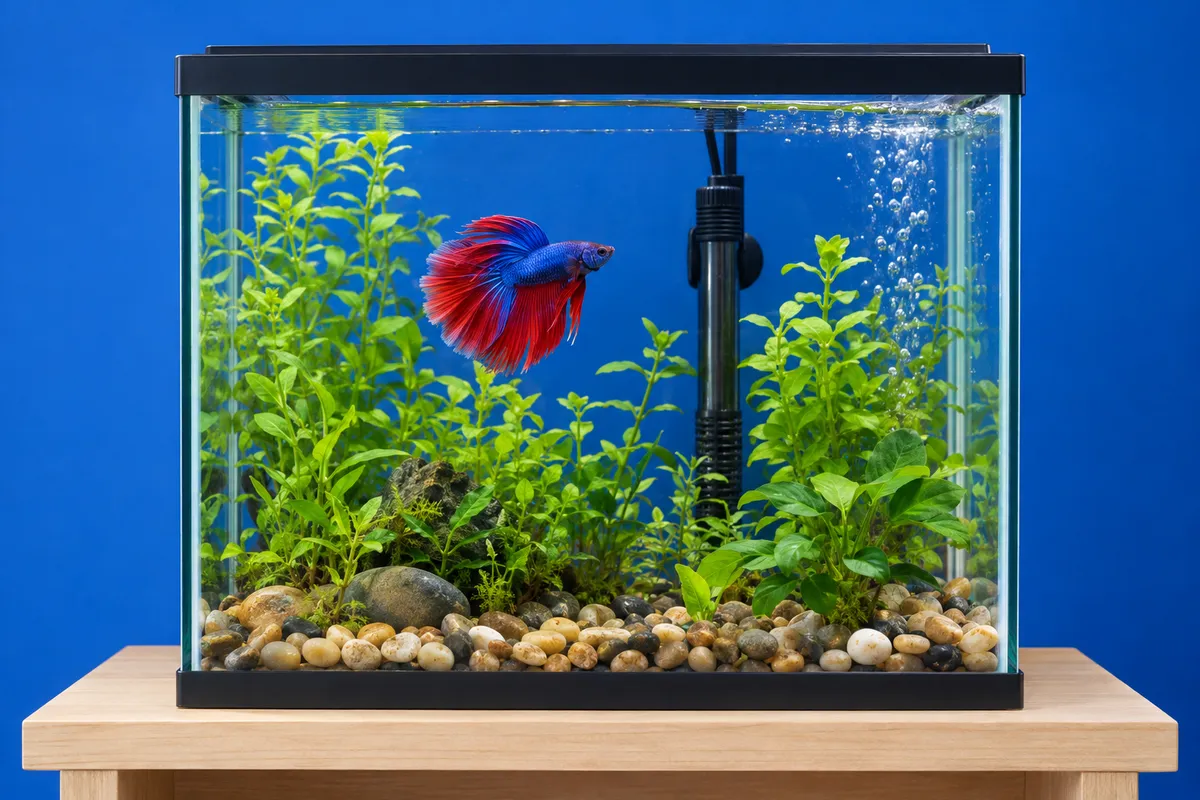
Most betta tanks of 2.5 to 5 gallons do well with a 10 to 25 watt heater. Bettas are tropical fish, so steady warm water is part of their everyday care; check a care sheet for the range your fish likes. Our guide on how to set up a betta fish tank walks through the rest of the setup.
The tiniest heaters, some only a few watts, are made for bowls and nano tanks of a gallon or two. They are slim enough to hide behind a plant. In a tank of 5 gallons or more, step up to 25 watts so the heater is not working flat out every evening.
Betta and nano heaters
Slim heaters sized for tanks of about 1 to 6 gallons.


How does room temperature change the heater size?
Size the heater for the coldest your room ever gets, not for today. Work out the gap: the temperature you want in the tank minus the lowest temperature the room reaches. A gap of a few degrees needs the bottom of the range; a gap of ten degrees or more needs the top of it, or a second heater.
- Warm living spaces that stay comfortable all year: the low end of the range is usually plenty.
- Basements, garages and rooms where the heat goes down at night: use the top of the range.
- Outside walls, windows and doorways: drafts pull warmth from the glass, so go up a size or add a second heater.
- Tanks without a lid: an open top lets warmth escape with the evaporating water, so a lid helps any heater keep up.
Check the tank on a cold morning after you set it up. If the water has dropped below your setting overnight while the heater light stayed on, the heater is too small for that spot.
Should you choose an adjustable or a preset heater?
Choose adjustable if you want control; choose preset if you want simple. A preset heater holds one fixed temperature, often around 78 degrees Fahrenheit on small models, and has no dial to knock. An adjustable heater lets you pick the temperature, by a dial on the heater or by an external controller with a digital display.
| Type | How you set it | Good to know | Suits |
|---|---|---|---|
| Preset | Nothing to set | One temperature only; check that it matches your fish | Betta and nano tanks, first tanks |
| Adjustable dial | Turn a knob on the heater | The dial marks are a guide; confirm with a thermometer | Most community tanks |
| External controller | Buttons and a display outside the tank | Easy to read and change without wet hands | Larger tanks, keepers who like to see the numbers |
Heaters with a display you can read
Adjustable heaters whose controller sits outside the water.


Glass, shatterproof or titanium: which heater body is best?
Glass is the classic, shatterproof plastic is the safest around active fish, and titanium is the toughest for big tanks. Quartz glass heaters are slim, clear and widely available, but a sudden temperature shock or a knock from a rock can crack them. Shatterproof heaters wrap the element in a tough plastic body. Titanium tubes pair with an external controller and shrug off bumps from large, boisterous fish.
- Glass: slim and easy to hide; handle gently and never move it from cold air straight into warm water while it is on.
- Shatterproof plastic: a good pick for tanks with digging or large fish, and for homes with curious little hands nearby.
- Titanium: very durable; the separate controller does the thinking, so place the probe where it reads the water well.
Heaters for 20 to 55 gallon tanks
Larger submersible heaters in glass, shatterproof and titanium bodies.


Is one heater or two better for a bigger tank?
For tanks of about 40 gallons and up, two smaller heaters are often better than one large one. Two heaters at opposite ends spread warmth more evenly along a long tank. If one fails, the other keeps the water from cooling quickly, and if one sticks on, a smaller heater takes longer to overheat the whole tank.
Split the watts you need in two. A 55 gallon tank that needs 300 watts can run two 150 watt heaters, one at each end. Set both to the same temperature and check them with a thermometer in the middle of the tank.
A steady pick for a 29 to 40 gallon tank
A 150 watt adjustable submersible heater in thermal shatter-resistant quartz glass, made for both freshwater and saltwater tanks.
- Fully submersible, so it can sit at an angle near the filter outflow
- Adjustable temperature for a range of fish
- Two of these suit a long 55 gallon tank
Where should you put an aquarium heater?
Put the heater where water moves past it, usually near the filter outflow or intake. Moving water carries warmth around the tank instead of leaving a warm pocket at one end. Our guide to aquarium filter types compared shows where each filter pushes its flow.
- Fix the heater to the back glass with its suction cups, near the flow and away from the thermometer.
- Mount it at an angle, if its instructions allow, so warm water rises along the whole length.
- Keep it clear of gravel and decor: a heater buried in substrate can overheat or misread the water.
- Check the water line: a fully submersible heater can sit anywhere under water, while one with a top cap must stay above its minimum water mark.
- Wait before plugging in, if your heater's instructions ask you to, so the glass can match the water temperature.
New to words like submersible, substrate or outflow? Our list of aquarium terms for beginners explains each one in a sentence.
Do you still need a thermometer if your heater has a display?
Yes. A separate thermometer is how you know the heater is doing its job. A heater's dial or display shows what it is set to or reading at one spot, and a heater that sticks on or off gives no warning on its own. A thermometer at the opposite end of the tank tells you what your fish actually feel.
Glance at it every day, at the same time, when you feed. Digital thermometers with a probe are easy to read from across the room; floating and standing glass ones are simple and need no batteries. Find more in our tanks and aquarium supplies.
Aquarium thermometers
Digital, floating and standing styles for a daily check.


How do you use an aquarium heater safely?
Unplug the heater before every water change and before you put your hands in the tank. A heater left running as the water level drops can heat up in the air and crack when the water comes back, and electrics and wet hands never mix.
- Unplug first, wait a little for the heater to cool, then lower the water.
- Plug back in only once the tank is full again.
- Give every cord a drip loop: a dip below the socket so water runs off the cord before it reaches the outlet.
- Use an outlet protected against ground faults where you can.
- Never run a heater outside water unless its instructions say it switches itself off when dry.
- Look over the heater at each cleaning for cracks, cloudy patches or water inside, and replace it if you see any.
Keep reading
Questions people ask
What size heater do I need for a 10 gallon tank?
A 50 watt heater suits most 10 gallon tanks in an average room. In a warm room a 25 to 30 watt heater can be enough. Check the heater's own tank rating and confirm the water with a thermometer.
Is a 50 watt heater too much for a 5 gallon tank?
It is more than a 5 gallon tank usually needs, which is about 25 watts. A thermostat will switch it off when the water reaches the set temperature, but a smaller heater is gentler if it ever sticks on. For a betta tank, 10 to 25 watts is the usual choice.
What size heater do I need for a 55 gallon tank?
Plan on 200 to 300 watts. Many keepers split that between two 150 watt heaters at opposite ends, which spreads warmth evenly and gives a backup if one stops working.
Can you have too big an aquarium heater?
A heater that is a size or two too big will still hold the set temperature, because its thermostat cuts out. The risk is what happens if the thermostat fails and the heater stays on: a very large heater warms a small tank much faster. Matching the watts to the tank keeps that risk smaller.
About the numbers
- Build Your Aquarium, "How to pick the right aquarium heater size", read 2026-11-01: rule of thumb of 5 watts per gallon for tanks of 55 gallons or smaller and 3 watts per gallon above 60 gallons; a larger or second heater for cold rooms, outside walls or doorways; heaters near the filter outflow; unplug during water changes
- Hobby heater sizing guides and calculators, read 2026-11-01: agree on a starting range of 3 to 5 watts per gallon, adjusted for room temperature and target temperature
- Google Keyword Planner, United States, 12-month average, read 2026-11-01: about 33,100 searches a month for betta fish heater, about 14,800 for aquarium heater (peak in December), about 6,600 for fish tank heater, about 1,900 for 10 gallon aquarium heater, about 1,600 each for 5 gallon aquarium heater and fish tank heater 20 gallon, about 1,300 for 50 watt aquarium heater
- Google autocomplete, United States, read 2026-11-01: people ask "what size aquarium heater do i need" and "how to size aquarium heater"