Aquarium Starter Checklist: Tank, Filter, Heater and Cycling
A community fish tank needs a roomy tank on a strong stand, a filter and heater sized to it, a light on a timer, conditioned water and a full cycle before the first fish.
In short
- For a first community tank, a bigger tank is easier: more water changes temperature and water quality more slowly, so small mistakes have time to be noticed.
- Water weighs about 8.34 pounds per US gallon, so a 20-gallon tank holds roughly 167 pounds of water before glass, gravel and rock; put it on a stand built for aquariums.
- Choose a filter and a heater rated for your tank's volume, add a separate thermometer, and run the light on a timer for a steady daily rhythm.
- Cycle the tank before adding fish: helpful bacteria turn ammonia into nitrite and then nitrate, and a new filter can take six to eight weeks to build up enough of them.
- Add fish a few at a time, test the water often in the first months, and keep a routine of partial water changes with a gravel vacuum and a bucket used only for the tank.
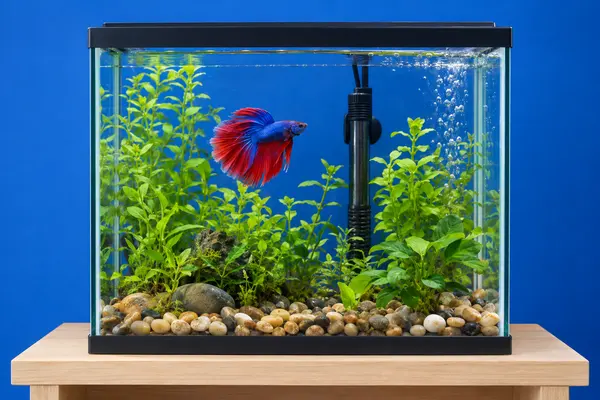
Hello, lovely. A tank full of little fish drifting between green plants is one of the calmest things a home can hold. This checklist is for a freshwater community aquarium, a tank where several peaceful species share one space. If you are planning a home for one betta, our betta tank setup guide is the place to start. Here we go bigger, step by step, from the floor up.
1. The tank: choose the biggest one you can care for
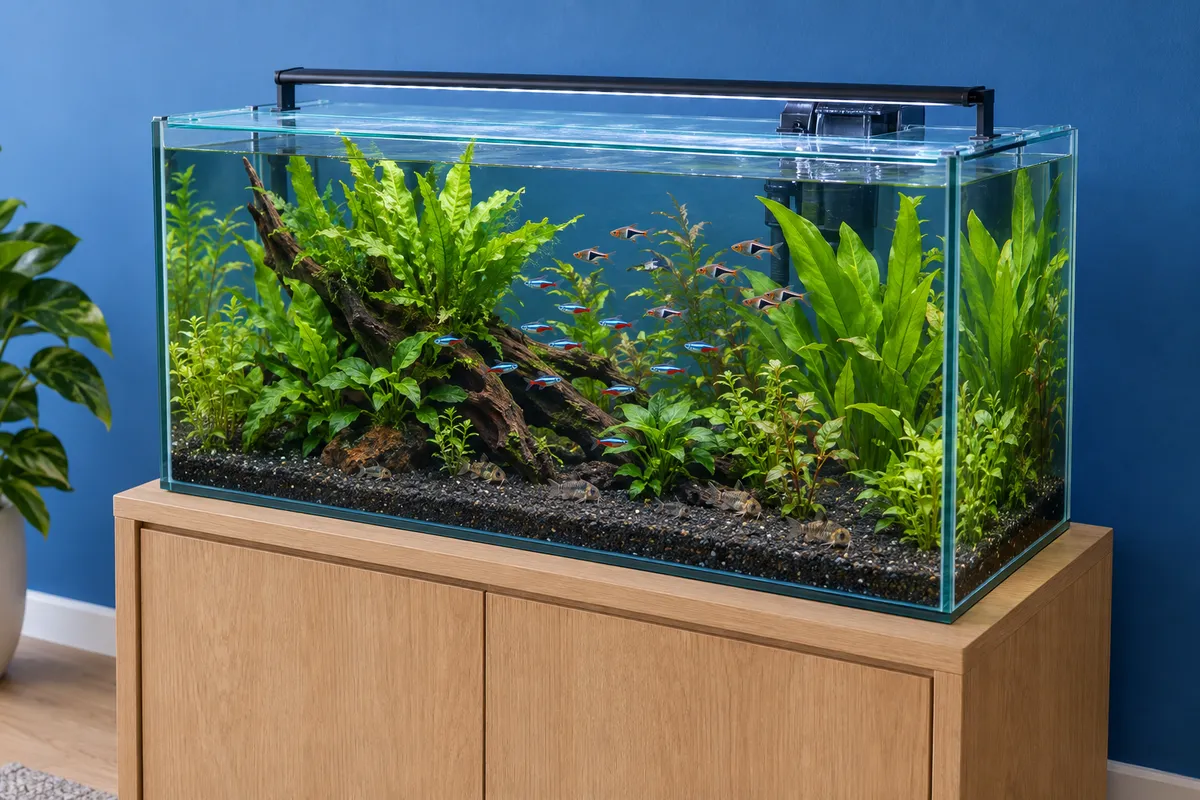
Bigger is kinder for a first community tank. More water means temperature and water chemistry shift more slowly, so a missed feeding or a warm afternoon has less effect. A small desktop tank can look simpler, yet it gives you less room for error and fewer fish choices. Many first-timers settle on a long, low rectangle because it gives fish more swimming length and more surface for air to meet water.
- Glass is scratch resistant and stays clear for years. It is heavier than acrylic.
- Acrylic is lighter and tougher against knocks but scratches more easily when cleaning.
- A lid keeps jumpers in, slows evaporation and keeps dust and curious paws out. A glass canopy lets the light shine straight through.
Tanks, kits and lids
An all-in-one kit includes a matched light and filter; a separate glass canopy fits a standard long tank.

2. The stand: plan for the full weight
Water is heavy. The USGS Water Science School gives about 8.34 pounds per US gallon, so a 20-gallon tank holds roughly 167 pounds of water and a 29-gallon tank roughly 242 pounds. Then add the glass, the gravel, the rock and the wood. A bookshelf or a dresser is not built for that kind of steady load.
- Use a stand made for aquariums and rated for your tank's size, and check that its top matches the tank's footprint so the frame rests evenly.
- Set it on a level floor, away from a sunny window (sun warms the water and feeds algae) and away from heating vents and doors that slam.
- Place it near an outlet, and decide on the spot before filling: a full tank cannot be moved safely.
- Leave room behind for the filter and cords, and a few inches above for lifting the lid and reaching in.
3. The filter: sized to the tank
The filter keeps water moving and, just as important, gives helpful bacteria a home. Pick one rated for at least your tank's volume; many keepers choose one rated for a slightly larger tank. Three common types suit a community setup:
| Filter type | How it works | Good to know |
|---|---|---|
| Hang-on-back | Hangs on the rim, pulls water up through cartridges or sponges | Easy to service; the most common choice for a first tank |
| Sponge filter | An air pump bubbles water through a foam block | Gentle flow for small fish and shrimp; needs an air pump and tubing |
| Canister | Sits under the tank, hoses carry water to and from it | Quiet and roomy for media; more parts to set up |
Filters and air for a community tank
A sponge filter needs the air pump and tubing beside it.


4. Heater and thermometer
Most popular community fish are tropical and need steady warm water. Choose an adjustable submersible heater rated for your tank size, and always add a separate thermometer so you can see what the heater is actually doing. Read the right temperature range for each species you plan to keep, and choose fish that share one range.
Heaters and thermometers
Check the rated tank size on each heater; a thermometer goes on the side opposite the heater.


5. LED light on a timer
Light lets you enjoy the tank and grows live plants. An LED bar sized to your tank's length runs cool and lasts a long time. A built-in or plug-in timer is the quiet hero here: fish and plants settle into the same day and night every day, and algae has fewer chances to take over when the light is not left on by accident.
Lights with timers
Match the light to your tank's length in inches.


6. Substrate, decor and plants
Substrate is the floor of the tank. Smooth gravel is easy to clean; a plant substrate gives rooted plants something to feed from; fine dark sand looks soft and natural. Rinse gravel well before it goes in. Then add hardscape: a piece of driftwood or a rock cave gives shy fish a place to rest out of the light.
Live plants use up some of the waste fish make and give fish cover. Easy beginner plants such as java fern and anubias grow slowly in modest light and are tied to wood or rock rather than buried. A sword plant is a classic for the back of the tank. Artificial plants need no light or care and are a fine choice too, or mix the two. Browse more in decor and substrate.
Floors, hides and greenery
Rinse substrate and wood before use; tie java fern and anubias to decor.


7. Water conditioner and a test kit
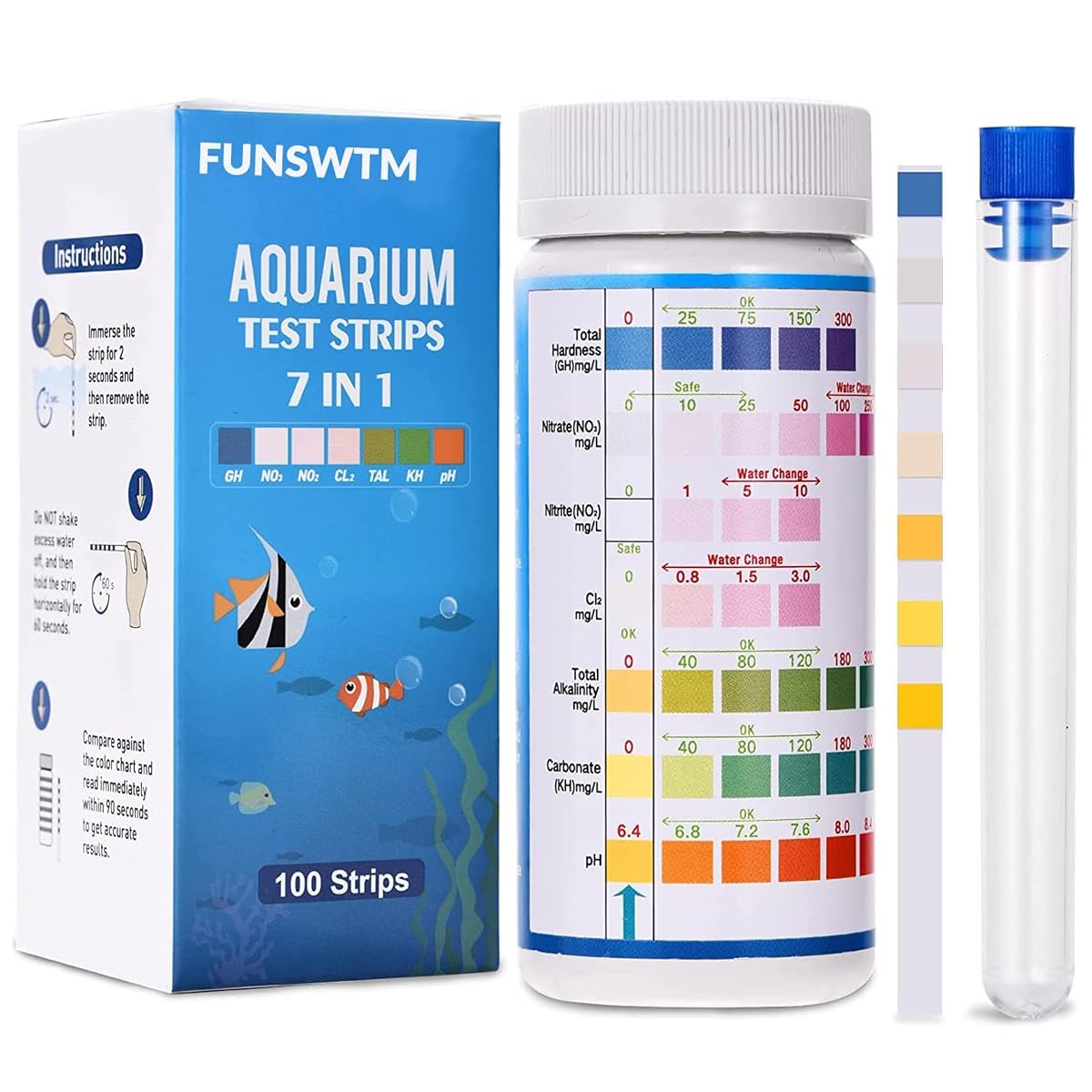
Tap water usually carries chlorine or chloramine, which is added to make it safe for people. A water conditioner (often called a dechlorinator) is mixed into tap water before it meets the tank; dose it exactly as the label says, every time you add new water. A test kit shows ammonia, nitrite, nitrate and pH, so you can see the cycle happen rather than guess. Strips are quick; liquid kits take a few more minutes per test. Find both in water care.
Water care
Keep the conditioner and tests together with your bucket.


8. The nitrogen cycle, explained simply
Fish produce ammonia through their waste and gills, and leftover food breaks down into it too. In a mature tank, one group of bacteria turns ammonia into nitrite, and a second group turns nitrite into nitrate, which is far less harmful and is removed with water changes. Those bacteria live mostly in the filter and on surfaces, and a brand-new tank does not have them yet.
That is why the tank is cycled before fish arrive. The University of Florida's extension guide on ammonia in aquatic systems explains that a new biofilter needs six to eight weeks to build up enough bacteria, and that the high ammonia and nitrite of that early stretch is what keepers call new tank syndrome. Run the filter and heater, add a small source of ammonia as your aquarium specialist suggests, and test. The cycle is done when ammonia and nitrite read zero and nitrate is showing.
- Ammonia rises first.
- Nitrite rises as ammonia falls.
- Nitrite falls to zero and nitrate appears.
- Do a water change, then begin adding fish.
9. Net, gravel vacuum and a tank-only bucket
A small net helps with moving fish and scooping leaves. A gravel vacuum is a siphon that pulls water out while lifting debris from the gravel, so cleaning and a water change happen at once. A long-hose water changer that runs to a sink saves carrying. Keep one bucket only for the tank, never washed with soap or used for cleaning the house, and mark it so nobody borrows it. A magnetic glass cleaner keeps the front clear between changes.
Cleaning and maintenance kit
A siphon, a net and a glass cleaner cover most weekly jobs.


10. Add fish slowly, then keep a rhythm
Once the tank is cycled, start with a few hardy fish and add more in small groups over the following weeks, testing the water between each addition. This lets the bacteria catch up with each new mouth. Research each species before you choose: adult size, temperature, schooling needs and temperament all decide who can share a tank.

A tidy first kit
A curved-front glass tank with its own light and filter, so the main parts already fit each other.
- Light and filter matched to the tank
- Add a heater and thermometer of your own
- Daily: a quick look and count at feeding time, a glance at the thermometer, and only as much food as is eaten quickly.
- Weekly or every other week: a partial water change with conditioned water at a matching temperature, plus a pass with the gravel vacuum.
- Monthly: rinse filter sponges in old tank water and wipe the lid so light reaches the plants.
- Whenever something looks off: test the water first, then ask a fish vet or an aquarium specialist.
For anything about fish health, ask a fish vet or an aquarium specialist; we stay with setup and routine here. To see everything for the tank in one place, try search for aquarium or the tanks and aquariums shelf.
Questions people ask
What do I need for a basic fish tank setup?
A tank with a lid, a stand built for its weight, a filter and heater rated for its size, a thermometer, an LED light with a timer, substrate, decor and plants, a water conditioner, a test kit, a net, a gravel vacuum and a bucket kept only for the tank. Starter kits bundle the tank, light and filter, so check what is missing before setup day.
How long should a new tank run before adding fish?
Until the tank is cycled: ammonia and nitrite read zero and nitrate is present on your test kit. The University of Florida's extension guide says a new biofilter needs six to eight weeks to build up enough bacteria. Test rather than count days.
What is the easiest fish tank setup for beginners?
A medium tank on a proper stand, a hang-on-back or sponge filter, an adjustable heater, an LED light on a timer, smooth gravel, and a few easy plants such as java fern or anubias. Fewer moving parts means fewer things to learn at once.
What is new tank syndrome?
It is the name for the high ammonia and nitrite in a new aquarium before enough helpful bacteria have grown to process fish waste. Cycling the tank before fish arrive and adding fish slowly afterwards are how keepers avoid it. If fish already seem unwell, ask a fish vet or an aquarium specialist.
Is a bigger tank really easier than a small one?
For most beginners, yes. More water changes temperature and chemistry more slowly, which gives you time to notice and fix a problem. A bigger tank also leaves room for a better range of community fish.
About the numbers
- USGS Water Science School, A Million Gallons of Water and Facts About Water, read 2026-10-07: Water weighs about 8.34 pounds per US gallon (8.33 on the facts page); tank water weights here are that figure times the tank's gallons.
- University of Florida IFAS Extension, FA16/FA031 Ammonia in Aquatic Systems (Francis-Floyd, Watson, Petty, Pouder), read 2026-10-07: Bacteria convert ammonia to nitrite and nitrite to nitrate; a new biofilter needs six to eight weeks to build up enough bacteria; new tank syndrome.
- Google search, people also ask and related searches for "how to set up a fish tank for beginners" and "aquarium starter kit", United States, read 2026-10-07: Questions on what a basic setup needs, how long to wait before adding fish, the easiest beginner setup and new tank syndrome.