Bringing Home a Second Cat: A Room Setup Checklist
Before a second cat comes home, set up a quiet base room with its own litter box, bowls, bed, hideout and scratcher, then add a see-through barrier, swap scents and give each cat its own perch.
In short
- A second cat starts life in your home in a base room of its own, with a litter box, food and water bowls, a bed, a hideout and a scratcher all inside.
- Your first cat keeps every one of its usual spots, so nothing it already owns moves into the newcomer's room.
- A tall pet gate or a zip mesh screen door lets the two cats see and smell each other across a doorway without touching.
- Swapping a soft blanket between the cats each day lets them meet by scent before they meet face to face.
- Shared rooms later need extra litter boxes, separate feeding spots and enough shelves and cat trees for each cat to have a perch of its own.
- Every introduction goes at the cats' own pace, so if you see hissing that does not settle, fighting or a cat that stops eating, ask your vet.
Hello, lovely. If you are wondering how to introduce a new cat to the cat you already have, the setup does much of the work. Give the newcomer a quiet room of its own, let the cats learn each other's scent and sight through a barrier, and add enough perches, boxes and bowls that nobody has to share too soon. Every pair of cats is different, so there is no promise of a calm first week, only a room-by-room checklist you can follow at your cats' pace.
Step 1: Set up a base room for the newcomer
The base room is the new cat's whole world for the first stretch. A spare bedroom, a home office or even a large bathroom works, as long as the door closes and your resident cat does not normally sleep or eat there. Your first cat keeps the rest of the house exactly as it was.
Put food and water on one side, the litter box on the other, and the bed and hideout in between where the cat can watch the door.
- Litter box: an open, high-sided box suits most cats; a hooded box gives a shy cat more privacy. Add a litter mat under it to catch stray granules.
- Bowls: one for food and one for water, wide and shallow so whiskers do not brush the sides.
- Bed: something soft and washable that will carry the newcomer's scent later.
- Hideout: a cave bed, a cardboard house or a covered nook. Somewhere to vanish into is often what a new cat wants most on day one.
- Scratcher: an upright post or a flat cardboard pad, so the cat can stretch and mark the room as home.
- A few toys: a wand toy for play sessions with you and a ball or crinkle toy for solo time.
Litter boxes for the base room
Open and hooded styles, plus a mat to catch what tracks out.


Wide, shallow bowls
Ceramic bowls that sit low or on a gentle tilt.


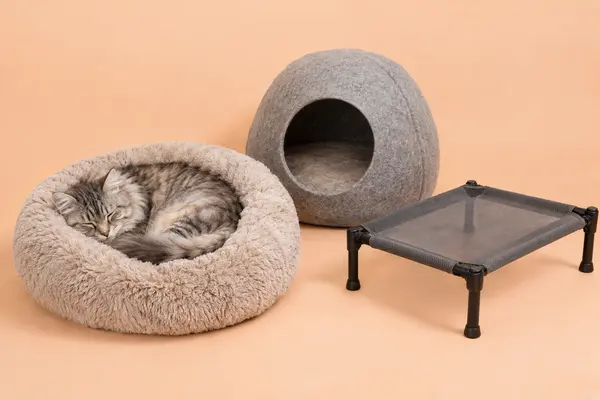
Hideouts and cave beds
Felt, plush and cardboard places to tuck away.


Scratchers for a small room
A tall post and a flat pad cover both ways cats like to scratch.


Step 2: Leave your first cat's world just as it is
Your resident cat is the one whose home is changing, so keep its routine steady. Its bowls, litter box, bed and favourite window stay exactly where they were. Feed at the usual times and keep its play sessions going.
If the base room used to hold something your first cat relies on, move it out a few days early. If your first cat is still young, our new kitten checklist covers the basics a growing cat needs too.
Step 3: Swap scents before anyone meets
Cats learn a lot about each other by smell, so let them meet that way first. Put a soft blanket in each cat's bed, then swap the blankets each day.
- Rub a cloth gently on the newcomer's cheeks and leave it near your first cat's bowl, a little way from the food.
- Once both cats are settled in their own spaces, let them swap rooms for an hour while the other is elsewhere, so each can explore the other's smell freely.
- Watch how each cat reacts. Sniffing and walking away is a good sign. If a cat hisses at the blanket or stops eating, slow everything down.
Soft blankets for scent swapping
Packs give you enough to swap daily and wash in between.


Step 4: Add a see-but-not-touch barrier
When both cats seem relaxed about each other's scent, let them see each other. A barrier across the base room doorway lets them look, sniff and walk away without being able to chase or swat. Short, calm sessions with a meal or play on each side work well, and the door can close again whenever one cat needs a break.
| Barrier | How it works | Good to know |
|---|---|---|
| Extra tall pet gate | Pressure mounts across a doorway; the tall frame makes jumping over less likely | Some cats still climb gates, so stay close during sessions |
| Zip mesh screen door | A see-through mesh panel that covers the whole doorway with a zip opening | Good for climbers; a determined scratcher can still test mesh |
| Door open a crack | A door stop holds the door just open enough to peek | Simple for the very first look; never leave it unattended |
Gates and mesh doors for a cat doorway
Measure your doorway width before you choose.


Browse more pet gates and pens if your doorway is extra wide or opens onto a hallway.
Step 5: Plan the shared home for later
Once the cats are spending time together, the rest of the house needs to work for two. The goal is that neither cat ever has to walk past the other to reach something it needs.
Litter boxes
A common rule of thumb is one box for each cat plus one more, spread across different rooms rather than lined up side by side. That way one cat cannot guard every box at once. Our guide to litter boxes for multiple cats goes deeper into how many, where and which type, and the full range of litter boxes and accessories has open, hooded and corner styles.
Feeding and water stations
Give each cat its own bowl in its own spot, out of each other's line of sight at first, and set water in more than one room.
Beds and hideouts
Move the newcomer's hideout into a shared room once the cats mix, so it still smells familiar, and add a second hideout elsewhere.
Step 6: Build vertical space so each cat has a perch
Cats share a room more easily when they can be at different heights. A tall cat tree, wall shelves or a window seat lets one cat watch from above while the other plays below. Aim for at least one high spot per cat.
- Choose cat trees with a wide, heavy base and more than one top platform, so two cats are not competing for a single spot.
- Wall shelves can make a route around a room, with more than one way up and down so nobody gets cornered.
- A window perch gives each cat its own view. See our cat window perch guide for sill seats and suction hammocks.
- For height, stability and sisal posts, read how to choose a cat tree before you buy.
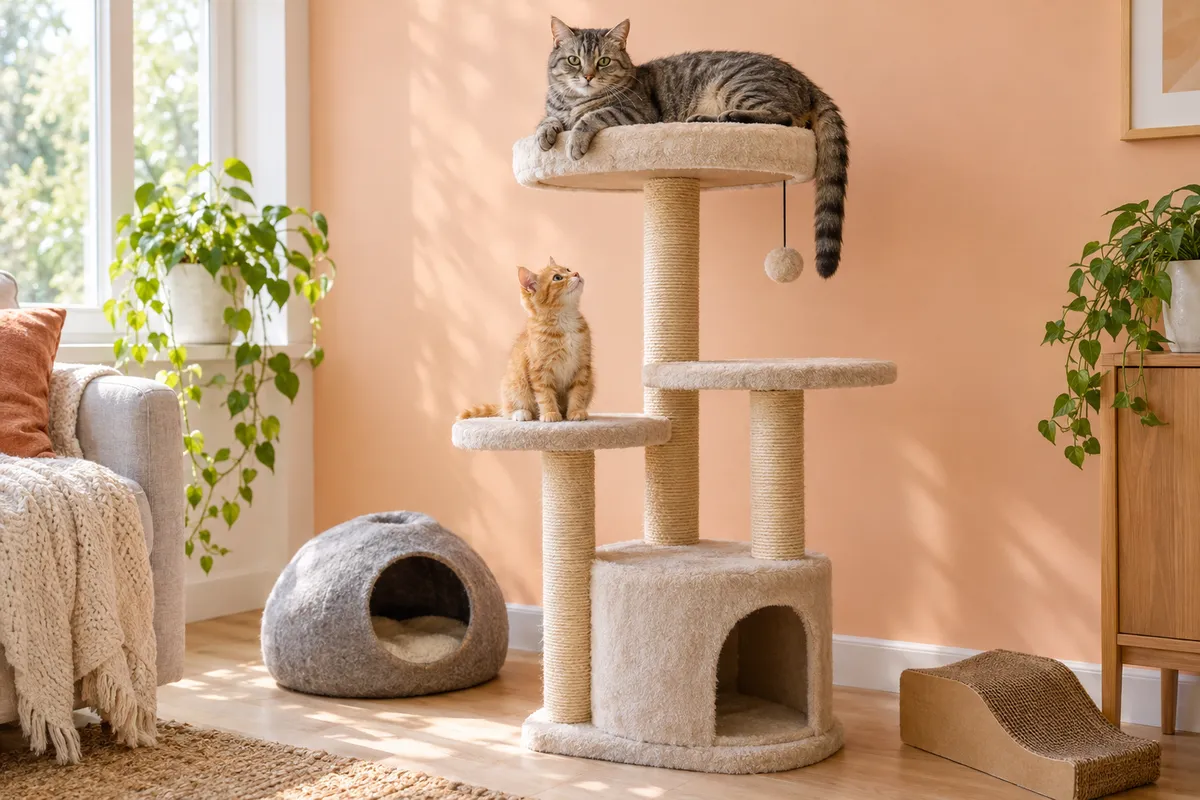
Cat trees with room for two
Multi-level towers with several perches and caves.


Wall shelves and window perches
Add height without adding floor clutter.


A tall tree with more than one top spot
This multi-level tree stands tall with sisal-wrapped posts, several platforms and a condo, so two cats can each claim a level at the same time.
- Several perches at different heights
- Sisal posts for scratching on the way up
- Fits a corner of a living room
Step 7: Toys for parallel play
Parallel play means each cat plays with its own toy, near the other but not together. Start on either side of the barrier, then in the same room with plenty of space between them.
- Use two wand toys and two people if you can, one wand for each cat.
- A tunnel gives a shy cat a place to play and hide at once.
- Put toys away after wand sessions, so string and feathers are never left out.
Wands and tunnels for side-by-side play
Two of everything keeps play fair.


More wand and teaser toys are in the Cat toys aisle.
Your printable checklist
- Choose a base room with a door that closes.
- Set out a litter box, bowls, a bed, a hideout, a scratcher and a few toys in it.
- Keep your first cat's spots and routine exactly as they are.
- Start daily blanket swaps once the newcomer has settled in.
- Fit a tall pet gate or a zip mesh screen door across the base room doorway.
- Hold short, supervised see-but-not-touch sessions with food or play.
- Add extra litter boxes and separate feeding spots around the house.
- Add cat trees, shelves or window perches so each cat has its own high spot.
- Ask your vet about any hissing that does not settle, fighting, hiding for days or a cat that stops eating.
Questions people ask
How do I introduce a new cat to my cat?
Start with the newcomer in its own base room and keep your first cat's routine the same. Swap scents with blankets, then let them see each other through a gate or mesh door in short, supervised sessions. Ask your vet if either cat seems very stressed.
Where should a cat sleep on its first night?
In its base room, with a bed or hideout ready and the door closed. Let the cat choose where to settle; many new cats spend the first night tucked out of sight. Keep the room quiet and check in gently.
How do I know if my cat will accept a new kitten?
Nobody can know in advance, and every cat is different. Signs that things are going well include sniffing the swapped blanket and walking away, eating normally near the barrier and playing on either side of it. Hissing that does not settle, fighting or a cat that stops eating are reasons to slow down and ask your vet.
How do I introduce a kitten to a cat in a small apartment?
A bathroom or a bedroom can be the base room, and a zip mesh screen door or tall gate across its doorway works in a small space. Wall shelves and a slim cat tree add perches without taking floor space. Keep litter boxes and bowls for each cat in different spots, even if the spots are close.
Can I use a baby gate for cats?
Yes, a pressure-mounted pet or baby gate across a doorway is a common see-but-not-touch barrier. Many cats can jump or climb a standard gate, so choose an extra tall one, stack two, or use a mesh screen door, and always stay close during sessions.
About the numbers
- Google search, United States, read 2026-10-28: People also ask: 'Where should a cat sleep on its first night?' and 'How do I know if my cat will accept a new kitten?'; related searches include how to introduce a new cat to another cat and how to introduce a kitten to a cat in a small apartment.