How to Trim Cat Nails at Home: Tools, the Quick and Calm Steps
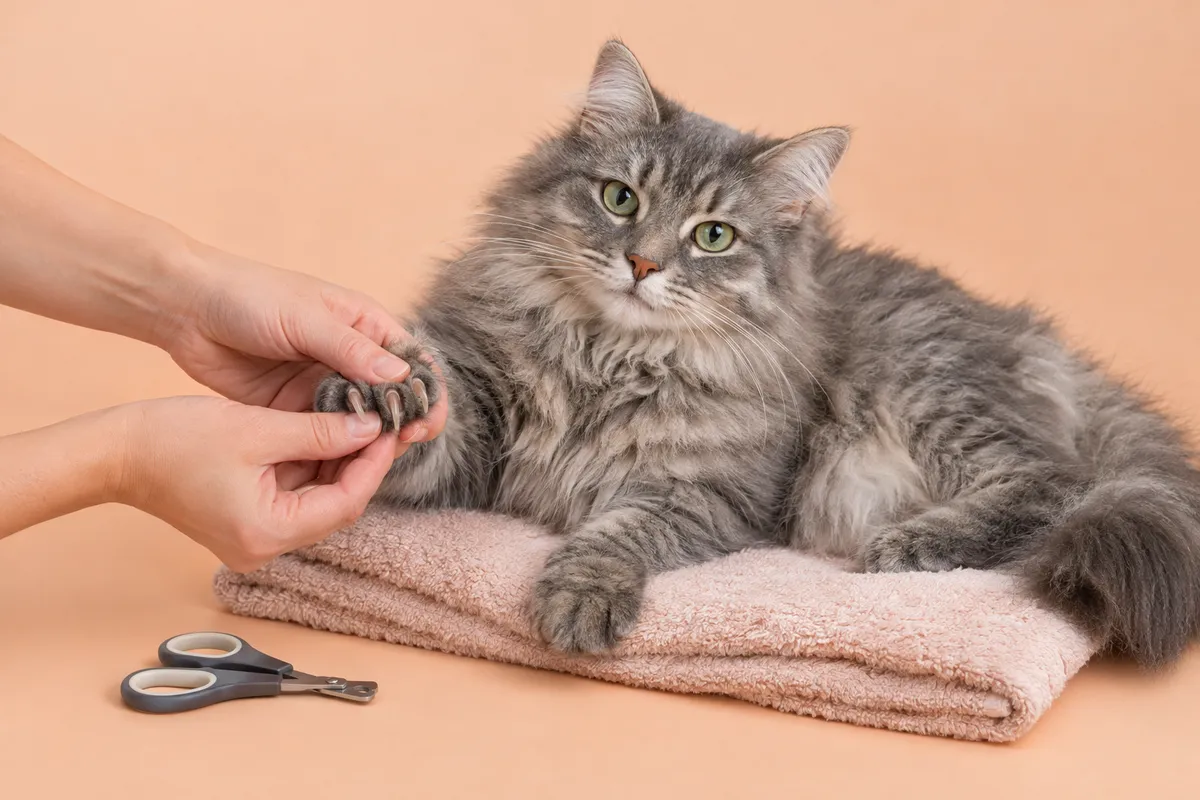
Wait for a sleepy moment, press the toe pad so the claw slides out, and snip only the sharp, clear tip in front of the pink quick. One or two claws a session is plenty.
In short
- Trim only the sharp, curved tip of each claw and stay well in front of the pink quick you can see through a pale claw.
- Small scissor-style cat clippers are the easiest first tool; guillotine clippers and quiet grinders suit some cats and some hands better.
- Press gently on the toe pad to slide the claw out, snip, release, and reward with a treat.
- A towel wrap keeps a wriggly cat snug and calm, and a good scratcher does a lot of everyday nail care between trims.
- If a quick bleeds and does not settle, or a claw looks thick, curled or is touching the pad, ask your vet.
Trimming a cat's nails at home is mostly about timing and patience, not strength. Wait for a relaxed, sleepy moment, press the toe pad so the claw slides out, and snip only the sharp, clear tip in front of the pink quick. Then let go, offer a treat, and stop while your cat is still happy. One claw done calmly beats ten done in a scramble.
Are you supposed to trim a cat's nails?
For most indoor cats, a regular trim is a kind thing to do. Indoor cats walk on soft floors and rugs, so the sharp tips do not wear down the way they might outside. Trimmed tips are less likely to snag on blankets and sweaters, and they are kinder to your sofa and your arms during cuddles.
Some cats keep their claws in shape with plenty of scratching, while senior cats often scratch less. If you are not sure whether your cat needs trims, ask your vet; for any question about declawing, talk to your vet too.
The tools: scissor clippers, guillotine, grinder and styptic powder
Start with a small pair of scissor-style cat clippers. They have short blades with a little curved notch that cradles the round claw, and you hold them like ordinary scissors, so your hand already knows what to do. Look for sharp stainless steel blades and handles that fit your fingers without pinching.
Scissor-style clippers sized for cats
Short notched blades that cradle a small, round claw.


Guillotine clippers work differently: you slip the claw tip through a small ring and squeeze, and a blade slides across. Some people find them precise; others find it harder to see exactly where the cut lands. If you choose one, pick a small size and keep the blade sharp, because a dull blade squeezes rather than cuts.
Guillotine-style clippers
Slip the tip through the ring, then squeeze.


A small nail grinder files the tip down instead of cutting it. It suits cats who dislike the click of clippers, but the buzz is new to most cats, so introduce it switched off first, then on at low speed. Keep long fur clear of the spinning head. Our nail grinder vs clippers guide was written for dogs, but the trade-offs are much the same.
Quiet grinders and a hand file
For smoothing edges or cats who dislike the click.


Finally, keep a small pot of styptic powder on the shelf with your clippers. It is what groomers keep within reach in case a quick is nicked. Ask your vet how they would like you to use it with your cat, and call them if a nail keeps bleeding.
Styptic powder to keep on hand
A small pot that lives with your clippers.


| Tool | How it works | Good for | Keep in mind |
|---|---|---|---|
| Scissor-style clippers | Notched blades close around the claw tip | First-time trimmers, kittens, most cats | Keep blades sharp and dry |
| Guillotine clippers | Blade slides across a ring | Steady hands that like a set cutting spot | Harder to see the exact cut |
| Small grinder | Rotating head files the tip | Cats who dislike the click, smooth edges | Introduce the sound slowly; keep fur clear |
| Hand file | You file by hand | Smoothing a rough edge | Slow for a full trim |
How to find the quick on a clear claw
The quick is the living center of the claw, where the blood supply and nerve sit. Most cats have pale, see-through claws, which makes it easy to spot: in good light you will see a pink triangle inside the claw, and a clear, curved hook beyond it. Only trim the clear hook, and leave a comfortable gap in front of the pink.
If your cat has dark claws, or you cannot see the quick, take off just the very point of the hook and stop. You can take a little more next week.
A calm step-by-step trim
- Pick a relaxed moment. After a meal or during an afternoon nap is ideal. Skip it if your cat is playful, hungry or already cross.
- Settle in. Sit with your cat on your lap facing away from you, or beside you on a sofa. Keep clippers, treats and styptic powder within reach before you start.
- Hold a paw gently. Stroke the leg, then cup one paw. Give a treat for simply letting you hold it.
- Press the toe pad. With your thumb on top of the toe and a finger under the pad, press softly. The claw slides forward.
- Snip the sharp tip. Cut only the clear, curved hook, in front of the pink quick, with the clippers at a slight angle so the cut follows the claw's curve.
- Release and reward. Let the paw go, praise softly and offer a treat straight away.
- Stop early. One or two claws is a good session for a new or nervous cat. Finish the rest tomorrow or later in the week.
A friendly first clipper
Small, notched stainless steel blades that cradle a cat's round claw, with soft handles that sit like everyday scissors.
- Sized for cats and kittens
- Easy to see where the cut lands
- Simple to wipe clean after each trim
Don't forget the dewclaws
Each front paw has a dewclaw on the inside, a little higher up the leg, like a thumb. It never touches the floor and rarely gets used on a scratcher, so it can grow long without anyone noticing. Check it every time you trim the front paws.
Push the fur back, press above the dewclaw to slide it out, and trim just the tip. Back claws are usually blunter and need trims less often. If a dewclaw looks curled or close to the skin, ask your vet.
For wriggly or unwilling cats: the towel wrap
If your cat hates nail trims, slow everything down. Spend a few days just touching paws and pressing toe pads with treats, with the clippers nearby but unused. Then try a single claw. Short, sweet sessions build trust far better than one long struggle.
For a cat who still wriggles, try the towel wrap, often called a purrito. Lay a large, soft towel flat, set your cat in the middle, and fold each side snugly over the body so only the head peeks out. Ease one paw out at a time, trim, tuck it back, and move on. A grooming bag with paw openings does the same job if you prefer zips to folding.
Towels and grooming bags for a snug hold
Soft wraps that keep paws tucked until you need them.


How often to trim, and scratchers between trims
Most indoor cats are happy with a little trim every few weeks, but every cat grows claws at their own pace. Check paws when you notice clicking, snagging or very sharp tips, and keep a gentle routine rather than a strict calendar.
Between trims, scratchers do the everyday nail care. Scratching pulls away the old outer layer of the claw and gives your cat a good stretch. Offer at least one tall, sturdy post for full-body stretching and one flat pad near where your cat naps. Our guide to sisal vs cardboard scratchers compares textures, and how to choose a cat tree covers taller climbing posts. You can browse every style in trees and scratchers, and all the clippers, files and towels in grooming.
Scratchers for everyday claw care
Tall posts for stretching and flat pads for nap spots.


If the quick bleeds or a claw looks wrong
Even careful trimmers nick a quick now and then. Stay calm, keep your cat close, and use the styptic powder the way your vet has shown you. If the bleeding does not settle, or your cat seems sore, call your vet.
Ask your vet, too, if a claw is split, thick or curling toward the pad, or if your cat suddenly will not let you touch a paw.
Questions people ask
Are you supposed to trim a cat's nails?
Most indoor cats benefit from a light, regular trim, because soft floors do not wear the sharp tips down. Trimmed tips snag less on fabric and are kinder during play. If you are unsure whether your cat needs trims, ask your vet.
How do I tell if my cat's claws are too long?
Clicking on hard floors, claws catching on blankets and carpet, or tips that feel very sharp on your skin are all signs a trim is due. A claw that curls back toward the paw or touches the pad needs your vet.
How do I trim an unwilling cat's claws?
Go slowly: practice touching paws and pressing toe pads with treats for a few days first, then trim one claw at a time. A snug towel wrap and a second person to hold and offer treats help a lot. If your cat is frightened, stop and ask your vet or a groomer for help.
How do I trim my indoor cat's claws safely?
Use small cat clippers, trim in good light, and cut only the clear tip in front of the pink quick. Keep styptic powder nearby, stop after a claw or two if your cat gets restless, and reward every calm moment.
Can I trim cat nails without clippers?
A small grinder or a hand file can shorten and smooth claws slowly, and sturdy scratchers keep tips in shape between trims. Human nail clippers tend to squeeze a round claw, so cat clippers are usually easier.
About the numbers
- Google search, people also ask, United States, read 2026-10-08: Shoppers ask whether cats need trims, how to tell when claws are too long, and how to trim an unwilling or indoor cat's claws safely.
- Google search, related searches, United States, read 2026-10-08: Related searches include how to cut cat nails when they hate it, for the first time, and without clippers.