Dog Food Storage Containers: Sizes, Seals, Wheels and Scoops
Match the container to the bag you buy (20, 40 or 50 lb), look for a gasket lid that latches, add wheels if it lives on the floor, and keep the kibble in its bag inside.
In short
- Choose a dog food storage container by the bag you usually buy: the listing should say it holds that weight, and if kibble is large or airy, go one size up.
- An airtight container has a rubber or foam gasket in the lid and latches or a screw top that press it shut; a lid that only rests on top is not airtight.
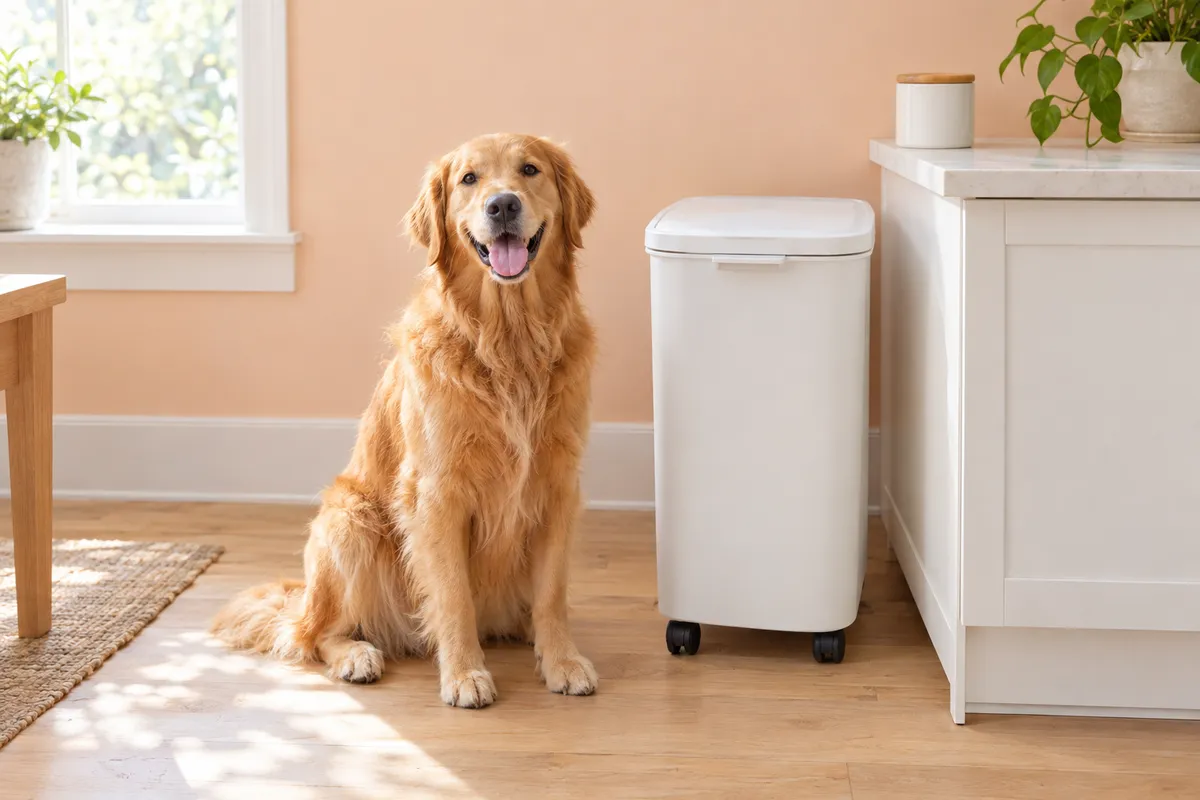
- Wheels matter once a container holds 25 lb or more, because a full bin is heavy to drag out from a pantry or under a counter.
- A common tip from container makers is to keep kibble in its original bag inside the bin, so the best-by date and lot number stay with the food.
- Wash and fully dry the container between bags so old crumbs and oils do not mix with the new food.
Hello, lovely. If your dog eats from a big bag of kibble, a good dog food storage container turns a floppy, rolled-down sack into something tidy that latches, rolls and scoops. The short version: buy for the bag size you actually use, check for a real seal, add wheels for anything heavy, and pick a look you are happy to see in the kitchen every day.
Searches are moving that way too. Over the past 90 days in the United States, searches for a 40 lb dog food storage container rose 650% and for a 50 lb one 550%, while "cute dog food storage container" rose 350%. People want room for the big bags and something pretty to put it in. Here is how to get both.
Start with the bag: 20, 40 or 50 lb
The single most useful number is the weight printed on the bag you buy most often. Container listings give their capacity in pounds of dry food, sometimes with litres or quarts beside it, so match pound for pound. A 40 lb bag wants a container that says it holds 40 lb or more.
Pounds are an estimate, not a promise. Kibble comes in very different shapes: small dense pieces pack tightly, while large, round or airy pieces leave more gaps and take up more room for the same weight. One container maker says plainly that size depends on kibble shape and density, and that when in doubt you should choose the next size up. That is the safest rule.
| Bag you buy | Look for a container that holds | Good to have |
|---|---|---|
| Up to 15 lb | 13 to 20 lb, or a 6 qt canister for small bags | Fits on a shelf or counter; a pop lid you can open with one hand |
| 20 to 30 lb | 25 to 35 lb | Wheels or a front handle; a scoop that clips inside |
| 40 lb | 40 to 45 lb | Wheels, latches on two sides, a wide opening for pouring |
| 50 lb | 50 lb or more (some hold up to 54 lb) | Wheels you can remove, a flat lid so things can sit on top |
Big bins for 40 and 50 lb bags
Each listing gives a capacity of 40 lb or more; most roll.


For 20 to 35 lb bags
A middle size for one medium dog or a bag that lasts a few weeks.


What makes a container airtight
Look at the lid, not the label. An airtight container has a soft gasket, usually foam or silicone, running around the rim, and something that presses the lid down onto it: snap latches on the sides, a lever lid, or a screw top. When it is shut you should feel it hold. A lid that simply sits on top keeps out dust, not damp air or a determined nose.
- Snap latches are quick and give a clear click so you know it is shut. Two or four latches hold more evenly than one.
- Screw tops spin on like a giant jar lid. They seal well and are hard for a clever dog to nudge open.
- Lever and flip lids open with one hand while the other holds the scoop, handy at breakfast time.
- Bamboo or wood lids look lovely on metal canisters; check the listing says there is a silicone ring underneath.
If you already own a sturdy bucket, a separate screw-on seal lid can turn it into storage. These are sized to fit standard 3.5 to 7 gallon buckets.
Seal it your way
Screw tops, pop lids and a lid made for buckets you already own.


Wheels, scoops and the small things you use every day
Wheels earn their place at about 25 lb and up. A full 40 lb bin is a lot to drag across tile, and wheels let you roll it out of a pantry, fill the bowl, and roll it back. Removable wheels are worth having if the bin will sometimes sit on a shelf.
A scoop is the other everyday hero. Many bins include one, often a 2-cup size, and some have a clip or holder so it lives inside the lid instead of in the kibble. A scoop with measuring lines, or a set of 1/2 and 1 cup sizes, makes it easier to serve the amount your vet or the bag suggests. Stainless steel and melamine scoops go in the dishwasher; a collapsible scoop that doubles as a bag clip is clever for a half-used bag.

The scoop that is also a bag clip
A collapsible half-cup scoop on a spring clip: measure, then pinch the bag shut with the same tool.
- Folds flat for a drawer or travel bag
- Clip handle closes a rolled bag top
- Also comes in a 1 cup size
Scoops that make serving easy
Fixed cups, measuring lines and a stainless option.


Keep the kibble in its bag, and clean between bags
A common tip from container makers is to set the whole bag inside the bin instead of pouring the kibble loose. Roll the top down, close the lid, and scoop from the open bag. It keeps the best-by date, the lot number and the feeding chart right there with the food, which is useful if you ever need to check a recall notice or switch recipes. It also keeps the inside of the bin cleaner.
If you prefer to pour, finish the old food before adding new, rather than topping up on top of crumbs. Either way, between bags:
- Empty the container and tip out the crumbs over the trash.
- Wash with warm soapy water and a soft cloth, paying attention to the gasket groove where dust collects.
- Rinse and let every part dry fully, lid open, before the next bag goes in.
- Check the gasket still sits flat and is not cracked; a tired seal is the first thing to go.
For storage directions, follow what the food bag itself says. If you have questions about your dog's food, ask your vet.
Where to keep it, and stackable treat jars
Choose a cool, dry spot indoors that you pass at mealtimes: a pantry floor, a mudroom, or under the counter in a laundry room. Keep it away from the stove, the dishwasher vent and sunny windows. A slim, tall bin fits beside the fridge; a wide, low one slides under a shelf. Measure the gap before you choose, including room to open the lid.
Treats deserve their own home. Stackable treat boxes sit on top of a matching food bin, and several makers sell combos of a big bin plus a small treat box. Pop-top canisters stack in a cupboard, and a pair of jars lets you keep crunchy biscuits and soft training bites apart.
Stackable combos and collapsible bins
A bin with its own treat box, plus folding bins for small spaces or road trips.


Pretty containers that suit a kitchen
If the bin lives in sight, it can be part of the room. Brushed stainless steel looks at home beside modern appliances and wipes clean. Powder-coated metal tins in sage, white or black with a bamboo lid suit a farmhouse kitchen, and many come with a matching scoop. Ceramic treat jars with wooden or bamboo lids sit happily on a counter next to the coffee canister.
For a modern kitchen
A brushed stainless bin sized for a 40 lb bag, with a latching lid, a front handle and wheels at the back for rolling it out of a corner.
- Listed for up to 40 lb of dry food
- Rolls on rear wheels
- Comes in several sizes and finishes
For a cute, farmhouse look
A metal tin with a bamboo lid and a matching scoop, sized for a 15 to 20 lb bag.
- Sage, white or black
- Side handles for lifting
- Scoop in the same colour
Treat jars for the counter
Ceramic and metal jars with sealed lids.


Want more ideas? Browse every bowl and feeder we carry, or search dog treat jars and dog food storage containers to compare sizes side by side.
Questions people ask
Is it better to store dog food in plastic or glass containers?
Both work for dry kibble; what matters most is a lid that seals and a container you can wash and dry. Large bins are usually plastic or stainless steel because glass that big is very heavy and breakable. Glass and ceramic suit small amounts, such as treats on a counter.
What size container do I need for a 40 lb bag of dog food?
Look for a container whose listing says it holds at least 40 lb of dry food. If your dog's kibble is large or round, choose the next size up, as makers note that kibble shape changes how much fits. Wheels are worth having at this size.
Should I pour dog food out of the bag into the container?
A common tip from container makers is to keep the kibble in its original bag inside the bin. That keeps the best-by date and lot number with the food and the bin cleaner. If you pour it in, finish the old food and wash the bin before adding a new bag.
How often should I clean a dog food storage container?
Wash it between bags with warm soapy water, then let it dry completely before refilling. Pay attention to the gasket groove in the lid, where crumbs collect. Wipe the outside and the scoop more often.
Where is the best place to keep a dog food container?
Somewhere cool, dry and indoors, away from the stove, vents and direct sun. A pantry, mudroom or laundry room works well. Follow any storage directions printed on the food bag.
About the numbers
- Google Trends, United States, past 90 days, read 2026-10-28: Rising searches related to dog food storage: "dog food storage container 40 lbs" up 650%, "dog food storage container 50 lbs" up 550%, "cute dog food storage container" up 350%, "dog food storage ideas" up 170%.
- Google search, United States, read 2026-10-28: People also ask: is it better to store food in plastic or glass containers; related searches: large dog food storage container, with lid, 20 lbs.
- Product listings on Hey Lovi, read 2026-10-28: Capacities (13 lb to 54 lb), seal types, wheels and scoop sizes as stated by each container's own listing; one listing advises choosing by kibble shape and density and going a size up when in doubt.