Best Brush for a Shedding Cat: The Right Tool for Each Coat
Short coats do best with a rubber curry or grooming glove; long coats need a wide-tooth comb and a slicker brush. Deshedding blades are for once a week, with a light hand.
In short
- For a short-haired cat, a rubber curry brush or a grooming glove lifts loose fur gently and most cats accept it quickly.
- For a long-haired cat, start with a wide-tooth steel comb, then follow with a slicker brush, and keep a dematting comb for the odd knot.
- A deshedding blade or undercoat rake works best about once a week, in short, light strokes with the lie of the fur, never pressed into the skin.
- Short, calm sessions at the same time each day teach a cat that brushing is a pleasant routine rather than a wrestle.
- If shedding suddenly increases, or you see bald patches, flaky skin or redness, ask your vet before reaching for a stronger tool.
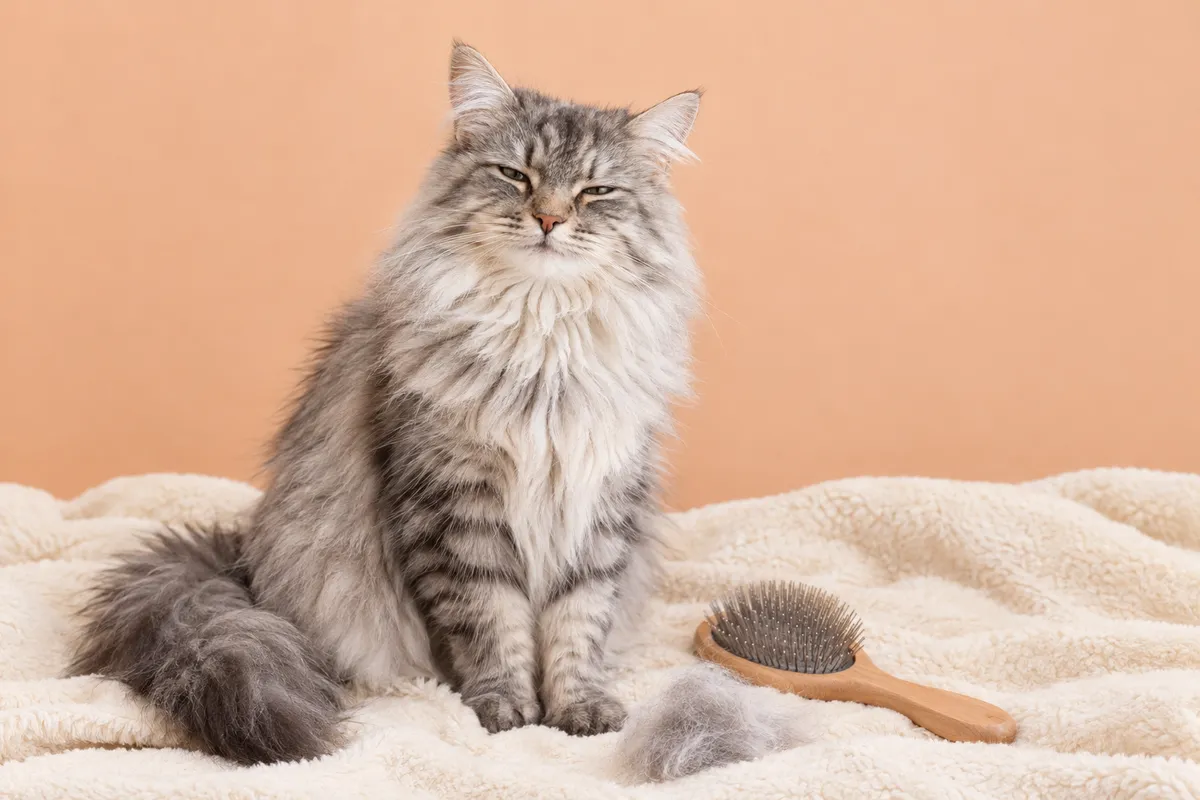
The best brush for a shedding cat depends on the coat. A short, sleek coat wants something soft and grippy, like a rubber curry or a grooming glove. A long, fluffy coat needs a comb that reaches the skin plus a slicker brush for the top layer. Deshedding tools sit on top of either routine, used gently and not too often. Here is how to match the tool to your cat, and how to make brushing something your cat looks forward to.
Does brushing actually help with shedding?
Yes, in a practical sense: brushing catches loose fur on the brush instead of on your sofa, your sweater and the floor. Cats shed their old hair whatever you do, so brushing does not stop shedding. What it changes is where that hair ends up. Every tuft you lift with a brush is one your cat does not swallow while self-grooming and one you do not vacuum later.
Brushing also gives you a close look at your cat's coat and skin every few days. If you notice anything new, such as thinning patches, scabs or a dull, greasy coat, that is a reason to ask your vet rather than to brush harder.
Match the tool to the coat: a quick table
Most cats do well with two tools: one that does the main work and one gentler finisher. Use this table to find your pair, then browse the full grooming aisle for sizes and handle shapes.
| Coat type | Main tool | Second tool | How often |
|---|---|---|---|
| Short, single coat | Rubber curry brush or grooming glove | Soft slicker for the tail and britches | Two or three times a week |
| Short, dense coat | Grooming glove or curry | Deshedding blade, lightly | Glove often, blade about once a week |
| Medium coat | Slicker brush | Wide-tooth steel comb | Every few days |
| Long, fluffy coat | Wide-tooth steel comb | Slicker brush, then dematting comb for knots | Daily, even for a few minutes |
| Senior or sensitive cat | Grooming glove | Fine comb around the face | Little and often |
Short-haired cats: rubber, silicone and gloves
For a short coat, soft rubber or silicone nubs are the kindest place to start. As you stroke, the nubs grip loose hair and roll it into a little mat you can peel away. There are no sharp edges, so even a cat who dislikes metal brushes usually relaxes into it.
A grooming glove works the same way but feels like petting. You slip it on, stroke your cat as you normally would, and the loose fur collects on the palm. Gloves are a lovely choice for a nervous cat, a kitten learning to be handled, or a senior cat with a bony back. A rubber curry with a loop handle is the sturdier cousin: a little firmer, quick to rinse under the tap.
Gentle tools for short coats
Soft nubs and gloves that feel like a good scratch.


Long-haired cats: comb first, then slicker
For a long coat, work from the skin out. A wide-tooth stainless steel comb goes first because it slides through to the base of the hair and finds tangles before they tighten. Comb in small sections, holding the fur above the section out of the way. Then follow with a slicker brush, whose fine bent pins smooth the outer coat and lift the fluff that the comb loosened.
Many slicker brushes now have a button that pushes the pins back so the collected fur slides off in one sheet. Choose one with pins that are coated or slightly rounded at the tip, and test it on the inside of your own wrist: if it scratches you, it is too firm for your cat.
Combs and slickers for long and medium coats
Comb to the skin, then smooth the top.


When a knot appears
A dematting comb has short curved blades that cut through a knot from the inside, so you are not tugging the whole clump. Hold the fur at the base, between the knot and the skin, so the pull goes into your fingers and not your cat. Work from the outer edge of the knot inward in tiny strokes. A large, tight mat close to the skin is a job for a professional groomer or your vet, not a home tool.
Dematting combs and rakes
For the odd tangle, held close to the base.


Deshedding tools, and how gently to use them
Deshedding tools have a fine-toothed edge that reaches the soft undercoat and pulls out hair that is already loose. They gather a surprising amount of fur, which is exactly why they need a light hand. The teeth do the work; you only guide them.
- Use it on a dry, tangle-free coat. Comb out any knots first.
- Hold the tool at a low angle and stroke in the direction the fur lies.
- Keep strokes short and light. Never press the edge into the skin.
- Skip the belly, armpits, face and tail, where skin is thin.
- Stop after a few minutes, or sooner if your cat's tail starts to twitch.
- Most coats only need this about once a week; use a glove or slicker on the other days.
Deshedding blades and undercoat tools
Weekly helpers for thick and double coats.


A good first tool for almost any cat
If you are not sure where to start, a soft five-finger grooming glove is the easiest win. It feels like petting, so most cats accept it on the first try.
- Silicone tips gather loose fur as you stroke
- Rinses clean under the tap
- Lets you feel lumps or burrs as you go
Self-groomer corner brushes: help between sessions
A self-groomer is a curved bristle pad that fixes to a wall corner or door frame at cheek height. Cats love to rub their faces on corners, and every rub leaves some loose hair on the bristles instead of on your furniture. Some come with a little catnip compartment to get a curious cat started. Some cat trees and scratching posts have one built in, too; you will find those among the cat trees and condos.
It is a bonus, not a replacement for brushing: a corner brush reaches cheeks and chin, never the back or the tummy. Clean the bristles every few days so they stay inviting.
Corner brushes and scratchers with a groomer
Cheek-height pads for a happy face rub.


A calm brushing routine your cat will enjoy
The easiest way to deshed a cat is the routine that keeps them still and happy. Short and regular beats long and rare. A few relaxed minutes after a meal, when your cat is sleepy, works far better than a big session once a month.
- Pick the same spot and time each day: a lap, a sunny windowsill, a towel on the sofa.
- Start where your cat already likes being touched, usually the cheeks and the top of the head.
- Move to the back and sides, following the fur. Leave the belly and legs for later, or for a calmer day.
- Stop while your cat is still enjoying it. Watch for a flicking tail, flat ears or skin rippling along the back.
- Finish with a treat or a play session so brushing ends on a good note.
If you are building a grooming habit, pair it with a quick paw check. Our guide on how to trim cat nails at home uses the same gentle, little-and-often approach. For an older cat who is stiff or bony, the ideas in Senior Cat Care at Home can help you set up a softer, warmer grooming spot.
Lint tools for the sofa, bed and car
Even with a great routine, some fur will reach your furniture. A reusable roller with a self-cleaning base sweeps hair off a sofa cushion into a little chamber, with no sticky sheets to throw away. A rubber or ridged detailer works well on car seats and carpet, where hair weaves into the fibres. Keep one by the sofa and one by the door so a quick tidy takes seconds.
Fur removers for furniture and fabric
Reusable rollers and detailers for the hair that escapes.


Share your home with a dog too? Our guide on how to brush a double-coated dog covers rakes and drying for thick dog coats. And if you want to compare more options, search all cat brushes.
Questions people ask
Does brushing my cat actually help with shedding?
Brushing does not stop a cat from shedding, but it catches loose hair on the brush instead of on your floor, furniture and clothes. Regular sessions also mean less loose fur for your cat to swallow while self-grooming. Two or three short sessions a week suit most short coats; long coats do best with a few minutes daily.
What is the best brush for removing cat fur?
It depends on the coat. For short-haired cats, a rubber curry brush or grooming glove gathers fur gently. For long-haired cats, a wide-tooth steel comb followed by a slicker brush works best. A deshedding blade, used lightly about once a week, lifts loose undercoat on thicker coats.
What is the easiest way to deshed my cat?
Short, calm sessions with a gentle tool are the easiest route. Brush when your cat is relaxed, start at the cheeks and head, follow the direction of the fur and stop before your cat gets restless. A self-groomer on a wall corner adds a little extra help between sessions.
Why is my cat still shedding so much even though I brush her?
Shedding often rises with seasonal changes and indoor heating, and brushing collects hair rather than stopping it. If the shedding is sudden or patchy, or you notice scratching, flaky skin or bald spots, ask your vet before changing tools.
How often should I use a deshedding tool on my cat?
About once a week is plenty for most cats, with a glove or slicker on other days. Keep strokes short and light, follow the lie of the fur and avoid the belly, armpits, face and tail.
Are cat self-groomer corner brushes worth it?
They are a nice extra. Cats rub their cheeks on corners naturally, so a corner brush picks up some loose hair between brushing sessions. It only reaches the face and chin, so keep your regular brushing routine too.
About the numbers
- Google search, United States, read 2026-10-28: People also ask: does brushing help with shedding, the best brush for removing cat fur, the easiest way to deshed a cat, why a cat still sheds despite brushing; related searches for short-hair, long-hair and deshedding brushes for cats