How to Choose a Cat Water Fountain: Material, Pump and Size
Choose a cat water fountain by material (stainless steel, ceramic, plastic or glass), by how the pump is powered and by a size that fits your pets. Then let your cat pick the flow.
In short
- Choose the material first: stainless steel for easy cleaning, ceramic for a heavy base that stays put, plastic for a light, see-through tank, glass to see every drop.
- Match the power to the spot: a corded pump near an outlet, a battery fountain where there is none, a gravity waterer when you want no pump at all.
- Size it for your pets and your cleaning routine: about 1.5 to 2.5 liters for one cat, 3 to 4 liters for several cats, 6 liters or more for a large dog.
- A fountain with more than one flow style, such as a flower top, bubbler or spout, lets your cat choose how it likes to drink.
- Easy take-apart matters more than any other feature, so count the parts before you buy and keep spare filters on hand.
Hello, lovely. Choosing a cat water fountain comes down to three decisions: the material of the bowl, how the pump gets its power, and a size that suits the pets drinking from it. Get those right and the rest (flow style, filters, a mat underneath) falls into place.
You are in good company. In the United States, searches for cat water fountains rose about 5% over the last four weeks against the four before, and over the past year stainless steel fountains have ranked among the most searched related terms. Filters make that list too, which says something useful: a fountain is a small, regular routine, not a one-time buy.
Material: stainless steel, ceramic, plastic or glass
Pick the material first, because it decides how the fountain cleans, how heavy it is and how long it looks good. Stainless steel shrugs off scratches, does not hold on to smells, and many steel tops go in the dishwasher. Ceramic is heavy, so a playful paw has a hard time pushing it across the floor. Plastic is light and often clear, so the water level reads at a glance. Glass shows every drop and every smudge.
| Material | Living with it | Watch for | Good fit |
|---|---|---|---|
| Stainless steel (often 304 grade) | Scratch resistant, many tops dishwasher safe | Often only the tray or lid is steel | Most homes |
| Ceramic or porcelain | Heavy, stable, glazed surface wipes clean | Can chip if dropped | Cats who paw at or tip bowls |
| Plastic (BPA free) | Light and often see-through | Fine scratches build up; use a soft sponge | Small spaces, a first fountain |
| Glass | You can see the water and any film | Breakable, needs a steady spot | Calm cats |
Stainless steel fountains
Some are steel all over; others add a level window or a tinted tank so you can see how much water is left.


Ceramic and glass fountains
Heavier bowls that stay put, with water running down a center tower, a sloped ramp or a glass dome.


A ceramic fountain that stays put
This porcelain fountain holds 2.1 liters and spills water down a tiered center column into a wide, scalloped bowl. It is heavy enough that a curious paw is unlikely to slide it, and a spare pump comes in the box.
- Porcelain bowl about 10.7 inches across
- Low-voltage 12 V pump, UL-certified adapter
- Spare pump and extra filters included
Pump and power: corded, cordless or no pump at all
Next, decide where the fountain will live, because the spot decides the power. A classic fountain has a small submersible pump with a low-voltage cord to a wall outlet. It runs all day and is the simplest kind to keep going. If the best place for water is nowhere near an outlet, go cordless.
| Type | Where it can go | Upkeep |
|---|---|---|
| Corded pump | Near an outlet | Open and rinse the pump at every clean |
| Cordless pump (power through the base) | Near an outlet, no cable in the water | Lift the pump straight out |
| Battery or rechargeable | Anywhere: a bedroom, a landing, a quiet corner | Recharge on a routine |
| Gravity, no pump | Anywhere, even with no power | Still water, so change it often |
Battery fountains often have more than one mode. One we feature runs on a motion sensor that starts the flow when a pet comes within about five feet, on a timer that sends a short flow every 15 minutes, or nonstop while plugged in. Some newer designs keep the motor in a sealed unit above the water, so nothing electric sits in the bowl.
Cordless and battery fountains
Fewer cables in the water, and two of these run on batteries so they can sit far from an outlet.


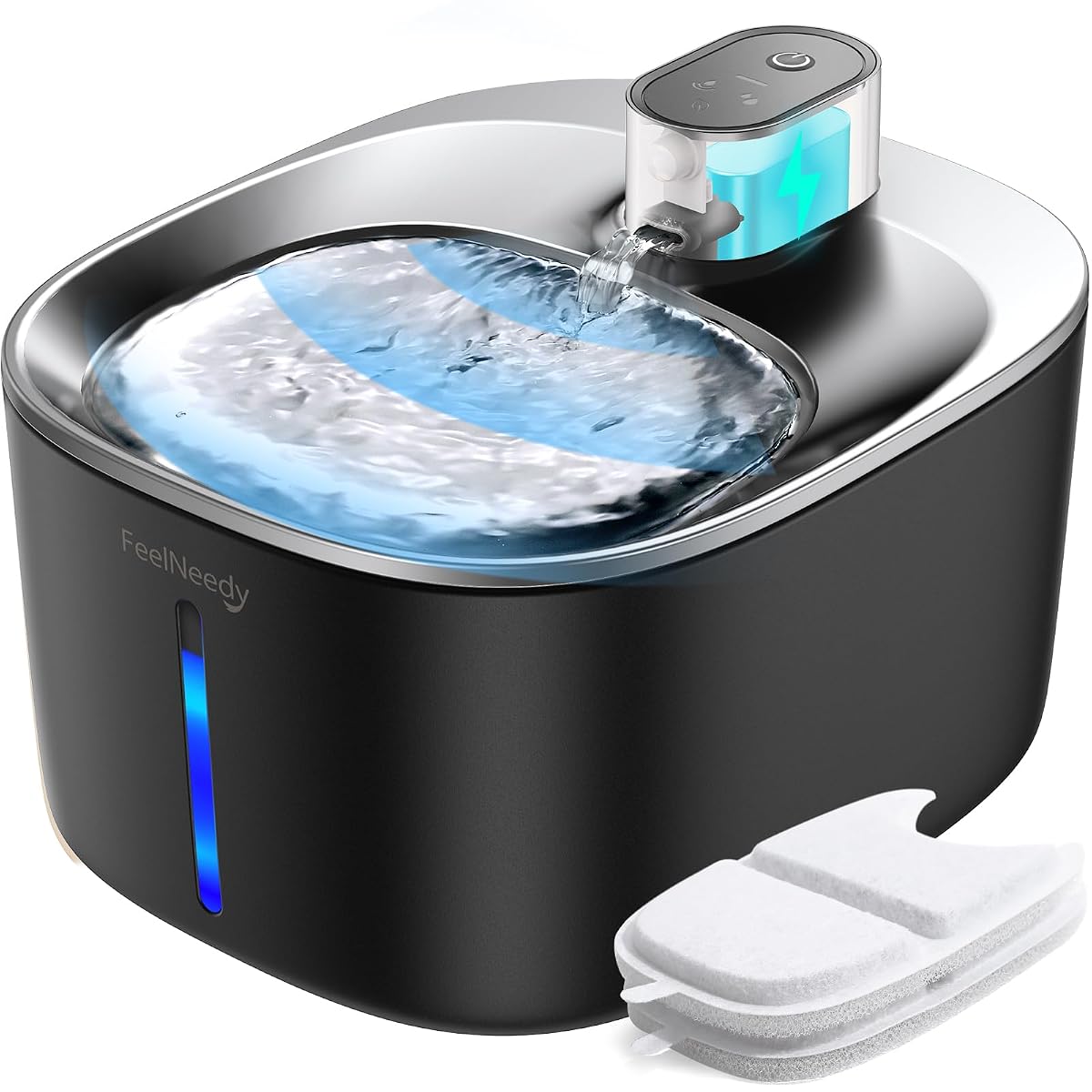
For a spot with no outlet nearby
A roomy 4 liter stainless steel basin with a wide, shallow drinking tray and a compact battery unit on top. Use sensor mode for a cat who wanders up for a sip, or timed mode to keep water moving while you are out.
- 4 liter basin for a multi-cat home
- Three flow modes, including a motion sensor
Size: match the tank to your pets and your cleaning day
Size the fountain to the pets drinking from it and to your cleaning routine, not to how rarely you would like to refill. Water in a big tank still needs changing on the maker's schedule, so an oversized fountain mostly means more water to pour away.
- One cat: 1.5 to 2.5 liters. A clear 1.5 liter fountain with a faucet attachment suits a small apartment.
- Two or three cats, or a cat and a small dog: 3 to 4 liters, with room for two to drink at once.
- A large dog or a busy multi-pet home: 6 liters and up, or a gravity waterer as a second station.
- Two floors: two smaller fountains often beat one big one.

For a big dog, or cats and dogs together
A 7 liter stainless steel fountain with a red light that warns when the water runs low, and a layered filter of foam, ion-exchange resin, activated carbon and fine fabric. The wide basin gives a large muzzle plenty of room.
- 7 liters of 304 stainless steel
- Layered filter with foam, resin and carbon
Flow style: let your cat choose
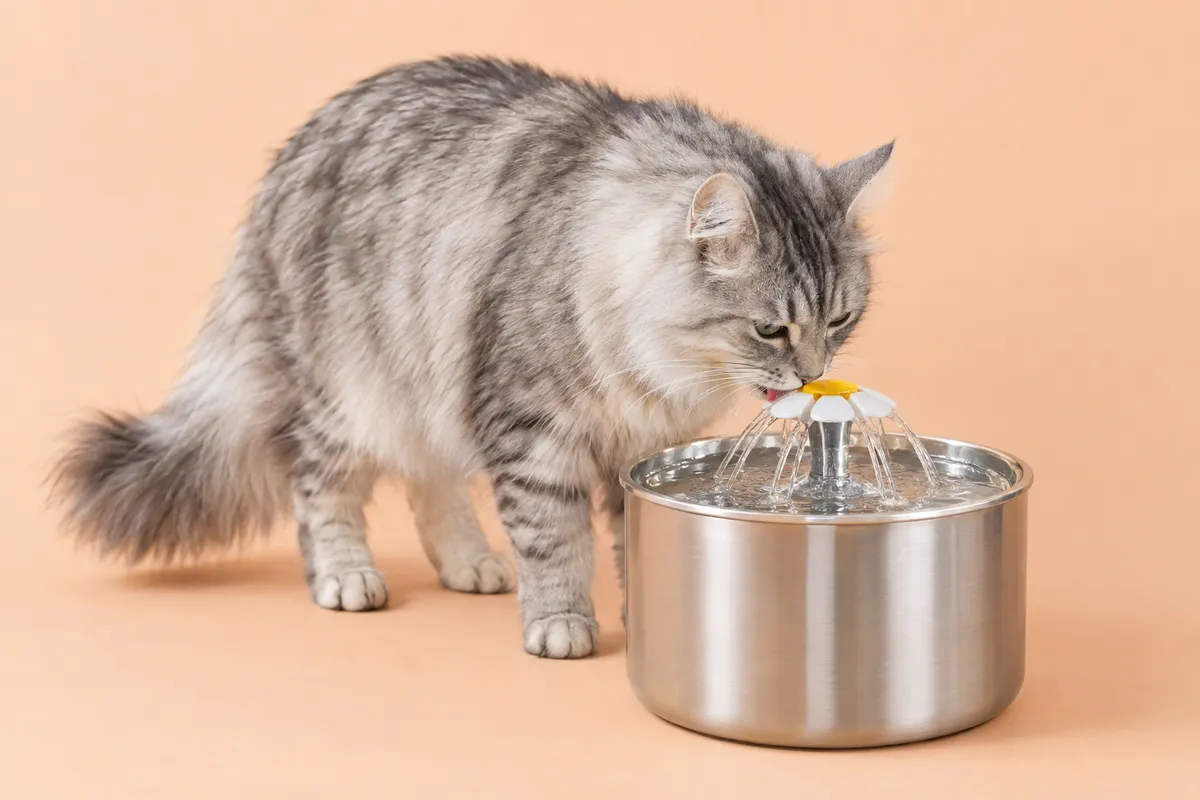
Cats can be particular about how water moves. A flower top sends out soft streams, a bubbler makes a little dome of water, and with no top you get a calm, gently flowing surface. A faucet spout makes a thin stream some cats love to lick from, and multi-level designs offer a high spot and a low spot. Not sure what your cat likes? Swappable tops let you find out without buying twice.
Fountains with more than one way to drink
Swappable tops, spouts and levels for cats who like to choose.


For a picky drinker
This 3 liter fountain sets a stainless steel top over a white base, with three flow settings: a gentle flow, a bubbling top or long, calm streams from the flower. The steel top can go in the dishwasher, and a soft night light helps after dark.
- Three flow settings in one fountain
- Dishwasher-safe stainless steel top
Gravity waterers: when you want no pump at all
A gravity pet waterer is a bottle turned upside down over a bowl: as your pet drinks, water flows down to refill it. No pump, no cord and no hum, so it suits a dog, a crate or a backup station. The trade-off is still water, so rinse the bowl and refill often. Compare more gravity pet waterers side by side.
Gravity waterers
From a 1 gallon bottle to a 3 gallon station, plus one that clips to a crate or pen.


A tidy gravity waterer
A clear 5 liter bottle over a stainless steel bowl, all BPA free, so you see at a glance how much is left. A good second station for a dog, or a quiet backup for cats while you are out.
- 5 liter clear reservoir
- Stainless steel drinking bowl
Where to put a cat water fountain
Choose a quiet spot a few steps from the food bowl and well away from the litter box. Set it on a waterproof mat with a raised edge, near an outlet if it has a cord, and out of direct sun, which warms the water and can turn a clear tank green. Tuck the cord along the wall, and give a shy cat a spot where it can see the room while it drinks.
Mats for under the fountain
Raised edges catch drips, and silicone wipes clean.


Cleaning and filters: the five-minute routine
A fountain only stays fresh if you actually take it apart, so before you buy, count the parts and look for a pump that opens without tools. Then follow the maker's schedule for cleaning and filters; most set it in weeks, not months.
- Unplug the fountain and pour out the old water.
- Lift out the pump, open its cover and rinse the little impeller, where hair collects.
- Wash the bowl, tank and top in warm, soapy water, with a bottle brush for the spout.
- Rinse the foam pre-filter and change the carbon filter when the maker says.
- Rinse, reassemble and fill to the MAX line before switching it on.
Most filters stack layers: a foam sponge that keeps hair out of the pump, activated carbon that takes the edge off tastes and smells, and on some, ion-exchange resin beads that hold on to minerals that leave white scale. Shapes vary, so search cat water fountain filters by your fountain's size and keep a pack in the cupboard.
Spare filters and a spare pump
Check the fit against your fountain's size and shape first.


Pick the material you want to live with, the power that suits the spot and a size for your crew, then let your cat vote on the flow. See every fountain side by side in bowls and feeders.
More for cat parents
Questions people ask
Which is better for my cat, a water bowl or a fountain?
It depends on your cat. Some cats are drawn to moving water, while others are happy with a wide, still bowl washed and refilled every day. Many owners offer both at first and watch which gets used. If you have any concern about how much your cat drinks, ask your vet.
Where is the best place to put a cat water fountain?
A quiet spot a few steps from the food bowl and well away from the litter box, on a waterproof mat and out of direct sun. Corded models need an outlet close by so the cable never crosses a walkway. In a home with more than one floor, water on each floor helps.
Do vets recommend water fountains for cats?
Your own vet is the right person to ask, because the answer depends on your cat's age, health and habits. A fountain is simply one way to keep fresh, moving water on offer, and a clean bowl is another. Bring it up at your next visit.
Can I leave my cat's water fountain on all the time?
Yes, plug-in fountains are made to run continuously. Keep the water above the MIN line so the pump never runs dry, and switch it off only to clean it. Battery fountains usually offer sensor or timed modes to stretch the charge.
How often should I change a cat fountain filter?
Follow your fountain's manual, since filters differ. Rinse the foam pre-filter whenever you see hair on it, and change the carbon filter on the maker's timetable, or sooner if the water looks cloudy.
About the numbers
- Google Trends, United States, past 90 days and past 12 months, read 2026-10-06: past 90 days: searches for cat water fountains up about 5% over the last four weeks against the four before, cat water fountain filter among the top related searches (46); past 12 months: stainless steel cat fountain (84) and stainless steel cat water fountain (84) rank just behind water fountain for cat (100), with dog water fountain (42) and cat water fountain filter (34) also listed