Automatic Cat Feeders: Timed, Wi-Fi, Wet Food and Microchip
Choose an automatic cat feeder by the food you serve and how many cats share it: timed hoppers for kibble, rotating ice-pack trays for wet food, microchip feeders for multi-cat homes.
In short
- Pick the feeder type by the food you serve: hopper feeders handle dry kibble, while rotating trays with ice packs are the kind made for wet food.
- In a multi-cat home, a microchip or collar-tag feeder opens only for the cat it knows, so each cat keeps its own bowl.
- Before buying, check the kibble size range, a jam-proof dispenser, battery backup, a lid lock and a bowl that comes off for washing.
- Introduce the feeder slowly, switched off at first, and stay home for the first few scheduled meals to watch it work.
- An automatic feeder never decides how much your cat eats: follow your cat's food label and ask your vet.
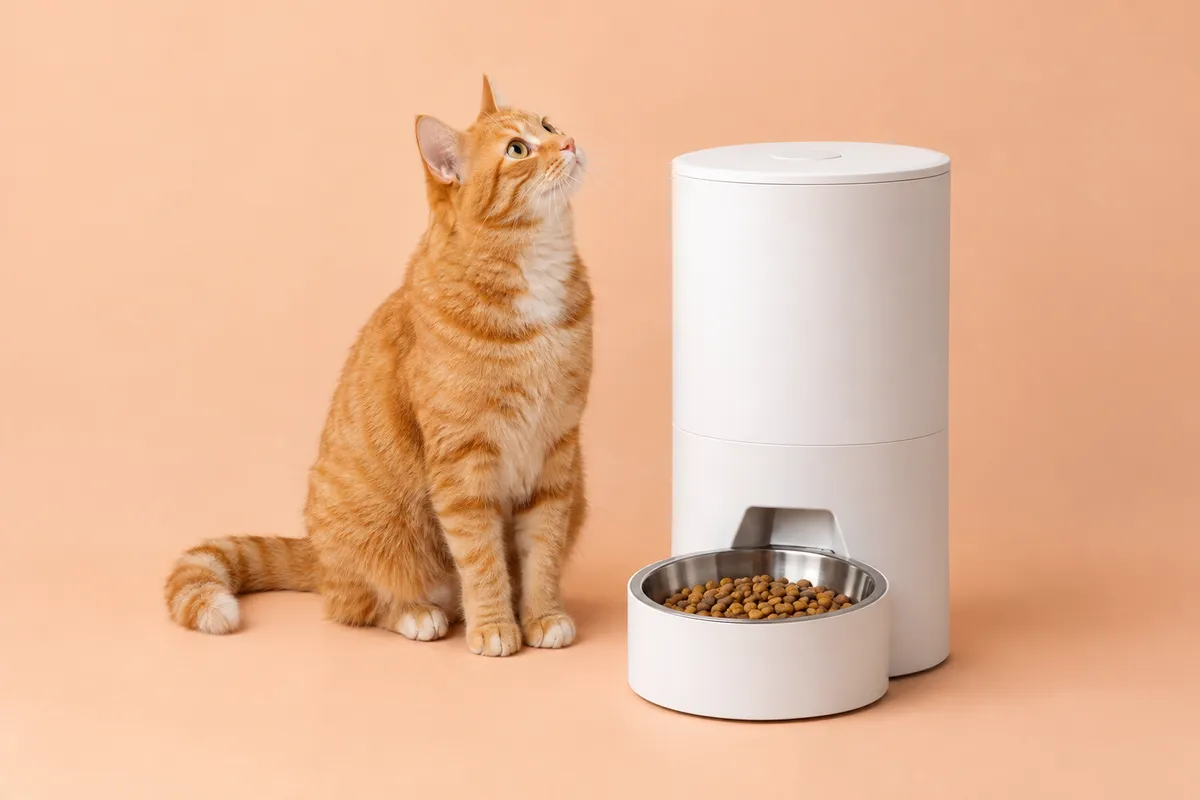
An automatic cat feeder serves meals on a schedule, so breakfast arrives at the same time whether you are asleep, at work or stuck in traffic. The right one depends on two things: what your cat eats (dry kibble or wet food) and how many cats share the kitchen. Here is how each kind works, what to check on the box, and how to set one up so your cat trusts it from day one.
The five kinds of automatic cat feeder
Automatic feeders fall into five families, which differ in how they release food and which food they hold.
| Type | Food | How it works | Best for |
|---|---|---|---|
| Gravity feeder | Dry | A clear tank refills the bowl as the cat eats | Topping up between your own meal times |
| Timed hopper | Dry | A motor turns a paddle to drop set portions at set times | Regular meal times with no app |
| Wi-Fi or app feeder | Dry | A timed hopper you schedule and check from your phone | Changing plans, feeding logs, several people in the home |
| Rotating tray | Wet or dry | A lid turns to open one sealed compartment per meal, ice packs underneath | Wet food and short trips away |
| Microchip feeder | Wet or dry | A lid opens only for a registered microchip or collar tag | Multi-cat homes where each cat eats its own food |
Gravity feeders
A gravity feeder is the simplest: an upturned tank sits on a bowl, and kibble slides down as space opens up. No motor, no battery and no portions, so it suits a top-up role more than scheduled meals. Look for a lid that clicks into place and a bowl that lifts off.
Gravity feeders
No power needed; refill the tank and the bowl tops itself up.


Timed dry-food feeders
A timed hopper holds a few days of kibble in a sealed tank and drops a set number of portions at each meal time you program on its buttons and screen. Many record a short voice clip that plays at meal time, which helps a cat learn the new sound means dinner. These are the go-to pick if you want a routine without an app or a Wi-Fi password.
Timed feeders you set with buttons
Program meal times and portions on the feeder itself.


App and Wi-Fi feeders, with or without a camera
A Wi-Fi feeder works like a timed hopper, with the schedule living in a phone app. You can move breakfast later on a Sunday, serve an extra portion you have already planned for, and see a log of every meal that dropped. A camera model adds a live view of the bowl, night vision and two-way audio, so you can watch your cat eat from the office. Check which Wi-Fi band your router uses: some feeders join only 2.4 GHz networks, others both 2.4 and 5 GHz.
App feeders
Schedule and check meals from your phone.


Feeders with a camera
See the bowl, and your cat, from anywhere.


Rotating-tray feeders for wet food
Wet food cannot go through a hopper, so wet-food feeders use a round tray split into covered compartments. At each meal time the lid turns and opens the next one. Frozen ice packs slide in underneath to keep the food cool while it waits, and a few newer models chill the tray with a built-in cooler instead. How long a wet meal should sit before your cat eats it is a question for your vet and the food's label, so treat these as a way to cover a missed lunch or an early breakfast rather than days away.
Rotating trays for wet or dry meals
One sealed compartment opens per meal; ice packs go underneath.


Microchip feeders for multi-cat homes
If one cat finishes in a minute and then wanders over to the other bowl, a microchip feeder solves it. The lid opens only when it reads a microchip or collar tag you have registered, and closes when that cat walks away. It is also the tidy answer when two cats eat different foods. Some read the microchip your cat already has; others use a lightweight tag on the collar. Most microchip feeders are made for one cat each, so plan one per cat who needs a private bowl.
Feeders that open for one cat
Registered microchip or collar tag only.

What to check before you buy
Most feeder trouble comes from a handful of details on the spec sheet. Check these against your own cat and your own food.
- Kibble size range. Hoppers list the smallest and largest pieces they can dispense. Measure a piece of your cat's food and make sure it sits inside the range, with room to spare.
- Jam-proof dispensing. Look for an anti-clog paddle or a jam sensor that sends an alert. Oddly shaped or oily kibble is the usual cause of a stuck feeder.
- Battery backup. A feeder that runs on mains power with batteries as a backup keeps its schedule through a power cut. Some models run on batteries alone, which frees you from the outlet.
- Portion size. Feeders measure in their own portions, often a fraction of a cup. Read what one portion holds so you can match the amount on your food label, and ask your vet if you are unsure.
- A bowl that comes off. Stainless steel or ceramic bowls lift out and are easy to wash. Check the manual for which parts are dishwasher-safe; the base with the motor never is.
- Desiccant. A small moisture-absorbing pack in the lid helps keep kibble crisp. Check how often the maker suggests changing it.
- A lid lock. Clever cats learn to paw at a hopper lid or tip a feeder over. A locking lid, a button lock on the panel and a heavy, wide base keep the food where it belongs.
Simple timed feeder, no app needed
A good first feeder for a single cat on kibble: set up to six meals a day on its screen and buttons, no phone or Wi-Fi involved.
- Lists the kibble size range it handles
- Long battery life, so it keeps working through a power cut
- Ceramic bowl that lifts out for washing
For wet food on a schedule
A round tray with six covered meals, a stainless steel tray and two ice packs underneath, scheduled from a phone app.
- Works for wet or dry food
- Ice packs slide under the tray
- Replacement ice packs are easy to keep in the freezer

For two cats who eat different food
The lid opens only for a registered microchip or the included collar tag, so each cat finishes its own meal in peace.
- Reads the microchip your cat may already have
- Takes wet or dry food
- Useful when cats are on different foods
Spare ice packs and desiccant pads
Small parts that keep meals fresh.


Setting it up and introducing it gently
Cats like routine, so give your cat a week to get used to the new machine.
- Place it where your cat already eats, on a flat, hard floor away from the litter box and the water bowl. A wipe-clean mat under it catches stray kibble.
- Leave it switched off for a day or two with the usual bowl beside it, so your cat can sniff it in peace.
- Set the clock and the schedule to match your current meal times. Keep the amounts you already serve; your food label and your vet are the guide, never the feeder.
- Run a manual meal while you are there so your cat hears the motor and sees food appear. Record a short voice message if the feeder offers one.
- Stay home for the first few scheduled meals. Check that the right amount dropped and that your cat ate it before you rely on the feeder for a day out.
- Keep checking. A feeder is a helper, not a sitter. Look at the bowl, the tank and the battery every day.
If you are also adding a cat water fountain, introduce one new thing at a time. And mealtimes are a lovely moment to add play: a few minutes with a wand before dinner fits neatly into an indoor cat play routine.
How to clean an automatic cat feeder
Food oils build up on bowls, chutes and trays. A simple rhythm keeps a feeder fresh.
- Bowl: wash it every day, just like a regular bowl, by hand or in the dishwasher if the manual allows.
- Wet-food trays: wash after every cycle, before refilling. Rinse and refreeze the ice packs.
- Hopper and paddle: empty the tank when it runs low and wipe it with a dry or barely damp cloth. Dry every part fully before adding kibble, as damp kibble is what jams a dispenser.
- Base: never put the motor base in water. Wipe the outside and the sensor or camera lens with a soft cloth.
- Desiccant: replace on the maker's schedule, and sooner if the kibble starts to feel soft.
Browse every bowl and feeder in Bowls & Feeders, or search for an automatic cat feeder by size and style.
Questions people ask
What is the most reliable automatic cat feeder?
Reliability comes from the details more than the name: a dispenser that suits your kibble size, an anti-jam design or jam alert, and battery backup for power cuts. A simple timed feeder has fewer parts to go wrong, while an app feeder lets you confirm each meal dropped. Whatever you choose, test it while you are home before trusting it with a full day.
Is it worth getting an automatic cat feeder?
It is worth it if your schedule moves around, if your cat wakes you for breakfast, or if two cats need separate bowls. It keeps meal times steady when you cannot be there. It does not replace daily checks on your cat, the bowl and the water.
Do vets recommend automatic cat feeders?
That is a question for your own vet, who knows your cat. Bring the feeder's portion size to the appointment and ask how much and how often your cat should eat. Then follow your cat's food label and your vet's advice when you set the schedule.
Can an automatic cat feeder handle wet food?
Hopper feeders are for dry food only. For wet food, choose a rotating-tray feeder with ice packs or a built-in cooler, or a microchip feeder with a closing lid. Ask your vet and check the food label for how long wet food should sit out.
What is the best automatic cat feeder for multiple cats?
If your cats eat the same food and share happily, a dual-bowl feeder that splits each meal into two bowls works well. If one cat steals or the cats eat different foods, a microchip or collar-tag feeder for each cat keeps every bowl private.
About the numbers
- Google search, people also ask for "automatic cat feeder", read 2026-10-07: Shoppers ask what the most reliable automatic cat feeder is, whether one is worth getting, and whether vets recommend them.
- Google search, related searches for "automatic cat feeder", read 2026-10-07: Related searches include automatic cat feeders for multiple cats, for wet food and with a camera.