How to Choose a Budgie Cage: Width, Bar Spacing and Setup
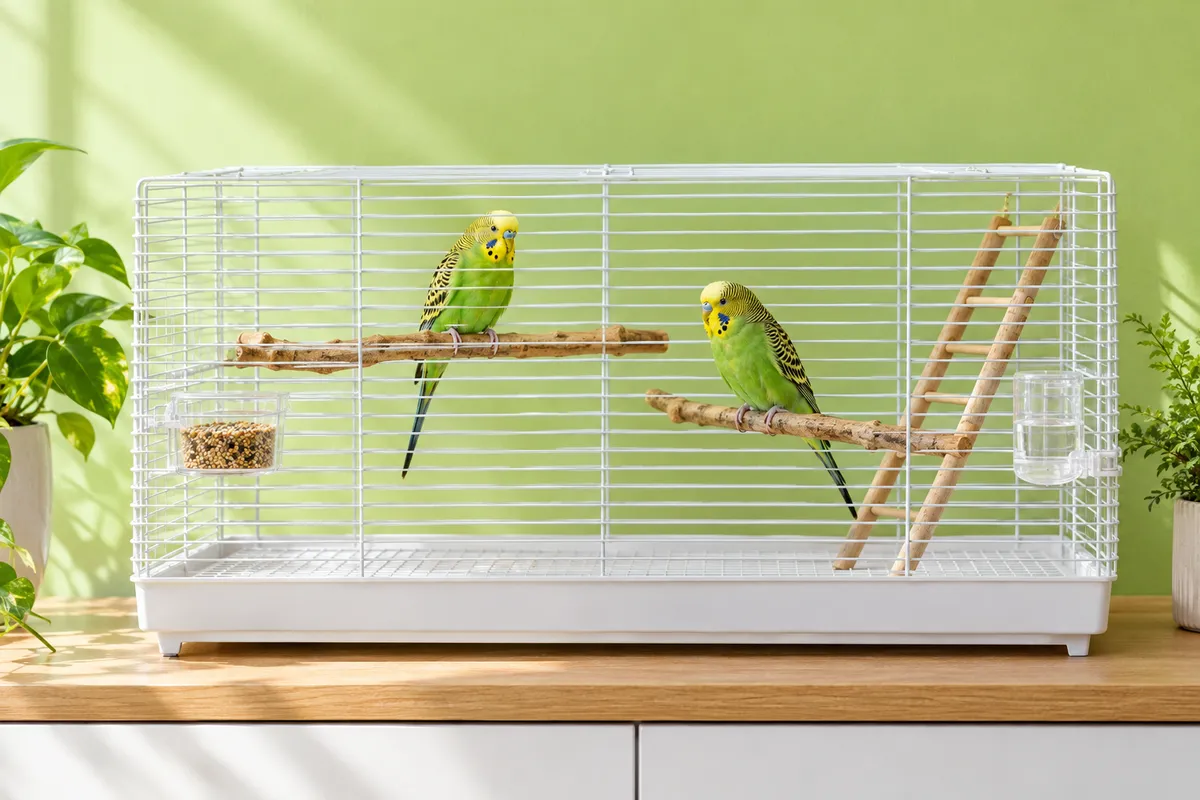
Pick a budgie cage that is wider than it is tall, with bars no more than half an inch apart, horizontal bars for climbing, wide doors and a pull-out tray.
In short
- Choose width over height: budgies fly from side to side, so a long, low cage gives more usable room than a tall, narrow one.
- Keep bar spacing at half an inch or less, the figure given by both an avian vet's care sheet and a bird rescue's cage guide.
- Look for horizontal bars on at least two sides, because budgies climb the walls of their cage with beak and feet.
- For two budgies, published minimums run from 30 x 18 x 18 inches to a 31 x 20 inch flight cage; bigger is kinder.
- Fit perches of mixed thickness and natural wood, place the cage away from the kitchen and drafts, and ask an avian vet about anything to do with health.
Hello, lovely budgie people. The right budgie cage is long, low and finely barred, with doors you can reach through and a tray that slides out for cleaning. Everything else, from perches to cups, builds on that frame. Here is how to read a cage listing so the home you bring back actually suits a small, busy, flying bird.
Wide beats tall: why budgies need length
Budgies fly side to side, not straight up like a helicopter. A tall, narrow cage looks grand but gives a budgie only a few wingbeats before the next wall. A flight cage that is longer than it is high lets a bird hop, flutter and glide from one end to the other, which is how budgies use space.
When you compare cages, read the length and depth of the cage itself, not the height with its stand. Many listings quote the height including a rolling stand, which adds nothing a bird can use. A cage around 30 inches long on a stand often beats a 60-inch tower that is only 18 inches wide.

A wide flight cage for a pair
This one is built the right way round: the cage itself is about 30 inches long and 18 inches deep, so a pair gets real flying length. It sits on a rolling stand with a storage shelf underneath, and the large front door opens wide.
- Long, low cage body on a separate stand
- Big front door for cleaning and hand training
- Shelf below for seed, liners and spare toys
Bar spacing for small birds
Keep bar spacing at half an inch or less. Teresa Manucy, DVM, writing a budgie care sheet, says the bars should be spaced half an inch apart or smaller, and the St. Louis Avian Rescue cage guide gives the same limit for budgies. Wider gaps can let a small bird push its head between the bars or slip out.
Check this number before anything else. Cages sold for cockatiels and conures often use wider bars, so a cage that looks perfect can still be wrong for a budgie. If a listing does not state the spacing, measure a sample on arrival or choose a cage that does.
Horizontal bars, doors and the tray
Budgies climb their cage walls using beak and feet, so horizontal bars on at least two sides turn the walls into a climbing frame. All-vertical bars give them little to grip.
- Wide doors: a big front door lets your hand, a perch or a cup through without a struggle. Small feeder doors are handy for refills.
- Pull-out tray: a slide-out tray means you can clean without opening the whole cage. A wire grate above it keeps birds out of the mess.
- Finish: powder-coated steel and stainless steel are the two finishes to look for. Both wipe clean; stainless costs more but has no coating to chip.
- Shape: rectangular cages give corners and flat walls for perches and cups; round cages give less usable space.
| Feature | What to look for | Why it matters |
|---|---|---|
| Shape | Longer than it is tall | Budgies fly side to side |
| Bar spacing | Half an inch or less | Keeps heads and bodies inside |
| Bar direction | Horizontal on at least two sides | Gives a climbing wall |
| Doors | One large front door plus feeder doors | Easy cleaning, easy handling |
| Tray | Slide-out tray under a wire grate | Quick daily cleaning |
| Finish | Powder-coated or stainless steel | Wipes clean, no flaking paint |
How big a cage for one budgie or a pair
Published minimums vary, so treat them as a floor, never a goal. Dr. Manucy describes 18 x 18 x 18 inches as an ideal enclosure for one budgie and 30 x 18 x 18 inches for two. The St. Louis Avian Rescue guide is roomier: 24 x 24 inches at least for a single bird and a 31 x 20 inch flight cage for two or more. Budgies are social, and many households keep a pair, so plan for the bigger number if you can.
Cages worth a look
Compare the cage body's length and the stated bar spacing first.


Perches: mixed thickness and natural wood
Most cages arrive with two smooth dowels of the same width. Swap at least one for natural wood and add perches of different thicknesses, so feet grip in more than one way. Dr. Manucy suggests budgie perches at least 4 inches long and 3/8 inch in diameter, offered in an assortment of sizes, heights, textures and materials.
- Grapevine and other branch perches have bumps and forks that change the grip.
- A rope perch bends into a curve and gives a soft spot to rest.
- A textured perch adds a rougher surface; keep it as one choice among several, not the only one.
- Place perches at different heights, and never directly over food or water cups.
Perches with variety
Mix branch wood, rope and one textured perch.


Where to put the cage
Put the cage in a lived-in room where your budgie can see you, with one side against a wall so the bird has a sheltered back. Keep it out of the kitchen, where cooking fumes, steam and heat swings reach it, and away from drafts from doors, windows and air vents. Avoid full afternoon sun on the cage. A stand that brings the cage to around chest height makes it easy to see into and to clean. For any question about fumes, temperature or your bird's health, ask your avian vet.
What goes inside
Keep the inside simple so there is still room to fly. A good starting set:
- Two food cups and one water source, clipped where droppings cannot fall into them.
- Three or four perches of different widths, as above.
- A cuttlebone in its holder, clipped to the bars. Ask your vet about what minerals your bird needs.
- A few toys, rotated weekly rather than all at once. Our bird toy glossary explains shreddables, foragers and swings.
- A shallow bath to offer a couple of times a week, removed after use.
Cups, water and the small extras
Clear and clip-on pieces make refills quick.


A cleaning routine that takes minutes
A little every day keeps the big clean easy. Dr. Manucy's care sheet suggests daily spot cleaning to remove soiled bedding and dropped food, washing food and water bowls daily, and changing the cage lining weekly.
- Daily: wash and refill cups and water, slide out the tray and change the paper, pick up dropped seed.
- Weekly: wipe the grate and bars, scrub perches, swap a toy or two.
- Monthly: take out everything and wash the whole cage with warm water and a mild, bird-safe cleaner, then dry fully before reassembling.
A seed catcher skirt around the base and a breathable cover for night time make life tidier and quieter. Browse more in cages and accessories.
Tidy-up helpers


Questions people ask
Do budgies need a vertical or horizontal cage?
A horizontal one. Budgies fly side to side, so a cage that is longer than it is tall gives them more room to move. Horizontal bars on the walls also help them climb.
What bar spacing is safe for a budgie?
Half an inch or less. That is the figure in a vet-written budgie care sheet and in a bird rescue's cage guide. Cages made for larger parrots often have wider bars, so always check.
How big should a cage be for two budgies?
Published minimums for a pair range from 30 x 18 x 18 inches to a 31 x 20 inch flight cage. Treat those as the smallest acceptable size and go longer if your space allows.
How many budgies can I keep in one cage?
That depends on the cage's length and on the birds themselves. Give each extra bird more length, enough perches and separate cups so nobody guards the food. Ask your avian vet or an experienced keeper before adding birds.
How often should I clean a budgie cage?
Spot clean and wash cups every day, change the lining weekly, and give the whole cage a full wash about once a month. A pull-out tray makes the daily part quick.
About the numbers
- Teresa Manucy, DVM, Budgie Care Sheet, read 2026-10-07: Bars half an inch apart or smaller; 18 x 18 x 18 inches for one budgie and 30 x 18 x 18 inches for two; perches at least 4 inches long and 3/8 inch in diameter in an assortment of sizes and materials; daily spot cleaning and bowl washing, lining changed weekly
- St. Louis Avian Rescue (STAR), Cage Sizes and Requirements, read 2026-10-07: Budgies: single bird 24 x 24 inches minimum, two or more birds a 31 x 20 inch flight cage, bar spacing no larger than half an inch
- Google search, people also ask for budgie cage size, read 2026-10-07: Questions on vertical vs horizontal cages and how many budgies per cage