Bird Toy Glossary: Shreddables, Foragers, Perches and Swings
Parrots need toys to shred, foragers that hide a treat, small foot toys, perches of mixed widths and textures, and a swing or ladder. Here is what every bird toy term means.
In short
- Parrots need one toy from each family: a shreddable, a forager, a foot toy, a chew, mixed perches and a swing or ladder.
- Shreddables are soft sola, paper, palm leaf or loofah toys made to be torn up, so a toy in scraps has done its job.
- Foragers hide a treat in paper, palm leaf or a metal puzzle; start with one where the reward is easy to find.
- Perches should vary in width, shape and surface, mixing natural branches, bendable rope and a flat platform.
- Buy every toy in the size listed for your bird, and rotate one or two toys about once a week.
Parrots need toys they can destroy, toys that make them work for a treat, small things to hold and perches that feel different underfoot, plus a swing or ladder for climbing. This bird toy glossary explains each term on the label, what the toy is made of and how a bird uses it, so you can build a mix from our toys and perches that suits your parrot.
What toys do parrots need? One from each family
Think in families, not single toys. A budgie, a cockatiel, a conure and an African grey use the same families; only size and toughness change. One of each, swapped around regularly, gives your bird something fresh to do without crowding its room to climb.
| Family | What it is | Common materials | What your bird does |
|---|---|---|---|
| Shreddables | Soft toys made to be torn up | Sola, paper, palm leaf, loofah | Bites and strips |
| Foragers | Toys that hide a treat | Crinkle paper, palm leaf, seagrass, metal | Digs and unwraps |
| Foot toys | Small loose toys | Rattan, sola, canvas, plastic | Holds and chews in one foot |
| Chews | Harder, longer lasting | Wood blocks, knotted cotton rope | Gnaws and pulls knots |
| Perches | What the feet stand on | Grapevine, manzanita, rope, flat wood | Stands and rests |
| Swings and climbers | Pieces that move or go up | Cotton rope, wooden rungs and beads | Swings and climbs |
Shreddables: toys made to be destroyed
A shreddable is soft enough for a beak to tear into strips and crumbs. Shredding is everyday parrot behavior, so confetti on the cage floor means the toy worked. Keep a spare ready.
- Sola: the dried, spongy pith of a marsh plant, Aeschynomene aspera. White, feather light and soft enough for a parakeet.
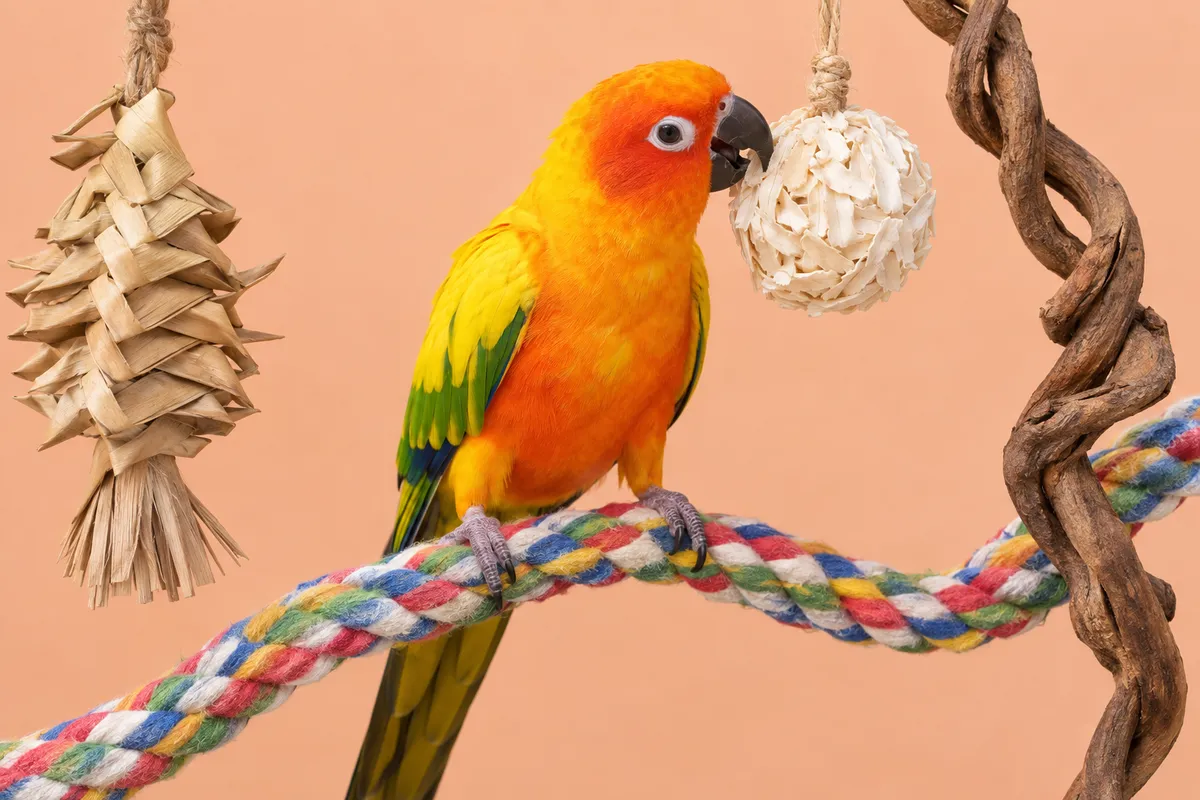
- Sola atta ball: an airy ball of crisscrossed sola, full of gaps a beak can hook into. Sola atta balls double as foot toys.
- Pith wood stack: soft wood rounds threaded on a cord, worked down one disc at a time.
- Crinkle paper: zigzag paper shreds, used as stuffing or on their own.
- Paper rings: layered paper discs that peel apart; some large toys can be refilled.
- Palm leaf: dried leaf strips woven into tubes, stars and piñatas. Tougher than paper, softer than wood.
- Loofah: slices of dried gourd sponge that crunch as they break.
Shreddables from soft to sturdy
Sola and paper for small beaks, refillable rings for big ones.


A first shreddable for small and medium beaks
Three 2-inch balls of natural sola with an airy, crisscrossed weave that is easy to grab. Small and medium birds pick them apart, carry them about or hold them in one foot.
- Light enough to hold in one foot
- Loose in a dish or strung onto another toy
Foragers: toys that hide a reward
A forager hides food or a treat so your bird has to search, pull or unwrap to reach it, a small taste of the food hunting that fills hours of a wild parrot's day. Start easy: if the reward is fully hidden, your bird may not know it is there. Browse our bird foraging toys and fill them with your bird's usual food or treats.
- Shredder ball: a jute ball packed with paper and small wooden pieces. A gentle first forager.
- Piñata: a woven palm leaf shell with soft stuffing; tuck a treat into the weave.
- Foraging heart or star: an open vine frame loaded with paper, cardboard and tubes.
- Seagrass mat: a woven panel clipped to the bars; push treats into it for a foraging wall.
- Treat skewer: a stainless steel rod with a disc stopper for pieces of fruit or vegetable.
- Baffle cage: a small stainless wire cage to stuff with food or paper.
- Puzzle ball: a metal sphere holding wooden balls or treats to turn and pull out. The expert level.
| Level | Set it up like this | Toy that suits |
|---|---|---|
| First try | Reward in plain sight | Treat skewer, baffle cage |
| Getting the idea | Reward half hidden in paper | Shredder ball, foraging heart |
| Confident | Reward wrapped or woven in | Piñata, seagrass mat |
| Expert | Reward turned or pulled out | Puzzle ball |
Foragers from first try to expert
Most can be restocked with fresh treats again and again.


An easy first forager
A 5-inch ball of colorful paper and jute with small wooden pieces tucked inside, sized for cockatiels, parakeets and conures. There is always paper to pull at, so the hunt starts straight away.
- Hangs from a quick link
- Paper and wood to shred after the hunt
Foot toys: small things to hold
Many parrots hold a small toy in one foot and chew it like a snack, while others rarely lift one, so see which your bird is before buying a pile. Drop foot toys in a spare dish or on a platform perch.
- Rattan ball: a hollow ball of woven rattan cane, also called a vine or wicker ball. Stuff it with paper for a tiny forager.
- Woven cylinder: a palm leaf tube packed with coconut coir fiber to tease out.
- Mini sneaker: a tiny cotton canvas shoe with a soft rubber sole and laces to untie.
- Birdie ball: a hard plastic ball with holes and a bell inside that rolls and rattles.
Foot toys to hold and toss


Chews: wood blocks and knotted rope
- Wood blocks: cut wooden pieces, often dyed bright colors, hung on rope or chain. Thicker blocks suit bigger beaks.
- Knots and blocks: blocks strung between thick cotton rope knots to chew and work loose.
- Cotton rope: soft twisted rope in chews, perches and swings. Check it often and replace any rope toy or perch that starts to unravel, because loose threads can wrap around toes.
Chews for medium and large beaks
The biggest blocks are for macaws and cockatoos.


Perches: what the feet stand on all day
Your bird stands almost all day, so perches matter as much as toys. Vary widths, shapes and surfaces around the cage. A good fit lets the toes wrap about three quarters of the way round without the front and back toes meeting.
- Dowel: the smooth round perch most cages come with. Fine as one of several.
- Natural branch: real wood with twists and changing width. Grapevine perches are real vine, so no two are the same shape.
- Manzanita: a very hard, smooth, reddish wood, sometimes part coated in pumice.
- Rope perch: cotton rope wound over steel wire that bends into curves.
- Bungee: a spiral rope perch hung from the cage top that gives a little as your bird climbs.
- Platform perch: a flat board for standing flat footed, eating or holding a foot toy.
- Textured perch: a rough pumice or cement surface. Use one among several, never as the only perch, and skip sandpaper perch covers. Ask your vet about feet or nails.
| Perch | Feels like | Where it works |
|---|---|---|
| Grapevine or natural branch | Natural wood, changing width | Main resting and lookout spots |
| Rope perch or bungee | Soft, a little springy | Linking levels, near toys |
| Platform | Flat and firm | Beside food, or as a foot toy table |
| Textured | Rough and gritty | One spot, such as in front of the food bowl |
Perches that change width and texture
Mix two or three types in one cage.


To swap out a plain dowel
Five grapevine perches, one forked and four straight, each with its own twists and width, for small and medium birds. Replace one or two dowels and every hop lands somewhere new.
- Widths from about 0.6 to 1.2 inches
- Real vine, so no two are alike
Swings, boings, ladders and play stands
Movement pieces let a bird swing, bounce and climb. Hang them clear of the path between perches and food. Find more bird swings and stands in cages and accessories.
- Swing: a hanging perch that sways, in rope triangle, wooden bead or rope ring styles.
- Boing: a long coil of cotton rope over a flexible core that bobs as your bird climbs, usually with a bell.
- Globe swing: crossed rope rings that a large parrot climbs inside and out.
- Ladder and ladder bridge: wooden rungs between rails, or a flexible run of rungs and beads hung in a curve.
- Play stand: a perch frame outside the cage with a tray, cups, a ladder and often a swing, so your bird can be near you.
Swings, ladders and stands
Multi-piece sets for small birds, big rope pieces for large parrots, and play stands in a few sizes.


For bouncing and climbing
A 96-inch coil of multicolored cotton rope over a flexible core, with a bell at the end, long enough to loop through a big cage or over a play stand.
- Soft rope grip all the way along
- A bell to ring on the way down
Mirrors and bells
- Bell: small for budgies, heavy stainless steel for strong beaks. Check the clapper is fixed so it cannot be pulled out.
- Mirror: some birds ignore it and a few get very attached to their reflection. Watch how yours responds, and ask your vet if it seems to take over the day.
Bells and mirrors


How to set up your parrot's toys
- Start with one toy from each family, two or three perch types and a swing or ladder.
- Match every toy to the bird size on its label.
- Hang toys clear of perches, the door and the dishes.
- If your bird is wary of new things, leave a new toy beside the cage for a few days, then hang it on the outside for a few more before it goes in. Stay close while your bird explores.
- Swap one or two toys about once a week, and replace frayed rope or remove loose parts when you clean.
Keeping a betta too? Our betta tank guide runs through the heater, filter, plants and hides.
Questions people ask
What toys do parrots like to play with?
Most parrots enjoy toys to shred, foragers that hide a treat, foot toys to hold and swings or boings to climb. Offer one from each family and notice which get destroyed first: those are your bird's favorites.
What does a parrot need to be happy?
Varied perches, a rotating mix of toys, daily time out of the cage with its people and a steady routine all help a parrot settle. For diet, sleep, feathers or anything about health, ask your avian vet.
How do I entertain my parrot?
Give it work: wrap a treat in paper, stuff a rattan ball with paper and a treat, or set up a play stand near you. Short games together, like passing a foot toy back and forth, count too.
How often should I change my bird's toys?
Swap one or two about once a week so the cage stays interesting without unsettling your bird. Replace shreddables when they are used up and rope toys as soon as they start to unravel.
Is it normal for my bird to destroy its toys?
Yes. Tearing and chewing are ordinary parrot behavior, and a shreddable in scraps did its job. If toys vanish too fast, add sturdier chews alongside.
About the numbers
- VCA Animal Hospitals, Perches for Birds: Toes should wrap about three quarters of the way around a perch; perches of different sizes; watch rope perches for fraying; sandpaper covers not recommended; concrete perches never the only perch, and one in front of the food bowl gets used.
- VCA Animal Hospitals, Toys for Birds: Chewable and foraging toys; avoid toys that come apart easily, bell clappers included; remove rope toys and perches that start to unravel; rotate toys about once a week; introduce a wary bird to a new toy beside the cage first.
- Avian Welfare Coalition, The True Nature of Parrots: Wild parrots spend hours foraging for a variety of natural foods.