What Do Hermit Crabs Need? A Habitat Setup Checklist
Hermit crabs need a glass tank with a tight lid, deep damp substrate, gentle warmth, high humidity, fresh and salt water, spare shells, hides and a friend or two.
In short
- Hermit crabs need a glass tank with a tight lid, deep substrate, warmth, humidity, two kinds of water, spare shells, hides and company.
- PetMD's care sheet suggests at least a 10-gallon glass tank for one or two crabs, plus about 5 more gallons for each extra crab.
- Substrate should be deep enough for your biggest crab to bury itself completely, because crabs dig down to molt.
- Keep a thermometer and a hygrometer in the tank and check both every day, rather than guessing.
- Hermit crabs are social, so plan for two or more from the start and give every crab a choice of spare shells.
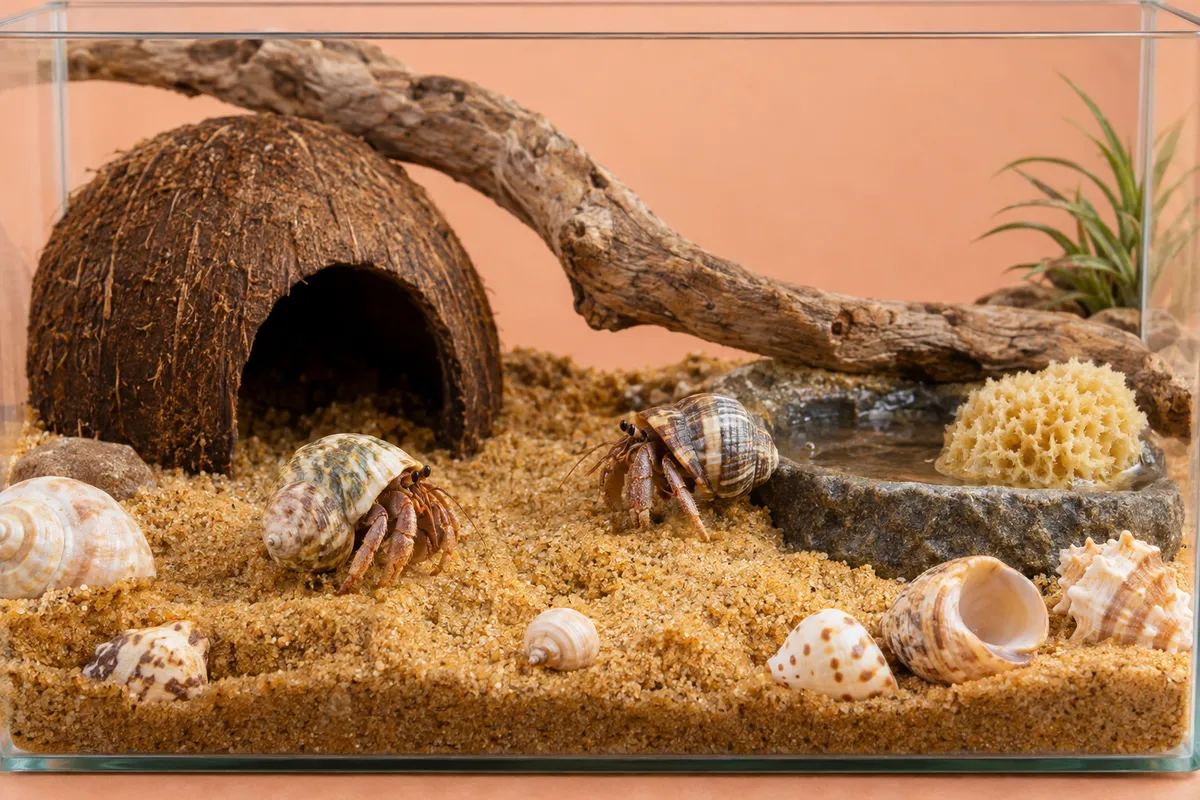
Hello, lovely! If you are wondering what hermit crabs need, the short answer is a little beach that stays warm and damp: a glass tank with a secure lid, sand they can dig deep into, a gentle heat source, steady humidity, a dish of fresh water and a dish of salt water, a pile of spare shells, things to climb and hide under, and at least one other crab. Get those right before your crabs come home and the rest is happy watching.
This checklist walks through each piece in the order you would set it up. Where we give a number, it comes from PetMD's hermit crab care sheet, credited below. For anything about your crabs' health, ask a vet who sees exotic pets.
1. A glass tank with a lid that really closes
Start with the home itself. Hermit crabs are escape artists and climbers, so the lid matters as much as the tank. PetMD's care sheet suggests at least a 10-gallon glass tank for one or two crabs, with at least 5 more gallons for each crab you add, so four crabs need 20 gallons or more. It also prefers glass to plastic, because glass holds warmth and humidity better.
Front-opening terrariums make daily misting and spot cleaning easy without lifting everything out. If your lid is mesh, many keepers lay a piece of glass or plastic over part of it to hold in moisture while still letting some air through. Browse more habitats and terrariums if you need a different footprint.
Glass terrariums with secure tops
Pick a size that leaves room for deep sand, two dishes and a hide or two.


2. Deep substrate for digging and molting
Hermit crabs bury themselves to molt, often for weeks, so the floor of the tank is their bedroom. PetMD suggests a substrate at least three times as deep as your largest crab is tall, made from washed sand mixed with coconut fiber at about five parts sand to one part fiber. Damp sand that holds its shape when you squeeze it lets tunnels stay standing.
Coconut fiber bricks expand when you add water, so one small brick goes a long way. A little sphagnum moss in one corner gives the crabs a soft, damp patch. Skip pine or cedar shavings, which PetMD lists among the things to avoid. You will find sand, coir and moss together in decor and substrate.
Sand, coconut fiber and moss
Mix sand and coir, then dampen until it packs like a sandcastle.


A ready mix to start with
This blend combines sand and coconut fiber in one bag, so you can fill the tank without measuring two materials.
- Sand and coconut fiber together
- Made for hermit crab tanks
- Easy to dampen and pack
3. Gentle warmth, and a thermometer to prove it
Do hermit crabs need a heat lamp? They need warmth, and how you provide it depends on your room. PetMD describes a warm end around 80 F and a cool end and night temperature around 70 F, using an under-tank heater on a thermostat with a low-wattage bulb for daytime light, about 10 to 12 hours a day.
Stick a heat mat on the side of the tank rather than under deep sand, so the crabs can dig away from the warmth if they want to. A thermostat switches the mat off when it reaches the set temperature, which is much kinder than a mat running flat out. PetMD lists hot rocks among the things to avoid.
Heat mats and thermostats
A mat plus a thermostat keeps the warm side steady.


4. Humidity, and a hygrometer to read it
Humidity is the number new keepers most often miss. PetMD suggests 70 to 90% humidity, checked every day with a hygrometer, and misting with dechlorinated water when it drops. Damp substrate, a moss patch, open water dishes and a partly covered lid all help hold it.
Digital gauges show temperature and humidity on one small screen. Place one at crab height on the warm side, and if you can, a second on the cool side so you know both ends of the tank.
Thermometer and hygrometer gauges
Read both numbers at a glance every morning.


5. Fresh water and salt water, easy to climb out of
Hermit crabs need two dishes: one of fresh dechlorinated water and one of salt water made with a marine salt mix, never table salt. PetMD suggests non-metal, non-porous dishes, kept shallow for small crabs, with a natural sea sponge or a ramp so every crab can climb out easily. Bigger crabs enjoy a dish deep enough to dip into, so match the depth to your smallest crab and add steps or pebbles.
Dishes with steps and ramps
Sloped sides help small crabs climb out.


6. Spare shells in several sizes
A hermit crab grows by moving house, so spare shells are not décor, they are the next home. PetMD suggests at least three to five empty shells per crab in assorted sizes, with openings a little bigger than the one each crab wears now. Choose natural shells without cracks, holes or paint.
Measure the opening of each crab's current shell and look for spares with a slightly wider mouth. Mixed packs make it easy to offer a real choice.
Natural shells for growing crabs
Assorted sizes so every crab has a next step up.


7. Hides, climbing décor and a quiet spot
Crabs like to hide during the day and climb at night. Give them at least one hide per crab on each side of the tank, plus branches, vines and hanging plants to scramble over. Coconut huts and resin caves both work, and wood and vines add climbing paths. See more hides and climbing décor.
Place the tank somewhere quiet, away from direct sun, drafts and heater vents, and away from a busy doorway. Keep climbers low enough that a crab cannot reach the lid.
Hides and things to climb
Mix caves on the floor with branches and vines above.


8. More than one crab, and a tidy routine
Hermit crabs are social. PetMD advises keeping them in pairs or groups, introducing new crabs gradually while you watch, and separating any that fight. Make sure there are enough shells and hides for everyone so nobody has to compete.
A small sand scoop makes daily spot cleaning quick. Leave a buried crab alone: PetMD says not to handle a crab while it molts.
For daily tidying

| Checklist item | Why it matters | What to check |
|---|---|---|
| Glass tank with lid | Holds warmth and humidity, stops escapes | Lid fits tightly |
| Deep substrate | Space to dig and molt | Deeper than 3 times your biggest crab |
| Heat mat and thermostat | Steady warmth | About 80 F warm side, 70 F cool side |
| Hygrometer | Shows humidity | 70 to 90% |
| Fresh and salt water | Two dishes, easy exits | Clean water daily |
| Spare shells | Room to grow | 3 to 5 per crab |
| Hides and climbers | Shelter and activity | One hide per crab |
| Company | Social animals | Two or more crabs |
Setting up more than one small pet? Our ferret setup checklist and aquarium starter checklist follow the same step-by-step approach, or browse hermit crab supplies.
Questions people ask
What supplies do you need for hermit crabs?
A glass tank with a tight lid, sand and coconut fiber substrate, a heat mat with a thermostat, a thermometer and hygrometer, fresh and salt water dishes, spare shells, hides and climbing décor. Set it all up and let the temperature and humidity settle before the crabs arrive.
Are hermit crabs easy to take care of?
They are quiet and small, but they need steady warmth and humidity, daily fresh and salt water, and spare shells. Checking the gauges and water every day is the main routine. For health questions, ask a vet who sees exotic pets.
What not to put in a hermit crab tank?
PetMD lists hot rocks, pine or cedar shavings, painted shells, metal food or water dishes and porous materials that cannot be cleaned. Also avoid table salt in the salt water dish and anything a crab could climb to reach the lid.
Do hermit crabs need a heat lamp?
They need warmth, but a lamp is not the only way. PetMD describes an under-tank heater on a thermostat with a low-wattage bulb for daytime light. Use a thermometer to confirm the warm side reaches about 80 F.
Can you keep just one hermit crab?
Hermit crabs are social, and PetMD advises keeping them in pairs or groups. Add a few extra gallons of space, shells and hides for each extra crab.
About the numbers
- PetMD, Hermit Crab Care Sheet, read 2026-10-28: 10-gallon glass tank for one or two crabs plus 5 gallons per extra crab; warm end 80 F, cool end 70 F; humidity 70 to 90%; substrate at least three times the largest crab's height, 5:1 sand to coconut fiber; 3 to 5 spare shells; keep in pairs or groups; items to avoid
- Google search, United States, read 2026-10-28: people also ask: what supplies do you need for hermit crabs, are hermit crabs easy to take care of, what not to put in a hermit crab tank; related: do hermit crabs need a heat lamp