Indoor Rabbit Setup Checklist: Pen, Flooring, Hay and Hideouts
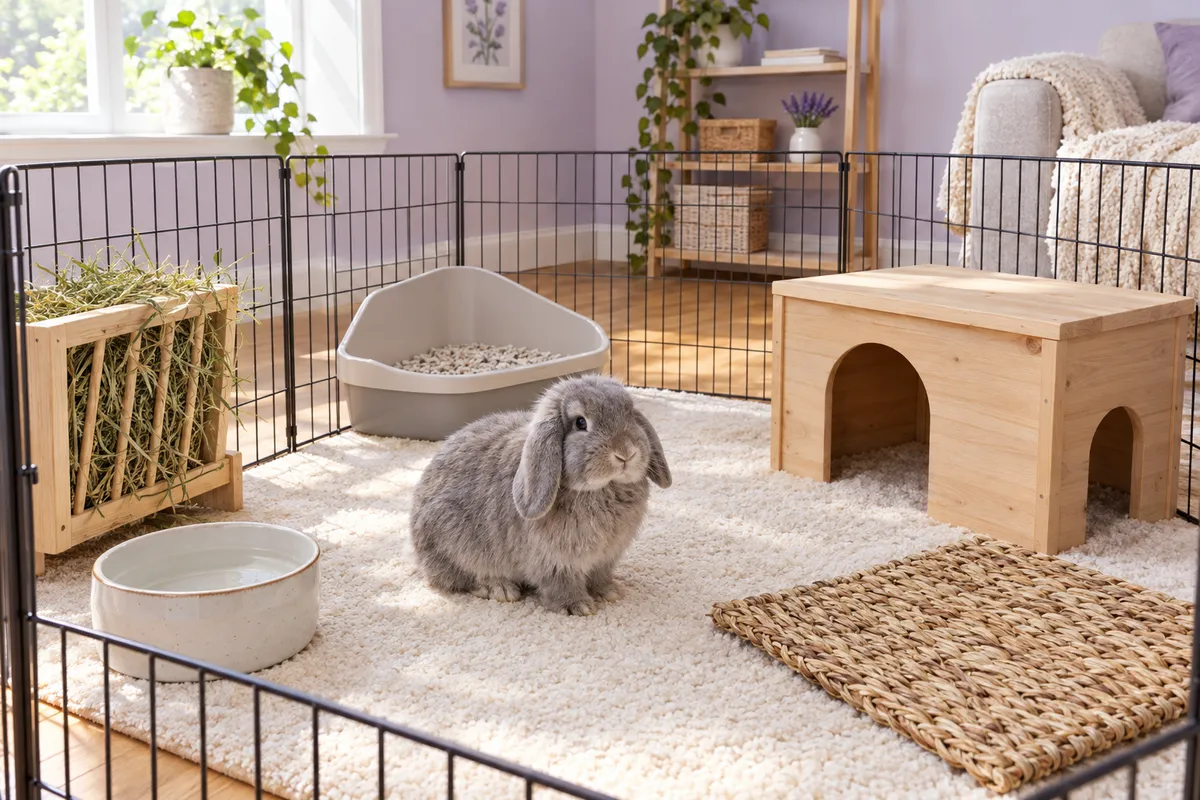
Rabbits need a roomy pen with soft flooring, daily free-roam time, a hay rack, a litter box with paper litter, a water bowl, a two-door hideout and things to chew and dig.
In short
- A rabbit's home base works best as an exercise pen or large enclosure, with several hours a day of free-roam time on top; the House Rabbit Society suggests a 4' x 4' pen plus free roam for most rabbits.
- The Rabbit Welfare Association & Fund sets its minimum for two average-sized rabbits at 3m x 2m x 1m high (about 9'10" x 6'7" x 3'3"), available at all times.
- Cover the floor with washable rugs or liners and skip wire floors, because rabbits have furry feet with no pads and slip on smooth surfaces.
- Put a hay rack right next to the litter box, fill the box with paper or pellet litter, and offer water in a heavy bowl rather than only a bottle.
- Add a hideout with two exits, natural chew toys and a dig box, then bunny-proof every cable and chair leg the rabbit can reach.
- For diet, health or how warm a particular rabbit should be kept, ask your vet.
Hello, bunny people. If you are asking what do rabbits need in their cage, the honest answer is: more than a cage. A happy indoor rabbit has a roomy home base, a soft floor, hay within reach of the litter box, water, a hideout, things to chew and dig, and a bunny-proofed room to zoom around in. Here is the whole setup as a checklist you can tick off before your rabbit comes home.
1. Space first: a pen or large enclosure plus free-roam time
Start with the biggest home base your room allows, then add time out of it every day. The House Rabbit Society says a rabbit's sleeping and leisure area should be at least four times the size of the rabbit, with access to a larger space for 4 or more hours of running, jumping and digging each day. It names a 4' x 4' puppy exercise pen with free-roam time as an ideal setup for most rabbits. Where a cage is used at all, the same group suggests it be 3 to 4 times the rabbit's stretched-out length, and treats it as a bedroom for resting, not a living space.
The Rabbit Welfare Association & Fund goes further. Its minimum for two average-sized rabbits is one enclosed area of 3m x 2m with 1m of height (about 9'10" x 6'7" x 3'3"), open to them at all times rather than for limited periods. Rabbits are social, so plan your space with a pair in mind.
- An exercise pen or modular enclosure as the home base, at least 4' x 4'
- Panels tall enough that your rabbit cannot hop out (some pens add a mesh roof)
- A cage, if you have one, used only as a bedroom with its door left open
- Free-roam time in a bunny-proofed room every day
- A plan for a bonded pair, with space sized for two
Pens and enclosures for an indoor home base
Panels join into a shape that fits your room; link two sets for a bigger run.


2. Flooring: soft rugs, no wire floors
Lay a washable rug, fleece or absorbent liner across the whole pen. The Rabbit Welfare Association & Fund points out that rabbits have furry feet with no pads, so they slip on tile, laminate and lino; it suggests non-slip mats, carpet tiles or runners. The House Rabbit Society lists blankets or other cushioned flooring as an essential and recommends a solid bottom rather than a wire grate. A sheet of vinyl or a waterproof tarp under the blanket keeps your own floor dry.
- Waterproof base layer under the pen
- Washable rug or liner on top, cut to cover every corner
- A second liner so one can be in the wash
- Any wire shelf or ramp covered with a mat
Washable rugs and liners
Big sizes cover a whole pen in one piece.


3. Hay rack, litter box and litter
Set the litter box and the hay side by side. Rabbits like to munch and go at the same time, which is why the Rabbit Welfare Association & Fund suggests putting hay near the litter tray, and in the spot your rabbit already chooses. A large, low-sided box is easier to hop into than a small corner tray.
Pick a rabbit-safe litter. The House Rabbit Society names compressed pine, paper or wheatgrass pellets, and says to avoid litters with wood shavings, silica-gel crystals, or clumping or clay litters. How much hay and which kind your rabbit should eat is a diet question, so ask your vet.
- A hay rack or hay bag mounted beside or over the litter box
- A large litter box, one per rabbit or more in a big room
- Paper or compressed pellet litter (no clumping or clay)
- A scoop and spare liners for quick cleanups
Hay racks and feeders
Bags hang on pen panels; the wooden manger sits right at nose height.


Litter boxes and paper litter
Steel pans are deep and easy to rinse; corner boxes tuck into tight spots.


4. Water: bowl or bottle?
Offer a heavy bowl. The House Rabbit Society prefers water bowls because rabbits drink more from them and they are easier to clean every day. A bowl that clips to a pen panel cannot be tipped over; a bottle makes a handy backup for travel or a second water source.
| Option | Good for | Watch for |
|---|---|---|
| Heavy ceramic bowl | Natural drinking position, easy daily wash | Hay and litter landing in it |
| Clip-on steel bowl | Stays put on a pen panel | Set it low enough to reach comfortably |
| Bottle | Backup source, carriers and trips | Check the spout daily; refill and clean often |
Bowls and a backup bottle


5. Hideouts, chews and a dig box
Give your rabbit somewhere to disappear. The Rabbit Welfare Association & Fund suggests a cardboard box with a hole cut at each end, so there are two ways in and out; wooden houses with two doorways or a tunnel do the same job. The House Rabbit Society lists hidey houses of cardboard, untreated wood or plastic.
Then add things to chew and dig. The House Rabbit Society suggests chew toys made of untreated wood, willow, sisal, jute, coconut, paper, cardboard, hay and other grasses, and mats of seagrass, timothy, coconut or jute for digging. A shallow box filled with shredded paper or a stack of grass mats makes an easy dig box. Introduce new things gently and watch the first few play sessions.
- One hideout per rabbit, each with two exits
- A tunnel to dash through
- Natural chews: apple sticks, grass balls, woven mats
- A dig box or a pile of seagrass mats
- A cozy bed inside the hideout

A hideout with more than one way out
This wooden house has an arched front door, a round side opening and little windows, so a rabbit can see out and leave by another door. It comes with a plush mat for the floor.
- Wide doorways for a medium rabbit
- Flat roof doubles as a lookout
Hideouts and tunnels
Look for two openings, or use a tunnel that runs straight through.


Chew toys and dig mats
Grass, apple wood and woven fibres, just as the welfare guides describe.


6. Bunny-proofing cables and furniture
Before free roam, get down to bunny height and look around. "Cables attract rabbits like magnets!" is how the Rabbit Welfare Association & Fund puts it, and it suggests cable protectors or hosepipe over exposed wires. The House Rabbit Society's list adds wire covers, baseboard protectors, couch covers and baby gates. Expect some nibbling and give better things to chew nearby.
- Every reachable cable sleeved, lifted or moved
- Chair legs, baseboards and door frames covered or blocked
- Gaps behind sofas and under beds closed off
- Houseplants, books and shoes moved up high
- A gate or pen panel to fence off what you cannot protect
Cord and furniture protection


7. Nights, temperature and the blanket question
Keep your rabbit in a comfortable room, away from radiators, drafts and sunny windows. The House Rabbit Society puts a rabbit's ideal temperature at 60 to 75°F. A fleece blanket or bed in the hideout is a nice option for snuggling, as long as your rabbit naps on it rather than eating it; swap it for a grass mat if it gets chewed. If you are unsure how warm your rabbit should be kept, ask your vet.
8. Outdoor hutches in winter vs bringing rabbits in
Searches for winter rabbit hutches are climbing this fall, but there is a simpler answer: bring them in. The House Rabbit Society says rabbits thrive indoors as part of the family, sheltered from weather extremes and predators. If your rabbits have lived outside, the Rabbit Welfare Association & Fund advises bringing them in gradually, first to an unheated room and then slowly warming up, and keeping them in until spring once they have moved. A hutch can still serve as an indoor bedroom inside a pen, which is how the outdoor-style hutches below work best.
Hutches and cages to use as a bedroom inside a pen
Leave the door open onto the pen so the space counts as one home.


Setting up for other small pets too? See how to set up a guinea pig cage and what size hamster cage works best, or browse everything in our rabbit shop and pens and gates.
Questions people ask
What do I put in my rabbit cage?
Soft flooring, a hay rack beside a litter box with paper or pellet litter, a heavy water bowl, a hideout with two exits, chew toys and a dig spot. Treat the cage as a bedroom with its door open onto a pen or bunny-proofed room.
How much space do rabbits need?
The House Rabbit Society suggests a 4' x 4' exercise pen plus daily free-roam time, with access to a larger area for 4 or more hours a day. The Rabbit Welfare Association & Fund's minimum for two average-sized rabbits is 3m x 2m x 1m high, available at all times.
Can bunnies stay in a cage all day?
Welfare groups say no. The House Rabbit Society describes a cage as a bedroom for resting and calls for at least 4 hours of running and play each day in a larger space.
Do rabbits need blankets at night?
A fleece blanket or soft bed in the hideout is a comfortable option if your rabbit does not chew it. Keep the room within the 60 to 75°F range the House Rabbit Society describes, and ask your vet about anything to do with your own rabbit's health.
Should I use a water bottle or a bowl for my rabbit?
The House Rabbit Society prefers a bowl, because rabbits drink more from bowls and they are easier to clean daily. A clip-on bowl will not tip, and a bottle is a useful backup.
What litter is safe for rabbits?
The House Rabbit Society names compressed pine, paper or wheatgrass pellets as rabbit-safe. It says to avoid wood shavings, silica-gel crystals, and clumping or clay litters.
About the numbers
- House Rabbit Society, Housing, read 2026-10-07: Living space 4x the rabbit's size, 4 or more hours of play a day, 4' x 4' pen with free roam, cage 3 to 4x stretched length as a bedroom, cushioned flooring, water bowls over bottles
- House Rabbit Society, Rabbit Shopping List, read 2026-10-07: Rabbit-safe litters and litters to avoid, hidey houses, chew and dig materials, rabbit-proofing supplies
- House Rabbit Society, Dangers of Outdoors, read 2026-10-07: Rabbits thrive indoors; ideal temperature 60 to 75°F
- Rabbit Welfare Association & Fund, Space Recommendations, read 2026-10-07: Minimum 3m x 2m x 1m high for two average-sized rabbits, at all times
- Rabbit Welfare Association & Fund, Indoor Rabbit Housing, read 2026-10-07: Slippery floors, cable protectors, hides with two exits, hay by the litter tray, bringing outdoor rabbits in gradually
- Google Trends, United States, past 90 days, read 2026-10-06: rabbit hutch searches down 21% over four weeks; rising: rabbit hutches outdoor, winter rabbit hutch (+120%)
- Google search, people also ask, read 2026-10-07: Can bunnies stay in a cage all day?; Do rabbits need blankets at night?; What to put in my rabbit cage?